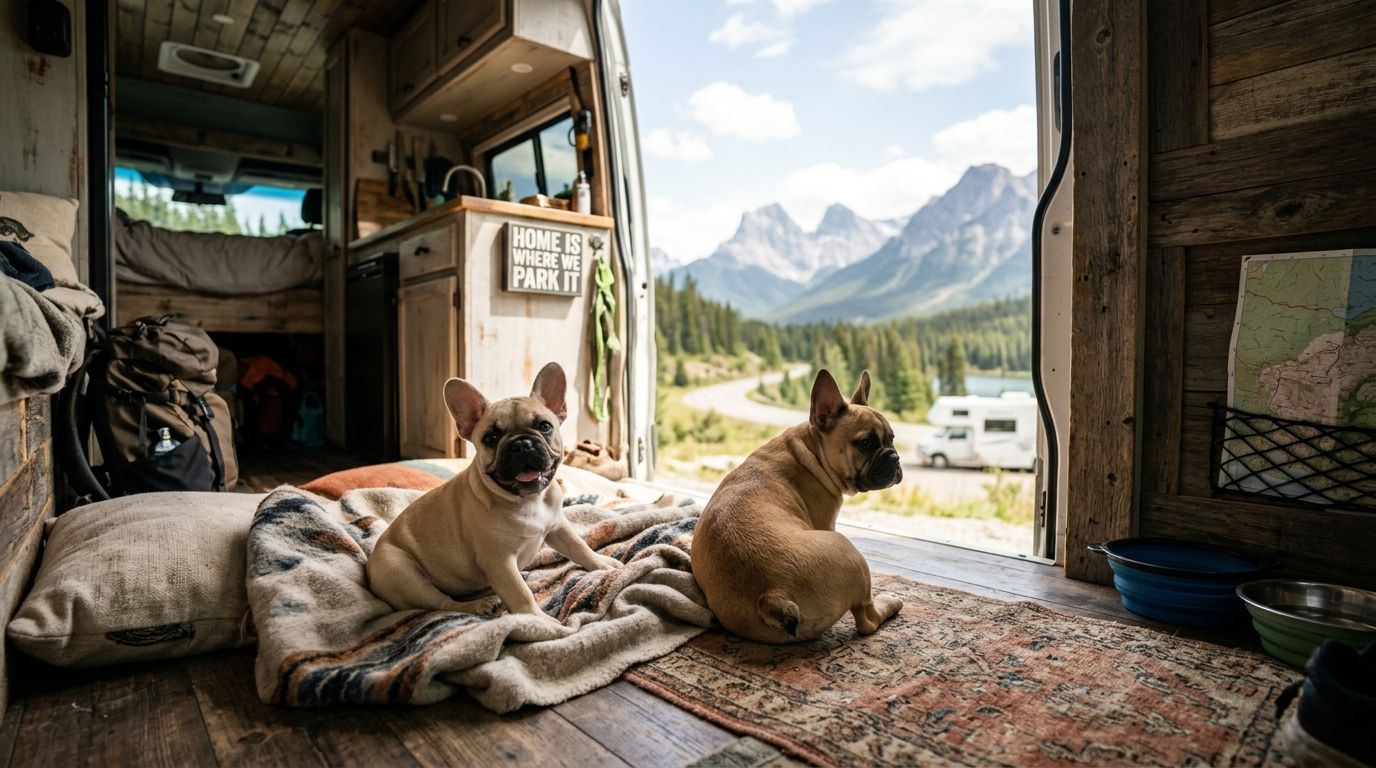
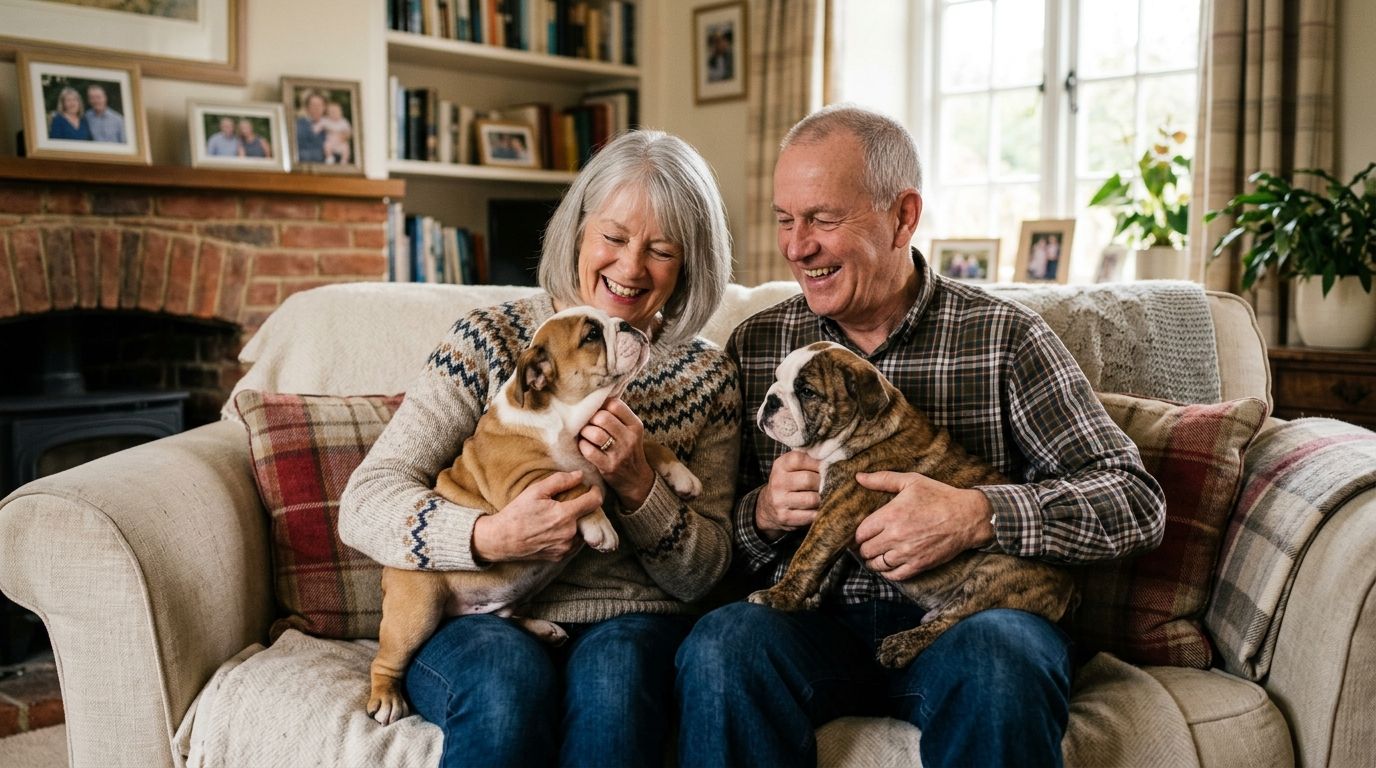
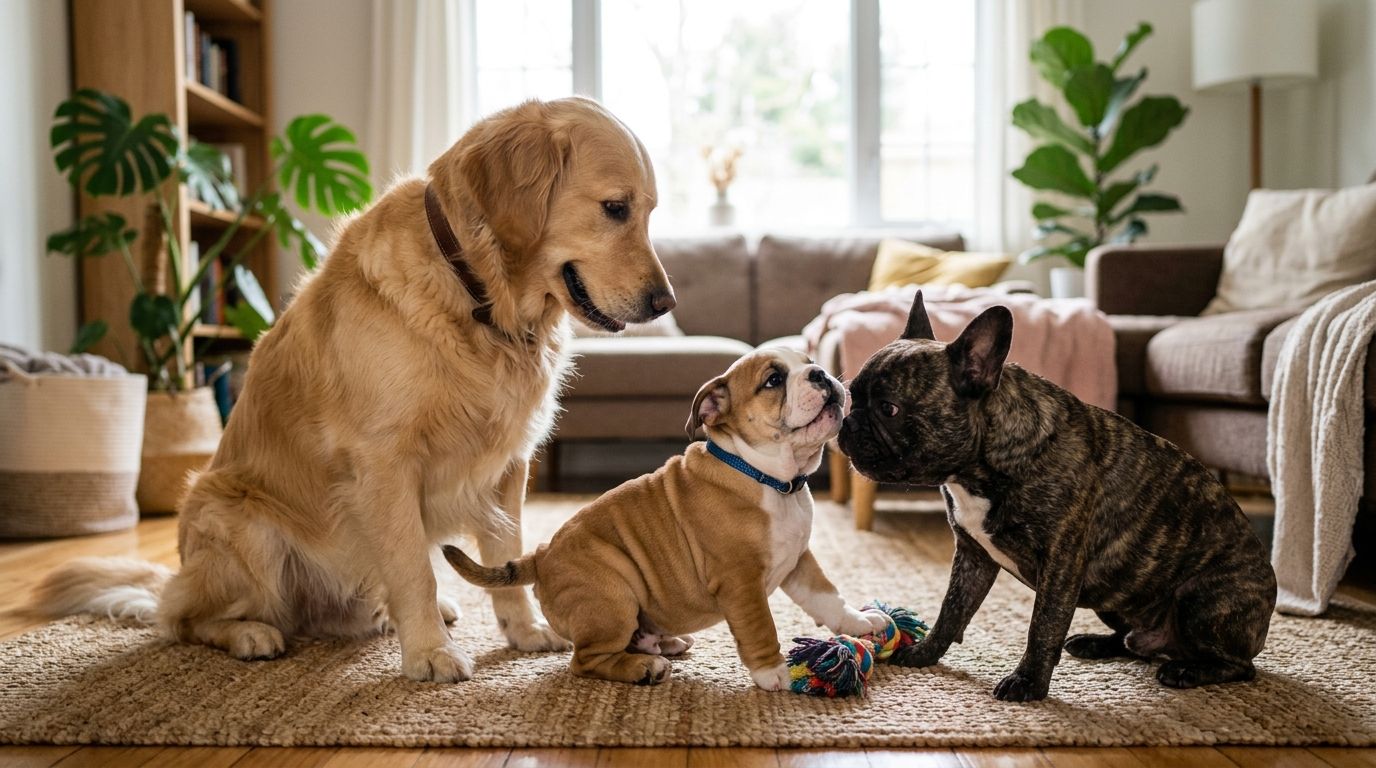
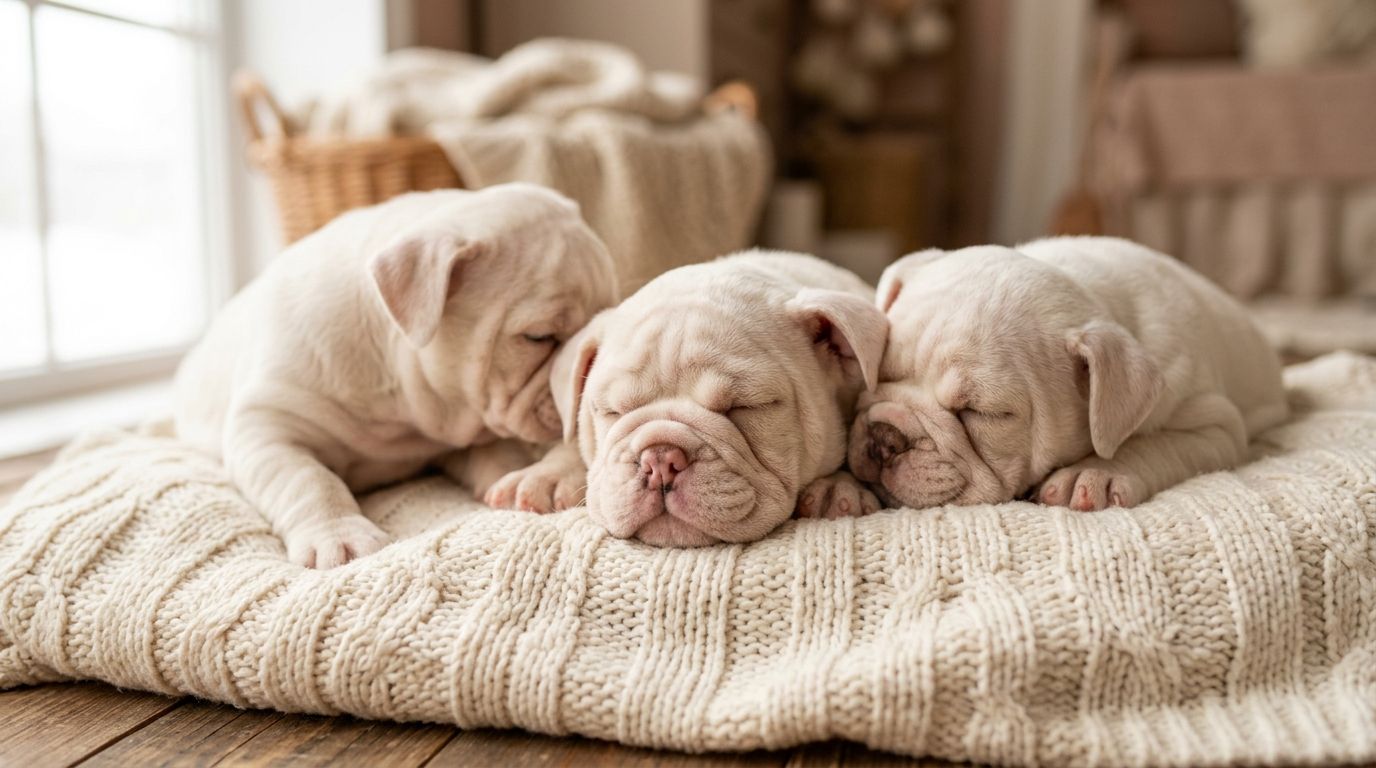
French Bulldog puppies for van life owners are compact, low-shedding companions bred for people who live and travel out of a converted van, truck camper, or small RV full-time. A van-life Frenchie needs to handle tight quarters, temperature swings, and hours of stillness in a moving vehicle better than a Frenchie raised in a five-bedroom house ever will. That means the puppy you pick, and the way you raise it, looks different from a standard suburban placement.
TL;DR
French Bulldog puppies for van life do best when picked young, under 20 lbs at maturity, and trained early to settle in a crate.
Shrinkabulls French Bulldog puppies come from AKC-registered lines, which matters when you’re crossing state lines or borders in 2026.
A Mini French Bulldog fits van storage and bunk space better than a standard-frame Frenchie in a 20-foot rig.
Heat management, not size, is the number one reason van-life bulldog placements fail in the first year.
Budget for vet access on the road before you budget for gear — brachycephalic breeds need specialists, not just any clinic.
Why this matters for van life
A Frenchie's flat face is the whole story here. Short snouts mean less efficient panting, which means a parked van in direct sun in July 2026 can turn dangerous in minutes, not hours. Van lifers who don't plan around that reality are the ones who end up posting panicked questions in Facebook groups at 2 a.m.
Space is the second issue nobody thinks about until move-in day. A standard-build French Bulldog can run 20 to 28 pounds. In a 70-square-foot living box, that's a meaningful amount of dog to step around, especially with a puppy that hasn't learned to settle on command yet.
Verdict: a well-socialized, appropriately-sized French Bulldog puppy is one of the better breed choices for van life in 2026 — but only if you build the routine around heat, restraint, and vet access before you hit the road, not after.
Pick a puppy built for your rig, not the breed standard
Before you fall for the first cute face on Instagram, think about your square footage.
Match puppy size to available space
A Mini French Bulldog is worth a serious look if your rig is under 25 feet or you're running a truck camper. Smaller frame, same personality, less dog to maneuver around a dinette that converts into a bed every night.
Ask the breeder for projected adult weight, not just current puppy weight
Confirm both parents' adult sizes if you're buying at 8-10 weeks
Favor a puppy that's already calm around noise and movement over one that's just the prettiest color
Skip anything advertised as "teacup" without health documentation to back it up
Prioritize even temperament over rare coat color if this is your first Frenchie on the road
Build a crate and restraint setup that survives real driving
A loose puppy in a moving van is a hazard to itself and to you. Crash-rated crates and secured harness systems exist for a reason, and brachycephalic breeds need gear designed around their shorter necks and compressed airways, not repurposed cat carriers.
Choose a crate rated for vehicle use, not just home containment
Anchor the crate to a fixed point, never let it slide on impact
Fit a harness rather than a collar for any restraint that clips to a seatbelt
Practice five-minute "parked and buckled" sessions before your first real drive
Reassess the fit every few weeks during the growth phase
Train calm settle behavior before you leave the driveway
A Frenchie that panics in motion is a Frenchie that overheats faster and stresses harder. Settle training is the single highest-leverage thing you can do before your first long haul.
Start in the driveway with the engine running and the puppy in its crate. Reward stillness, not excitement. Extend the sessions over two to three weeks before your first real trip on the road in 2026.
Practice short, stationary sessions before any real mileage
Reward calm silence, ignore whining
Add engine noise and vibration gradually
Keep first real drives under 30 minutes
Build up to full travel days only after a week of short trips go well
Build a rest-stop and bathroom routine that actually works
Van life means unpredictable stop spacing. A French Bulldog puppy on a house-training schedule needs more consistency than your route usually offers, so you build the consistency yourself.
Stop every 2-3 hours minimum during active house-training months
Keep a designated potty mat or turf patch that travels with you for unfamiliar rest stops
Log stop times for the first month to spot patterns
Carry water and offer it at every stop, not just at meals
Never let a young puppy "hold it" through a long driving stretch just to hit a mileage goal
Manage heat and airflow every single day you're parked
This is the mistake that ends van-life bulldog placements. A Frenchie's compressed airway means it can't cool itself the way a longer-nosed breed can, and a parked vehicle heats up faster than most owners expect.
Never leave a Frenchie puppy alone in a parked vehicle in warm weather, full stop
Run auxiliary fans or a dedicated 12V cooling system when parked
Track ambient temperature inside the van, not just outside air temp
Move driving and outdoor time to early morning or evening in hot climates
Watch for open-mouth breathing that doesn't settle within a few minutes of shade and water
Budget honestly before you hit the road
Rare coat colors and specific bloodlines carry real cost differences, and van lifers on tighter margins need to know that going in rather than getting surprised at reservation time. If you're weighing a merle, blue, or lilac Frenchie against a standard fawn, what rare color puppies really cost breaks down the color-driven price gaps you'll actually run into in 2026.
Factor in mobile vet visits too. Not every roadside clinic is comfortable with brachycephalic anesthesia protocols, and finding one before you need one beats scrambling from a parking lot in a national forest.
Comparison: which Frenchie build fits which rig
Option
Best for
Key limitation
Standard French Bulldog
Larger vans, truck-bed campers, families with more square footage
Higher body mass means more heat retention on hot travel days
Mini French Bulldog
Compact vans under 25 feet, solo or couple travel
Smaller litters mean waitlists run longer than standard puppies
Rare-color Frenchie (blue, lilac, merle)
Owners set on a specific look who've already priced it in
Color rarity adds cost and narrows breeder options
Adult rehome or retired breeding dog
Van lifers who want a calmer temperament from day one
Fewer available, and you skip the puppy-specific bonding window
Buy verdict: a young Mini French Bulldog from an AKC-registered breeder is the strongest fit for most compact van builds in 2026 — go standard-size only if your rig genuinely has the room.
Common mistakes van-life owners make with a French Bulldog puppy
Buying the color before the temperament. A rare-color Frenchie that panics in motion is still a Frenchie that panics in motion — pick calm first.
Skipping the vet-access plan. Brachycephalic breeds need vets comfortable with airway issues; know your nearest option before you're three states from home.
Underestimating heat inside a parked vehicle. This is the single most common and most preventable failure point for traveling bulldog owners.
Treating house-training like it'll sort itself out. Irregular stop schedules make house-training slower, not faster, without a deliberate routine.
Ignoring growth-stage gear changes. A harness that fit at 10 weeks won't fit at 20 weeks — recheck it monthly.
Yes, with planning around heat and space. Their compact size fits small rigs well, but their short airways mean parked-vehicle heat management is non-negotiable in 2026 and every year after.
What size French Bulldog is best for a small van?
A Mini French Bulldog, generally under standard adult weight, fits tighter van layouts better than a full-standard-frame Frenchie. Confirm projected adult size with the breeder before you commit.
Can a French Bulldog puppy handle long drives?
Yes, once it’s been trained to settle in a crate through short, gradually extended sessions. Puppies that skip this training tend to pant and stress through long stretches on the road.
How do you house-train a French Bulldog puppy while traveling?
Stop every 2-3 hours minimum and carry a consistent potty surface, like a turf patch, so the puppy has a familiar cue at unfamiliar rest stops. Consistency of surface matters more than consistency of location.
Is a French Bulldog safe in a hot van?
Not without active cooling. A parked vehicle heats up fast, and a Frenchie’s compressed airway makes it far less able to cool itself than most other breeds, so it should never be left alone in a warm, parked van.
Do rare-color French Bulldogs cost more for van-life buyers?
Yes. Colors like merle, blue, and lilac carry a price premium over standard fawn or brindle, and that gap is worth budgeting for before you reserve a puppy.
What harness works best for a French Bulldog in a moving vehicle?
A harness built for brachycephalic breeds, fitted around the chest rather than the throat, clipped to a seatbelt anchor point. Standard collars aren’t appropriate restraint for vehicle travel.
Should a first-time owner get a French Bulldog for van life?
It’s workable, but first-time owners should budget extra time for settle training and vet-access research before departure, since brachycephalic care has a steeper learning curve than most breeds.
One last thing
A French Bulldog's short snout isn't just a look — it's the reason panting alone can't cool them the way it cools a longer-nosed dog, which is exactly why heat management, not floor space, decides whether a van-life placement works out. Owners who treat cooling as a daily routine instead of an emergency response are the ones still happily on the road with their Frenchie a year later.
English Bulldog puppies for empty-nest couples fill the quiet a departed kid leaves behind with a companion that wants nothing more than to nap next to you and follow you room to room. This breed's low prey drive, short walks, and couch-loving temperament suit a two-person household better than a working dog or a high-drive terrier ever could. Retirees and downsizing parents get a dog that matches their pace instead of demanding a pace they gave up years ago.
TL;DR
English Bulldog puppies for empty nesters fit low-energy, two-person households better than high-drive breeds in 2026.
Shrinkabulls recommends budgeting for lifetime costs, not just the puppy, before reserving a litter.
Brachycephalic health needs (breathing, joints, heat sensitivity) matter more for older owners managing their own routines.
Verify breeder health testing and AKC papers before any deposit changes hands.
Why English Bulldog puppies matter for empty nesters
An empty nest changes what a household needs from a dog. Kids aren't around to burn off a Labrador's energy, and a couple in their late 50s or 60s isn't chasing a puppy across a yard for 90 minutes a day. English Bulldog puppies sleep 12 to 14 hours daily as adults, which lines up with a slower household rhythm far better than a Border Collie or a young retriever would.
The breed's affection also runs one direction: toward the people already in the house. Bulldogs bond tightly with their owners and don't need a pack of other dogs or constant social rotation to stay content, which matters when the household has shrunk from four people to two. That said, the same traits that make Bulldogs easy companions also come with breed-specific health management that an empty-nest household needs to plan for early, not discover later.
Choosing an English Bulldog puppy as an empty nester
Decide if a puppy or an adult dog fits your routine better
A puppy means 12 to 16 weeks of house training, teething, and disrupted sleep before the dog settles into the low-key adult temperament you're picturing.
Puppies need overnight bathroom breaks for the first several weeks
Adult English Bulldogs already show their settled temperament and energy level
A puppy lets you shape socialization and training from day one
An older dog skips the chewing and housebreaking phase entirely
Verdict: if your household values predictability over the puppy stage, an adult or young adult English Bulldog is worth asking about directly.
Match the bulldog's energy and heat tolerance to your daily life
English Bulldogs are a brachycephalic breed, meaning the flattened muzzle limits their ability to cool themselves in heat and restricts how much exertion they can handle safely.
Skip midday walks between May and September in hot climates
Keep exercise to two short walks a day, not one long one
Watch for open-mouth panting that doesn't settle after five minutes of rest
Air-conditioned indoor time matters more than yard access for this breed
Couples relocating to warmer regions in retirement should read through options built for that climate before committing to a puppy.
Budget for the true cost before you fall in love with a face
The purchase price is the smallest number in this equation. Health testing, vaccination series, spay or neuter, pet insurance, and the higher-than-average vet bills tied to brachycephalic care all add up across the dog's life.
Vaccination and deworming schedules run through the first 16 weeks
Skin fold and wrinkle care is a recurring cost, not a one-time purchase
Emergency care for breathing distress or heat stroke isn't optional to plan for
Pet insurance premiums are higher for brachycephalic breeds than for most others
Vet the breeder as carefully as you'd vet a financial advisor
A breeder's health testing panel tells you more about the puppy's future than its color or pedigree chart ever will. Ask for hip, cardiac, and airway screening results on both parents before you ask about anything else.
Request proof of AKC registration on the litter, not just the parents
Ask what health guarantee covers and for how long
Confirm the breeder screens for brachycephalic airway syndrome in the line
Get references from past buyers, not just testimonials on a website
Shrinkabulls walks buyers through exactly what to vet before signing anything, and the process holds regardless of which breeder you choose.
Set up healthcare before the puppy comes home, not after
Brachycephalic breeds need a vet who already understands the anatomy — narrow nostrils, elongated soft palates, and joint sensitivity aren't things every general practice handles well.
Find a vet with documented experience in brachycephalic breeds before day one
Ask if the clinic has anesthesia protocols adjusted for flat-faced dogs
Line up pet insurance before symptoms exist, since preexisting conditions won't be covered later
Schedule the first wellness visit within 72 hours of pickup
Older owners managing their own health appointments often underestimate how many vet visits a bulldog's first year requires — plan the calendar accordingly.
Build a home and routine that suits two people and one dog
Bulldogs don't need acreage. They need cool floors, low furniture they can climb onto without jumping, and a routine that doesn't change every week.
Hard flooring or low-pile rugs beat thick carpet for joint comfort
Ramps help an aging bulldog avoid stairs and furniture jumps
A consistent feeding and walk schedule matters more than variety
Orthopedic bedding reduces pressure on hips and elbows over time
Comparing bulldog options for empty-nest households
Option
Best for
Key limitation
Verdict
Standard English Bulldog puppy
Couples wanting the classic breed temperament
Heat sensitivity and airway management from day one
Buy if you can commit to climate control
XL English Bulldog
Owners wanting more physical presence in the home
Larger frame adds strain on joints over time
Consider if mobility support is part of your plan
Cream English Bulldog
Owners who want a softer, classic coat color
Coat color doesn't change health needs
Buy on temperament fit, not color alone
Champion bloodline English Bulldog
Buyers prioritizing pedigree and conformation history
Fewer available, temperament already set (which can be a plus)
Ask breeders directly if this option exists
Every option on this table still needs the same health-testing scrutiny. Color, size, and bloodline change the look and the price tag — they don't change what a brachycephalic breed needs from its owners.
Reserve a puppy before the litter arrives
Secure your spot on an upcoming English Bulldog litter with a deposit.
Assuming a bulldog is "easy" because it's low-energy. Low exercise needs don't mean low health-management needs — skin folds, breathing, and joints all need active attention.
Skipping pet insurance until symptoms show up. By then the condition is preexisting and coverage won't apply.
Choosing a puppy for color rarity over temperament fit. A blue or lilac coat doesn't change how much exercise or vet care the dog needs.
Underestimating heat risk during travel or errands. A car left running for five minutes in summer heat can be fatal to a brachycephalic dog.
Not planning for later-life mobility costs. Joint supplements, ramps, and orthopedic beds become necessary well before old age in this breed.
FAQ
Are English Bulldog puppies good for empty nesters?
Yes, English Bulldog puppies suit empty-nest households because their low exercise needs and strong one-on-one bonding match a quieter, two-person routine. Their brachycephalic health needs do require active management from day one.
How much exercise does an English Bulldog need per day?
Two short walks a day, roughly 15-20 minutes each, cover most English Bulldogs’ exercise needs. Longer or midday exercise in heat risks overheating due to their limited ability to cool themselves.
Is an English Bulldog or a French Bulldog better for retirees?
Both suit low-energy households, but English Bulldogs run larger and heavier, which can matter for owners managing their own mobility. French Bulldogs are smaller and easier to lift, which some retirees prefer.
What health issues should empty-nest buyers ask breeders about?
Ask for hip, cardiac, and airway health testing on both parents before discussing color or price. Brachycephalic airway syndrome, hip dysplasia, and skin fold infections are the three most common concerns in the breed.
Do English Bulldogs do well in retirement communities or smaller homes?
Yes, their low exercise needs and calm indoor temperament fit smaller homes and retirement communities well. Hard flooring and climate control matter more than square footage for this breed.
How long do English Bulldogs typically stay active companions?
English Bulldogs remain affectionate, low-key companions well into their senior years, though joint and mobility support often becomes necessary earlier than in other breeds. Orthopedic bedding and supplements help manage this over time.
Should empty nesters buy a puppy or an adult English Bulldog?
An adult English Bulldog skips the housebreaking and teething phase and shows its settled temperament immediately, which suits some retirees better. A puppy allows more control over training and socialization from the start.
What should empty nesters budget for beyond the puppy price?
Vaccination series, spay or neuter, pet insurance, wrinkle and skin fold care, and higher-than-average vet visits for brachycephalic issues all add to the lifetime cost. These recurring costs typically exceed the purchase price within the first two years.
One last thing
English Bulldogs sleep the majority of the day as adults, which sounds like a convenience but actually signals something buyers miss: this breed's activity window is narrow, and missing it with too much exertion or too much heat is what causes most emergency vet visits in 2026. Plan the walk schedule around the cool hours, not around your own morning coffee routine, and the rest of bulldog ownership gets a lot easier for a two-person household.
French Bulldog puppies for content creators are dogs chosen and raised for a specific job: looking good on camera, handling a busy filming schedule, and staying healthy enough to be a long-term subject instead of a one-video novelty. This segment needs more than a cute face — it needs a puppy whose color, temperament, and airway health can survive studio lights, travel days, and an audience that notices everything.
TL;DR
French Bulldog puppies for content creators need camera-ready color, verified AKC papers, and a brachycephalic-savvy vet before the first video ships.
Rare colors like platinum and merle photograph distinctly but carry higher scrutiny — buyers should confirm health testing, not just aesthetics.
Shrinkabulls documents registration and pedigree so creators can show provenance on camera without guesswork.
Budget for a French Bulldog puppy’s first year runs well past the purchase price once vet visits and gear are counted.
Puppy scams target visible buyers fastest in 2026 — video-verify any breeder before sending a deposit.
Why French Bulldog puppies matter for content creators
A content creator's dog is a recurring character, not a one-time prop. That changes what matters: a Frenchie with a distinctive coat pattern separates a channel from every other "cute dog" account, but a dog that struggles to breathe under studio heat or during a flight to a brand shoot becomes a liability fast.
Brachycephalic breeds like the French Bulldog already run hotter and breathe harder than long-nosed dogs. Add travel days, ring lights, and fan attention, and the health margin for error shrinks. Creators searching for French Bulldog puppies in 2026 are increasingly filtering by color rarity and temperament stability, not just price — the dog has to perform in front of a camera and hold up afterward.
Pick a color that reads well on camera
Color is the first filter most creators apply, and it should be, because pattern and saturation change how a dog reads on a phone screen versus a DSLR.
Solid rare colors (platinum, isabella) photograph as one clean block of color under ring lights
Merle and pied patterns create visual texture but can wash out under harsh overhead light
Darker coats (chocolate, sable) need more fill light to avoid looking flat on video
Contrast markings around the eyes and muzzle read well in close-up thumbnails
A rare-color pick like a platinum French Bulldog puppy gives a channel a visually distinct dog without relying on double merle genetics, which carries documented health risk and should not be a content strategy.
Confirm the breeder's paperwork before you post a single video
A creator's audience will ask about the dog's papers, health testing, and price in the comments within the first week. Answering with confidence protects the channel's credibility as much as it protects the puppy.
Request AKC registration documents before any deposit changes hands
Ask for a pedigree chart going back at least two generations
Confirm parent health testing results, not just photos of the parents
Video-call the breeder and ask to see the puppy in its actual living environment
Cross-check the breeder's claims against independent reviews, not just their own site
Puppy scams specifically target buyers who are visible online and move fast, because a public buyer is less likely to walk away once they've announced the purchase. Reviewing how to spot puppy scams when buying a bulldog online before you commit is a five-minute read that prevents a very public mistake.
Budget past the purchase price
The purchase price is the smallest number in year one. Vet visits, vaccines, gear built for a brachycephalic frame, and emergency visits for heat stress all add up fast, and a creator posting unboxing content needs the real number, not the marketing number.
Initial vet exam and core vaccine series in the first eight weeks
Cooling gear and travel crates rated for flat-faced breeds
Pet insurance that covers breathing-related procedures, not just accidents
A contingency fund for heat-related emergency visits during outdoor shoots
A French Bulldog puppy's airway does not care about a posting schedule. Structuring shoots around the dog's limits, not the content calendar, is what keeps a channel's star healthy past year one.
Cap outdoor filming to cooler parts of the day, especially above 80°F
Build in recovery breaks between takes — panting that doesn't stop after five minutes is a stop signal
Keep a vet experienced with brachycephalic breeds on speed dial before travel, not after a scare
Avoid stacking multiple shoot locations in one day during the first six months
Train for the camera, not just the house
House training and camera training are different skill sets, and a puppy that's calm on a leash at home can still bolt at a studio light rig on day one.
Desensitize to camera flashes and tripod movement in short five-minute sessions
Reward calm behavior near unfamiliar equipment before expecting full stillness
Practice "stay" cues on a marked spot, the same technique used for on-camera product shots
Introduce crowd noise recordings before any live audience appearance
Comparison table: content-creator dog options
Option
Best for
Key limitation
Rare-color Frenchie (platinum, isabella)
Creators wanting instant visual distinction
Higher scrutiny on health testing and pedigree claims
Standard fawn or cream Frenchie
Creators prioritizing lower health-risk genetics over rarity
Less visually distinct in a crowded niche
Merle-pattern Frenchie
Pattern-focused channels and photo content
Requires extra due diligence on double merle risk
Rehomed adult Frenchie
Creators who can't manage puppy-stage filming demands
Skips the "puppy journey" content arc entirely
For a deeper breakdown of what rare colors actually cost to acquire versus maintain, the independent merle bulldog price guide covers the real numbers behind the color premium.
Common mistakes content creators make
Buying for color before temperament. A striking coat means nothing if the dog panics at a ring light.
Skipping the pedigree check because the deal moves fast. Fast-moving "reserve now" pressure is a scam pattern, not urgency.
Filming outdoor content in peak heat. Brachycephalic dogs overheat faster than any other breed group, and it shows on camera as distress, not cuteness.
Underbudgeting for vet costs. A channel that promises transparency loses trust fast if the "true cost" video ignores the biggest line items.
Treating the puppy stage as content-only. A dog raised purely for footage without downtime develops behavior problems that eventually show up on camera anyway.
Reserve a French Bulldog puppy before birth
Lock in a spot on an upcoming litter with a deposit.
What’s the best French Bulldog color for content creators in 2026?
Solid rare colors like platinum and isabella photograph as clean blocks of color under studio lighting and stand out in thumbnails. Patterned coats like merle or pied add texture but need stronger lighting control to avoid washing out on camera.
Is a French Bulldog puppy better than an English Bulldog for filming content?
French Bulldogs are smaller, more portable for travel-heavy shoots, and generally lower energy for indoor filming setups. English Bulldogs suit creators with a stationary studio and less frequent travel.
How much does it cost to raise a French Bulldog puppy for content in the first year?
Costs beyond the purchase price include vaccines, a brachycephalic-savvy vet exam, cooling gear, and pet insurance covering breathing procedures. Budgeting for these before the first video keeps unboxing content accurate.
Can a French Bulldog puppy handle a heavy filming schedule?
Only with breaks built in around heat and panting recovery time. Stacking multiple shoots in one day, especially outdoors, raises the risk of heat stress in a brachycephalic breed.
How do I know a bulldog breeder isn’t running a scam?
Request AKC registration papers and a two-generation pedigree chart before any deposit, and insist on a live video call showing the puppy in its actual environment. Refusal to do either is the clearest red flag.
Do rare-color French Bulldog puppies have more health risks?
Merle patterning carries documented risk when two merle parents are bred together, producing double merle puppies with higher rates of vision and hearing issues. Reputable breeders test for this before pairing dogs.
What gear does a French Bulldog puppy need for on-location shoots?
Cooling vests, a travel crate sized for a brachycephalic frame, and a portable water setup are the minimum for outdoor filming days in 2026. Skipping cooling gear is the most common oversight creators make.
Should I buy from a breeder with a large social following?
Follower count says nothing about registration, health testing, or pedigree accuracy — verify those independently regardless of how visible the breeder is online. A large following can just as easily amplify a scam.
One last thing
The detail most creators miss isn't the coat color or the follower math — it's that a French Bulldog puppy's airway anatomy is fixed at birth and no amount of training fixes a poor structural pick. Choosing a puppy whose breeder can document normal breathing and clear health testing matters more for a long-running channel than any single rare color ever will. Shrinkabulls documents registration and pedigree on every French Bulldog puppy placed, which gives a content creator something concrete to show an audience instead of just a cute clip.
English Bulldog puppies for multiple dogs means matching a puppy and an introduction plan to a home that already has at least one resident dog, with the goal of a calm household instead of years of resource guarding. A multi-dog match needs different screening than a single-dog home: temperament testing against your existing dog's energy, sequenced introductions, and enough space for a brachycephalic breed to retreat when it's overstimulated.
TL;DR
English Bulldog puppies for multiple dogs need temperament screening against your resident dog before any deposit changes hands.
Shrinkabulls recommends a neutral-ground first meeting and separate food/water stations for at least the first 30 days.
Same-breed litters carry littermate syndrome risk if two puppies from one litter aren’t raised with individual attention.
Hip dysplasia and cherry eye screening matters more in multi-dog homes because two recovering dogs compete for the same space.
Why this matters for multi-dog households
A single English Bulldog is forgiving of a few training gaps. Two dogs sharing a crate room, a food bowl schedule, and a couch is a different math problem entirely.
Resource guarding between bulldogs shows up fast because the breed is food-motivated and short on patience for waiting. The households that succeed treat the first 30 days as a managed rollout, not a reunion. Skip that phase and you're negotiating a truce for the next decade instead of raising two dogs that actually like each other.
2026 litters at Shrinkabulls include English and French Bulldog puppies bred with pedigree and temperament records on both sides, which matters more once a second dog enters the picture — you want data, not guesswork, about what a puppy's parents did around other dogs.
Match temperament before you fall for a face
Pick the puppy for the pack you already have, not the puppy that photographs best.
Ask the breeder how the litter behaves around adult dogs during weaning
Request video of the puppy's parents interacting with other resident dogs
Avoid pairing two dominant-leaning puppies from the same litter
Flag any puppy showing early food-guarding at the bowl
Match energy level, not just color or size
Introduce puppy and resident dog on neutral ground
Don't bring a new bulldog straight into the resident dog's territory on day one.
Meet in a yard or park neither dog claims as home turf
Keep both dogs leashed for the first 10-15 minutes
Watch body language, not just tail wagging — stiff posture means stop and reset
Reward calm proximity with treats for both dogs, not just the newcomer
Repeat the neutral meeting twice before the first home introduction
Two bulldogs sharing one food bowl or one bed is the fastest way to manufacture a guarding problem that didn't need to exist.
Feed in separate rooms or crates for at least the first 60 days
Give each dog its own water bowl, even in the same room
Assign separate sleeping crates before the puppy arrives, not after a fight
Rotate high-value chews one at a time, never loose together
Keep toy baskets duplicated, not shared
If you're still deciding on timing, reserving a puppy with a deposit before birth lets you plan the resource setup weeks in advance instead of scrambling the week the puppy comes home.
Build a supervised routine for the first 30 days
Supervision, not hope, is what prevents the first serious scuffle.
Keep the puppy leashed indoors during the first week around the resident dog
Never leave the two unsupervised until you've seen 10+ calm interactions
Crate the puppy separately overnight for at least two weeks
Log any growling or stiffening so you can spot patterns, not just incidents
Extend supervision if either dog shows guarding at mealtimes
Watch for resource guarding signals early
Small warning signs at week two become real fights by month three if ignored.
Freezing over a toy or bone
Hard stares held longer than a second or two
Lip curling without a sound
Blocking the other dog's path to food or a person
Resource guarding around a specific human, not just objects
Loop in a vet experienced with brachycephalic breeds
A general practice vet isn't always tuned to the airway and joint issues that complicate a two-bulldog household.
Confirm the vet has treated English or French Bulldogs regularly
Ask about anesthesia protocols specific to short-muzzled breeds
Schedule both dogs' checkups close together to track comparative growth
Discuss weight targets for each dog individually, not as a pair
Littermate syndrome risk without separate crate time
Puppy from a different litter, same breeder
Owners wanting a known bloodline with age spacing
Longer wait for the right timing
Adult English Bulldog from a breeder
Households wanting a calmer, already-settled second dog
Fewer adults available at any given time
Puppy of a different breed entirely
Owners avoiding same-breed resource competition
Loses breed-specific socialization matching
Verdict: a puppy from a different litter at the same breeder, spaced by a few months of age, gives you the best balance of known temperament and manageable introduction risk for most multi-dog homes in 2026.
Reserve your second bulldog puppy
Lock in a spot before the litter arrives so you can plan introductions early.
Introducing indoors on day one. Territory triggers guarding behavior that a neutral meeting would have avoided.
Feeding both dogs from the same bowl or same room. This is the single most common cause of the first real fight.
Assuming a puppy will "figure it out" with an older dog. Bulldogs are slow to read social cues and need active coaching, not just proximity.
Skipping individual vet visits. Treating two dogs as one unit hides weight and joint issues specific to each puppy.
Choosing two puppies from the same litter without a separation plan. Littermate syndrome shows up as over-bonding between the pair and under-socialization with humans and other dogs.
FAQ
Are English Bulldog puppies good for multi-dog households?
Yes, English Bulldog puppies work well in multi-dog households when the new puppy is temperament-screened against the resident dog and introductions happen on neutral ground first. Skipping that screening is the main reason multi-dog placements fail.
Should I get two puppies from the same litter?
Getting two puppies from the same litter risks littermate syndrome, where the pair over-bonds with each other and under-socializes with people. A puppy from a different litter, spaced a few months apart, is generally the safer choice.
How long does it take to introduce a bulldog puppy to a resident dog?
Plan on at least 30 days of supervised interaction before leaving two bulldogs unsupervised together. Shorter timelines increase the risk of resource guarding incidents going unnoticed.
Do two English Bulldogs need separate food bowls?
Yes, separate food and water stations for at least the first 60 days prevent the most common trigger for guarding behavior between two bulldogs. Shared bowls are the fastest way to manufacture a conflict.
Is an adult bulldog or a puppy better for a second dog?
An adult English Bulldog is often calmer and easier to integrate for households wanting a settled second dog, but availability is limited compared to puppies. A spaced-out puppy from a known bloodline is the more common route.
What health issues matter more in a two-bulldog household?
Hip dysplasia and cherry eye history matter more when two dogs are recovering or competing for the same space at the same time. Requesting screening results from the breeder before buying reduces this risk.
Can French Bulldogs and English Bulldogs live together?
Yes, French and English Bulldogs generally do well together because their play styles and energy levels are similar. Introduction and resource-station rules still apply regardless of which two bulldog breeds you’re pairing.
How do I know if my resident dog is a good match for a new puppy?
Watch how your resident dog behaves around other adult dogs and puppies during a neutral-ground meeting before committing to a specific litter. A dog that stiffens or fixates during a supervised meeting needs more prep time before any puppy comes home.
One last thing
Most multi-dog bulldog conflicts trace back to the first two weeks, not month six — the households that log every stiff posture and growl in week one catch the pattern before it becomes a habit, and that log is worth more than any training class booked after the fact.
Cream English Bulldog puppies for soft-color fans are bulldogs bred toward the lightest, most muted end of the standard color range—ivory, pale biscuit, soft off-white—for owners who want a gentler look than a classic red or brindle bulldog. Unlike merle, blue, or lilac, cream sits inside the AKC breed standard, so soft-color fans get the aesthetic they want without the dilute-gene debate that follows non-standard colors.
TL;DR
Cream English Bulldog puppies are a standard AKC color, not a dilute variant like blue or lilac.
Pigment on nose and eye rims usually stays black on a true cream, unlike dilute coats.
Verify AKC papers and pedigree before reserving in 2026 — cream is easy to mislabel in bright-light photos.
Budget for the full first-year cost, not just the reservation deposit, before you commit.
Why cream English Bulldog puppies matter for soft-color fans
Soft-color fans aren't chasing the rarest color on the chart. They want a specific, calmer look that photographs well and doesn't clash with a bright brindle pattern. That's a genuinely different buying motivation than someone hunting merle or lilac, and it changes what you check before you reserve.
Because cream is standard-recognized, it doesn't carry the same dilute-gene conversation that surrounds choosing between a merle, lilac, or blue bulldog puppy. That's a real advantage if your priority is a soft coat plus a straightforward pedigree. It also means some sellers label a pale fawn puppy as cream to capture the same buyer interest, so you need to know the difference before a deposit leaves your account.
Confirm the coat is genuinely cream, not faded fawn
A true cream coat holds its tone from puppyhood into adulthood. A pale fawn often darkens or shows more contrast as the coat matures, and that is not the same dog you thought you reserved at 6 weeks.
Ask for photos taken in natural daylight, never studio lighting that washes out color.
Check nose and eye-rim pigment in person or on video, not in edited stills.
Request current photos of both parents, not only the litter.
Ask the breeder directly whether the color is genetically confirmed or a visual call.
Get the color description written into the sales contract.
Verify AKC registration and pedigree before you reserve
Color claims mean nothing without paperwork behind them. Verifying AKC registration papers on the actual puppy — not just the parents — takes less time than most buyers expect and settles most disputes before they start.
Match the litter registration number to the specific puppy you're shown.
Confirm sire and dam are individually registered, not described as AKC bloodline.
Ask how many generations back the pedigree is documented.
Cross-check the registered kennel name against AKC records.
Request the pedigree chart before you pay, not after.
Ask for DNA color genetics testing on the litter
A visually cream coat and a genetically confirmed cream coat aren't always the same puppy. DNA color genetics test kits built for rare-color bulldog breeding give you a lab answer instead of an opinion.
Ask whether both parents have been panel-tested for coat color genes.
Request the lab report itself, not a breeder summary of it.
Confirm which specific genes the panel covered — panels vary by lab.
Ask whether littermates were tested individually or only the parents.
Compare cream littermates side by side
Color is one variable. Structure, breathing, and temperament matter more over a 10-year life, and they don't show up in a color photo.
Watch each puppy at rest — labored breathing is a flag regardless of coat shade.
Ask for weekly weight tracking across the first 8 weeks.
Compare littermates in person or on a live video call, not through curated albums.
Ask which puppy the breeder would keep, and why.
Note which puppies approach you first versus retreat.
Reserve early, but only after the paperwork checks out
Demand for a soft standard color means cream litters move fast, often reserved before the puppies reach 8 weeks. That's exactly why verification comes first. Paying a deposit before confirming color and pedigree is the most common regret buyers describe.
Budget for the full first year, not just the puppy
A cream bulldog costs the same to raise as any other English Bulldog color. Vet visits, food, and brachycephalic-specific care don't discount because the coat is lighter. Soft-color demand can push reservation pricing on well-documented litters the same way rarer dilutes do — the merle bulldog price breakdown is a useful reference even for standard-color buyers, because first-year vet and diet costs track closely across colors.
Plan for the full puppy vaccination series, typically spread across the first 16 weeks.
Include spay or neuter timing in your 2026 budget conversation with your vet.
Account for skin fold care supplies from week one.
Set aside a reserve for brachycephalic-specific vet consults.
Comparison: soft-palette color options for English Bulldogs
Coat option
Best for
Key limitation
Verdict
Cream
Buyers who want a soft, AKC-standard coat with clean pedigree
Easily confused with faded fawn without paperwork
Buy
Light fawn
Buyers who want warmth without high-contrast markings
Shade can shift as the puppy matures
Buy
Cream and white pied
Families who want a lighter face and body pattern together
Lightly pigmented areas need sun awareness
Consider
Blue (dilute)
Collectors chasing a rarer palette near cream
Dilute genetics carry coat and skin discussion in the breed
Hold
Lilac (dilute)
Enthusiasts wanting the palest possible coat
Double-dilute pairings raise added health questions
Hold
Cream wins the practical comparison for soft-color fans in 2026: it delivers the muted look without stepping into dilute-gene territory that blue and lilac buyers have to research much harder.
“If a cream puppy has a pink or liver-toned nose, stop and ask more questions before you send a deposit.”
Common mistakes soft-color fans make
Trusting lighting over paperwork. Bright studio light makes nearly any fawn puppy read as cream. Daylight photos and pedigree records settle it.
Prioritizing color over structure. A beautiful cream coat on a puppy with poor jaw and skull proportions is still a dog facing harder years.
Skipping DNA verification. A breeder's visual color call is not a lab-confirmed genetic result, and only one of those holds up later.
Underestimating first-year costs. Soft-color demand can raise reservation pricing, and ongoing vet and diet costs don't drop because the coat is pale.
Reserving before checking registration. A deposit on an unverified puppy is the fastest route to disappointment at pickup day.
FAQ
What makes a cream English Bulldog different from a fawn one?
Cream is a lighter, more uniform shade that holds its tone into adulthood, while fawn often darkens or shows more contrast as the coat matures. Pedigree records and DNA color panels are the only reliable way to confirm which one you’re looking at.
Is cream a standard AKC color for English Bulldogs?
Yes, cream falls within the AKC-recognized color range for English Bulldogs, unlike merle, blue, or lilac, which are non-standard. That distinction matters if you want a puppy that sits squarely inside breed standard documentation.
Do cream English Bulldog puppies cost more than standard colors?
Demand for soft, lighter coats can push reservation pricing higher on well-documented cream litters in 2026, similar to how rarer colors carry a premium. Ask the breeder for current litter details rather than assuming a fixed markup.
Are cream English Bulldogs prone to more health issues than other colors?
No. Because cream is a standard color rather than a dilute, it doesn’t carry the dilute-gene discussion tied to blue and lilac coats. Standard brachycephalic health considerations still apply to every English Bulldog regardless of coat color.
How do I verify a cream coat isn’t just a faded fawn?
Ask for natural-daylight photos, request the parents’ DNA color panel results, and check nose and eye-rim pigment on a live video call. Lab results and paperwork answer this better than photos ever will.
What should I ask before reserving a cream puppy?
Ask whether the color is genetically confirmed, how many pedigree generations are documented, and what the deposit refund terms are before birth versus after. Get all three answers in writing before any money moves.
Do cream bulldogs need special skin care?
Lightly pigmented dogs can be more sun-sensitive, so shade during outdoor time in 2026 summer months matters. Beyond sun awareness, skin fold care is the same as for any other English Bulldog color.
Is a cream English Bulldog a good choice for a first-time owner?
Yes, coat color has no bearing on temperament or trainability in English Bulldogs. Focus your first-time-owner decision on breeder support, health testing, and structure rather than shade.
One last thing
The detail most soft-color fans miss: a true cream bulldog typically keeps black pigment on the nose and eye rims, because cream is a standard color rather than a dilute. A pink or liver-toned nose on a puppy sold as cream points toward a dilute line, and that's a different purchase with different research attached. Check pigment before color in 2026, and the rest of the decision gets easier.
Pattern collectors chasing panda French Bulldog puppies want a coat that pairs a solid or brindle base with crisp white markings across the muzzle, chest, and paws — a look breeders shorthand as the panda pattern. Unlike pied, which spreads white patches broadly across the body, panda concentrates its white in a tight facial mask, which is exactly why collectors treat it as a separate category worth hunting down.
TL;DR
Panda French Bulldog puppies show white masking on the muzzle, chest, and feet over a solid or brindle base coat.
DNA color-genetics testing is the only way to confirm the pattern is inherited, not coincidental fading.
Panda is not an AKC-recognized standard color, so registration papers won’t list it as a separate category.
Reserve a panda litter before birth if you’re collecting the pattern — Shrinkabulls’ rare-color program runs limited litters per year.
Compare panda against pied, merle, and sable before committing; each pattern carries different health and grooming considerations.
Why panda French Bulldog puppies matter for pattern collectors
Most buyers shopping for a Frenchie want a companion. Pattern collectors want something more specific: a documented, identifiable variation they can point to and say "that's the one." Panda delivers that because the mask is visually distinct from pied French Bulldog puppies, which spread their white in larger, less predictable patches across the trunk and legs.
Because panda isn't an AKC-standard color designation, it doesn't show up as its own registration category — the papers will list the base color (black, brindle, fawn) and the white markings get noted separately if at all. That means pattern collectors have to do more homework than someone buying a standard fawn or brindle puppy. In 2026, that homework starts with genetics, not photos.
Build panda into your collection the right way
Confirm the pattern is real, not a pied overlap or brindle fade
A lot of "panda" listings online are actually wide-blaze pied puppies with lucky white placement. Before you get attached to a litter, check the fundamentals yourself.
Look for white confined tightly to the muzzle, chest, and feet — not spreading across the back or hips like pied.
Ask for photos of both parents; panda typically needs the marking genes present in at least one parent's line.
Confirm there's a solid or brindle base coat underneath the white — panda is a marking pattern, not a base color on its own.
Watch puppies at 6-8 weeks, since some white areas shift slightly as coats mature.
Request DNA color-genetics testing before you commit
Photos lie. Genetics don't. A DNA panel is the fastest way to separate a true panda pattern from a coincidental white blaze.
Ask the breeder for panel results on the puppy, not just the sire and dam.
Compare littermates' panels if you're choosing between siblings — inheritance patterns should track logically.
Save the report; it's the document you'll reference if you ever breed the dog yourself.
Reserve early — panda litters run short
Pattern-specific litters sell out faster than standard color litters because the buyer pool is narrower but more determined. Shrinkabulls runs its panda French Bulldog puppies through the same rare-color program that produces its merle, lilac, and blue litters, and spots fill before whelping.
Get on a breeder's list before the litter is confirmed, not after puppies are born.
Ask what a deposit secures — pick order, specific puppy, or general waitlist position.
Understand you may be committing before you can evaluate individual temperament.
Panda won't appear as its own AKC category, so the paperwork review shifts to pedigree depth and base color accuracy instead.
Confirm the base color listed on the registration matches what you see in person.
Cross-check the sire and dam's registered names against the pedigree chart.
Ask how many generations back the paperwork documents — three generations is standard for most AKC pedigree certificates.
Flag any breeder who can't produce individual AKC papers per puppy, not just a litter registration.
Screen for brachycephalic health risks before pattern shopping
A striking pattern doesn't offset the breathing, skin, and joint issues that come standard with the breed. Health screening matters more than coat markings.
Ask which health testing panels the breeder ran on the parents.
Check the puppy for early signs of skin fold irritation around the new facial markings, since panda's white areas can be more sun-sensitive.
Confirm the litter has been evaluated for hip and joint soundness before you finalize.
Get a written health guarantee and read the terms before signing anything.
Budget for the real cost of a panda Frenchie
Rare patterns carry a premium over standard colors, and panda is no exception given how few litters produce it reliably. Before you fall for a specific puppy, understand where the true cost lands.
Factor in the puppy price plus first-year veterinary costs, since brachycephalic breeds run higher vet bills than average.
Ask about payment plan options if the total cost is a stretch.
Budget separately for pet insurance given the breathing-surgery risk common to French Bulldogs.
Plan grooming and skin care around the white markings
White-masked skin can be more reactive than the surrounding pigmented coat, especially around the muzzle folds.
Clean facial wrinkles daily, paying extra attention to lighter-pigmented skin around the mask.
Watch for redness or irritation in the white-marked areas after sun exposure.
Keep grooming routines consistent — a panda coat doesn't need special products, just more frequent checks.
Ask your vet about sunscreen formulated for dogs if your puppy spends time outdoors regularly.
How panda compares to other collector patterns
Pattern
Best for
Key limitation
Panda
Collectors who want a distinct facial mask
Not AKC-standard; harder to verify without DNA testing
Pied
Collectors who want broader white body patches
White placement varies widely litter to litter
Merle
Collectors chasing mottled coat patterns
Double-merle pairings carry serious health risks
Sable
Collectors who want subtle shading over a solid base
Pattern can be mistaken for standard brindle at a glance
Panda wins for buyers who specifically want the face-mask look and are willing to lean on DNA verification instead of an AKC color category. Skip it if you're not prepared to do the genetic homework — the pattern gets misrepresented online more than almost any other Frenchie variation.
Common mistakes pattern collectors make with panda Frenchies
Trusting photos over paperwork. A well-lit photo can make a wide pied blaze look like panda masking.
Skipping DNA verification because the breeder "seems trustworthy." Trust doesn't replace a lab report.
Ignoring the base coat underneath the white. Panda is a pattern layered on a base color, not a color itself — buyers sometimes confuse the two.
Underestimating skin sensitivity in the white-marked areas. Lighter pigmentation needs more attention, not less.
Reserving a litter without asking what the deposit actually secures. Pick order, specific puppy, and waitlist position are three different things.
Reserve a panda French Bulldog puppy
Get on the list for Shrinkabulls’ rare-color litters before they’re born.
A panda French Bulldog carries a solid or brindle base coat with white markings concentrated on the muzzle, chest, and feet, forming a mask-like pattern. It’s not an AKC-standard color designation, so verification relies on DNA testing rather than registration papers alone.
Is panda pattern rarer than pied in French Bulldogs?
Panda tends to be harder to find than pied because the white has to fall in a specific facial pattern rather than spreading broadly across the body. Litters producing true panda markings in 2026 remain limited compared to standard pied litters.
How do I know if a puppy is really panda and not just pied?
Check whether the white is confined tightly to the muzzle, chest, and paws versus spreading across the back and legs like pied. DNA color-genetics testing is the most reliable way to confirm the pattern beyond visual inspection.
Does panda pattern come with extra health risks?
Panda itself isn’t tied to the serious health risks seen with double-merle pairings, but the lighter-pigmented white areas can be more sun-sensitive. Standard brachycephalic health screening still applies regardless of coat pattern.
Can I register a panda French Bulldog with the AKC?
Yes, but the registration will list the base color, not "panda" as a separate designation, since AKC standards don’t recognize the pattern independently. The pedigree and base color still need to check out on paper.
How much does a panda French Bulldog puppy cost compared to standard colors?
Rare patterns like panda typically carry a premium over standard fawn or brindle pricing due to limited litter availability. Budget for the puppy cost plus first-year veterinary expenses, which run higher for brachycephalic breeds.
Should I reserve a panda puppy before the litter is born?
If you’re set on the panda pattern specifically, yes — pattern-specific litters fill waitlists before whelping more often than standard color litters. Ask exactly what the deposit secures before you commit.
What’s the difference between panda and platinum French Bulldog patterns?
Panda is a white-masking pattern over a solid or brindle base, while platinum refers to a distinct dilute coat color rather than a marking pattern. The two aren’t interchangeable and collectors typically pursue them for different visual goals.
One last thing
The single biggest mistake pattern collectors make in 2026 isn't overpaying — it's skipping the DNA panel because the breeder's photos looked convincing. A panel report costs far less than discovering a puppy's white masking was pied overlap, not panda, after you've already paid a deposit. Ask for the report before the puppy leaves the litter, not after.
Merle pied French Bulldog puppies for pattern lovers stack two rare coat traits into one dog: merle's marbled, mottled base and pied's bold white patches over color. For a buyer chasing pattern above almost everything else, that combination is the rarest visual payoff in the breed right now, and it comes with genetics you need to understand before you fall for a photo.
TL;DR
Merle pied French Bulldog puppies combine merle mottling with pied white patching, making each dog’s pattern genuinely one-of-one.
Never pair two merle carriers — double merle puppies face real vision and hearing defects, not just a color risk.
Ask for a DNA color panel on both parents before you commit to a deposit, not after the puppy is already picked out.
Pied placement varies litter to litter, so photos and video of the actual puppy matter more than the parents’ coats.
Shrinkabulls breeds merle pied pairings around structure and health testing first, pattern second.
Why pattern matters this much to merle pied buyers
Solid-color French Bulldogs are common. Merle pied dogs are not, and that scarcity is exactly why pattern collectors gravitate toward them — no two merle pied puppies lay out their patches and mottling the same way, so the dog you bring home really is unrepeatable.
That rarity cuts both ways, though. Because merle is a dominant gene layered onto a recessive pied pattern, breeding for both traits at once takes deliberate pairing, and it opens the door to shortcuts from breeders chasing a look instead of a healthy litter. Pattern lovers who understand the genetics ask sharper questions and end up with better puppies.
If you're weighing a pied French Bulldog puppies for pattern collectors against a merle pied combination, the difference comes down to how much visual complexity you actually want — pied alone gives you clean patches, merle pied gives you patches plus marbling underneath.
How to shop for merle pied French Bulldog puppies the right way
Verify the genetics before you fall for the coat
A merle pied puppy's pattern is a genetic outcome, not a stylistic choice a breeder makes at will. You want proof of what's actually being paired, not just a description.
Ask for a DNA color panel showing both the merle locus and the pied (S locus) results on sire and dam
Confirm neither parent is a hidden or "cryptic" merle carrier with minimal visible patches
Request the panel from a named lab, not a verbal assurance
Cross-check the panel results against the puppy's own coat once photos are available
Ask about the double merle risk directly
This is the single most important question a pattern lover can ask, and it's non-negotiable. Merle-to-merle breeding produces double merle puppies at a predictable rate on a standard genetics cross, and those puppies commonly carry vision and hearing defects tied directly to the double copy of the gene.
Ask flat out: "Is either parent merle, and if so, is the other parent merle-free?"
Walk away from any breeder pairing merle to merle, no matter how the coat photos look
Read up on the topic through a dedicated double merle health risks resource before you sign anything
Ask whether the breeding program has ever produced a double merle litter, and how it was disclosed
Check the breeder's pattern combinations across multiple litters
A breeder who's actually planned for merle pied outcomes over several litters will have a track record you can look at, not just one lucky puppy.
Ask to see photos of past litters with the merle pied combination, not just the current one
Look for consistency in structure and bite across those litters, not just varied coats
Ask how many generations the color line has been tracked
Compare pied placement and merle mottling in photos and video
Because pied patches move around on every puppy, no two littermates look identical even from the same merle pied pairing.
Request video, not just still photos, since coat pattern reads differently in motion and light
Ask for close-up shots of the eyes — merle can carry blue or partial-blue eye color, which some buyers want and others don't
Get updated photos at 6-8 weeks since merle pigment can shift slightly as puppies mature
Ask whether the ears and nose leather show merle mottling too, since some buyers care about full-body pattern consistency
Vet the health testing tied to the coat genes
Color genetics testing and general health testing are two different things, and pattern lovers sometimes only ask about one.
Confirm hip and patella screening exists independent of the color panel
Ask about BOAS (breathing) screening given the breed's brachycephalic structure
Request documentation of eye exams, since merle carriers warrant extra scrutiny here
Ask whether skin fold and ear canal checks were part of the puppy's wellness exam
Confirm registration and color documentation
Merle and pied are recognized color/pattern descriptions, but registration paperwork should match what the DNA panel says.
Cross-check the AKC paperwork's stated color against the DNA test results
Ask for a copy of the pedigree showing color genetics across at least two generations
Confirm the litter registration number matches the specific puppy you're reserving
Budget honestly for a rare pattern combination
Merle pied puppies sit at the rarer end of the color spectrum, and rarity in this breed tracks directly with demand. Before you commit, look at what rare-color pricing actually reflects industry-wide by reading what rare color puppies really cost, so you're evaluating any quote against a real baseline instead of a guess.
“If a breeder is pairing merle to merle to chase a rarer pattern, that’s a double merle litter waiting to happen — not a deal worth taking.”
Comparing coat options for pattern-focused buyers
Coat option
Best for
Key limitation
Merle pied
Buyers who want maximum pattern complexity and a truly one-off coat
Requires strict merle-safe pairing; pattern placement is unpredictable litter to litter
Solid merle
Buyers who want marbling without white patching
Same double merle pairing risk applies; less visual variation than merle pied
Solid pied
Buyers who want clean white-and-color patches without merle genetics
Lower genetic complexity means less pattern rarity than merle pied
Standard fawn or brindle
First-time owners who want a predictable, well-documented coat
No pattern novelty for buyers specifically chasing rarity
Merle pied is the right call for a buyer who wants maximum pattern rarity and is willing to vet genetics carefully. It's the wrong call for anyone unwilling to ask hard questions about parent pairings first.
Common mistakes pattern lovers make
Chasing pattern over structure. A dramatic coat on a puppy with poor hip or bite conformation is still a puppy with poor hips or bite.
Skipping the double merle math. Some buyers get so focused on pattern they forget to ask whether both parents carry merle at all.
Trusting coat photos over DNA panels. A cryptic merle parent can look nearly solid-colored and still pass on the gene.
Assuming merle pied puppies are interchangeable with solid pied. The genetics, health considerations, and pattern variability are meaningfully different.
Not asking for updated photos closer to pickup. Merle mottling and pied placement can shift as a puppy matures past 6 weeks.
Reserve your merle pied puppy early
Rare color litters fill fast — see how the deposit process works before you commit.
What makes a French Bulldog merle pied instead of just merle or just pied?
A merle pied French Bulldog carries both the merle gene, which creates marbled mottling, and the pied pattern, which adds white patches over color. The combination produces a coat where mottled color and white patching appear together, and the exact layout varies puppy to puppy.
Is a merle pied French Bulldog puppy healthy?
A merle pied puppy from a single-merle-parent pairing carries no more health risk from the color itself than any other French Bulldog. The risk only appears when both parents carry merle, producing double merle puppies with documented vision and hearing concerns.
How can I tell if a breeder is pairing two merle dogs?
Ask directly whether both the sire and dam carry the merle gene, and request DNA color panel results for each. A responsible breeder will have this documentation ready before you ask.
Does pied placement stay the same as a puppy grows?
Pied patch boundaries are largely set at birth, but merle mottling and pigment can shift subtly through 6 to 8 weeks. Ask for updated photos close to pickup rather than relying only on early puppy pictures.
Are merle pied French Bulldogs rarer than solid merle or solid pied?
Yes, because the puppy needs to inherit both the merle gene and the pied pattern simultaneously, which narrows the pool of qualifying litters. That combined rarity is why demand for merle pied puppies tends to run higher than for either trait alone.
What’s the difference between merle pied and platinum or lilac patterns?
Merle pied describes a pattern (mottling plus white patching), while platinum and lilac describe base coat color genetics. A puppy can theoretically show merle pied patterning on top of different base colors, so the two classifications aren’t mutually exclusive.
Can eye color differ in merle pied French Bulldog puppies?
Merle genetics frequently produce blue or partial-blue eyes, which can appear in merle pied puppies as well. Not every merle pied puppy will have blue eyes, so ask for close-up eye photos if that detail matters to you.
What should I ask a breeder before reserving a merle pied puppy?
Ask for DNA color panel results on both parents, confirm neither is a hidden merle carrier, and request health testing documentation separate from the color panel. A breeder unwilling to provide any of these should be a hard pass.
One last thing
Here's the detail most buyers never hear until it's too late: a merle parent doesn't always look merle. "Cryptic" or "phantom" merle dogs can carry the gene while showing barely any visible mottling, which means two apparently normal-coated parents can still produce a litter of double merle puppies if both happen to be hidden carriers. The only way to rule this out is a DNA color panel on both parents, every single time — not a visual check, not a breeder's word, the actual test result. In 2026, that panel is a standard, accessible tool, and any breeding program working with merle pied French Bulldog puppies should be running it as a matter of course.
Fawn French Bulldog puppies carry the classic solid tan-to-red coat that's been a standard, AKC-recognized color since the breed was first registered, and that makes them the pick for buyers who want a timeless look instead of a rare-color price tag. Classic color lovers care less about how unusual a coat is and more about correct pigment, sound structure, and a breeder who can prove the color isn't hiding a health-linked dilute gene.
TL;DR
Fawn French Bulldog puppies carry a standard AKC coat color, not a dilute gene like merle or blue.
Shrinkabulls breeds fawn Frenchies alongside rare colors in 2026 — ask for pedigree proof before you reserve.
Fawn costs less than merle or lilac litters simply because it isn’t diluted or rare.
A reputable breeder health-tests hips, patellas, and airways the same way regardless of coat color.
The AKC breed standard formally recognizes fawn; it does not recognize merle in French Bulldogs.
Why fawn matters for classic color lovers
Buyers searching for fawn French Bulldog puppies usually aren't chasing Instagram novelty — they want the coat their grandparents' Frenchie had, the color that shows up in AKC conformation rings, and a puppy whose genetics haven't been stacked for rarity at the expense of structure. That's a smart instinct. Dilute colors like blue, lilac, and merle carry documented skin and coat issues tied to the dilution gene itself, while fawn is a naturally occurring, non-dilute pigment pattern.
At Shrinkabulls that distinction matters because the same breeding program produces both classic fawn litters and rare-color litters like merle and lilac. A classic color lover buying fawn should still expect full AKC paperwork, full health testing, and full transparency about the sire and dam's coloring — the puppy is just built differently on the color-genetics side, not on the care side. Fawn is the color the breed standard was written around; that's the whole appeal.
How to buy a fawn French Bulldog puppy the right way
Confirm it's true fawn, not a diluted look-alike
Fawn can range from pale cream-fawn to deep red-fawn, and some dilute colors get marketed loosely as "fawn" when they're closer to lilac-fawn or blue-fawn carriers. Ask directly.
Request the puppy's coat color as written on the AKC registration application, not just a marketing name
Ask whether either parent carries the dilute (d) gene, even if neither parent shows a diluted coat
Look at nose and paw pad pigment — true fawn Frenchies keep black pigment, dilutes trend toward blue-gray or liver
Get photos of both parents in daylight, not filtered breeder marketing shots
Check the pedigree for AKC-recognized coloring
A classic color buyer's biggest protection is the paperwork trail, not the photo.
Pull the AKC pedigree chart and confirm generations of documented, non-dilute coloring — the guide on reading a bulldog puppy's pedigree chart walks through what each line means
Confirm the litter registration number matches the individual puppy's application
Ask if any ancestors within three generations carry merle, blue, or lilac genetics
Verify the breeder will hand over papers at pickup, not "after final payment clears" with no documentation in between
Compare fawn against the rare-color litters in the same program
Most breeders who offer rare colors also breed classic fawn, cream, and brindle in the same kennel. Comparing them side by side clarifies what you're actually paying for.
Ask to see fawn, merle, and lilac puppies from the same or similar litters to compare structure, not just color
Confirm fawn litters get the identical vet-check and deworming schedule as rare-color litters
Ask why fawn is priced differently than dilute colors — rarity, not health superiority, drives that gap
Vet the breeder's health testing panel
Color has nothing to do with hip, patella, or airway soundness. A fawn puppy from an untested program carries the same brachycephalic risks as any other Frenchie.
Set your home's temperature control — Frenchies of every color struggle with heat
Fawn vs. the rest of the color lineup
Color option
Best for
Key limitation
Fawn
Buyers who want the AKC-standard classic look and the most conformation-ring history
Least "exclusive" option — no rarity premium if resale or novelty matters to you
Cream / Pied
Buyers who want a lighter classic variation still within AKC standard colors
Pied patterning varies litter to litter, harder to predict exact markings
Merle
Collectors specifically drawn to the mottled coat pattern
Not AKC-recognized; carries documented eye and hearing risks tied to the merle gene
Lilac / Blue
Buyers prioritizing rare-color novelty over standard recognition
Dilute gene linked to color dilution alopecia and skin sensitivity in some lines
Verdict: fawn French Bulldog puppies are the right call for buyers who want AKC-standard coloring, lower cost than dilute rarities, and a coat pattern with the deepest health track record — pick fawn if novelty isn't the priority.
Reserve your fawn puppy today
Lock in a spot on an upcoming fawn litter with a deposit.
Assuming fawn means "plain" and skipping health testing entirely. Coat color has zero bearing on hip, patella, or airway soundness — every color needs the same scrutiny.
Confusing fawn with cream or light dilute shades. These look similar in photos but differ genetically; ask for the AKC color designation, not a marketing label.
Assuming a lower price means a lesser puppy. Fawn costs less than merle or lilac because it's common and non-dilute, not because the breeding program cut corners.
Not checking for hidden dilute carriers in the pedigree. A fawn puppy can still carry a recessive dilute gene that shows up in future litters if you plan to breed.
Skipping the deposit paperwork because "fawn is easy to find." Popular, well-bred fawn litters from proven programs still fill up in 2026 the same as rare-color litters.
FAQ
What is the difference between fawn and cream French Bulldog puppies?
Fawn is a solid tan-to-red base coat, while cream is a much lighter, near-white dilution of that same base. Both fall within AKC-recognized standard colors, unlike merle or lilac.
Are fawn French Bulldogs healthier than merle or lilac Frenchies?
Fawn carries no dilute gene, so it avoids the skin sensitivity and coat thinning documented in dilute colors like blue and lilac. Brachycephalic risks like airway issues still apply to every color, including fawn.
Is fawn a rare French Bulldog color?
No. Fawn is one of the most common and long-standing AKC-recognized colors in the breed, which is why it typically costs less than merle, lilac, or blue litters.
Can two fawn French Bulldogs produce a merle puppy?
Not unless one parent carries a hidden merle gene, which reputable breeders test for and disclose. A pedigree check before buying confirms whether that risk exists in a given litter.
How much does a fawn French Bulldog puppy typically cost compared to a merle one?
Fawn litters generally cost less than merle, lilac, or blue litters because fawn is a standard, non-dilute, widely available color rather than a rare one. Exact pricing varies by breeder and should be confirmed directly.
Does the AKC recognize fawn French Bulldogs?
Yes, fawn is one of the AKC’s officially recognized French Bulldog colors. Merle is not currently recognized by the AKC breed standard.
What should I ask a breeder before buying a fawn French Bulldog puppy?
Ask for AKC pedigree documentation, parent health testing results, and confirmation that the fawn coloring is a true non-dilute pattern rather than a diluted look-alike. A list of specific breeder questions helps structure that conversation.
Do fawn French Bulldog puppies shed more than other colors?
Coat color doesn’t affect shedding volume in French Bulldogs; shedding is tied to coat type and season, not pigment. Fawn, brindle, and pied Frenchies shed at similar rates.
One last thing
Here's the detail most buyers miss in 2026: fawn isn't just common, it's the color the French Bulldog breed standard was effectively written around, while merle has never been AKC-recognized at all. If AKC-standard conformation and a documented health track record matter more to you than color rarity, fawn is the color that checks every box without the dilute-gene tradeoffs.
Blue fawn French Bulldog puppies carry a diluted fawn coat softened by the blue gene, producing a smoky, grayish-tan color that stands apart from standard fawn, brindle, or pied Frenchies. Rare-color collectors chase this shade specifically because it sits at the intersection of two recessive traits, making it one of the harder combinations to produce reliably in a breeding program.
Verdict: blue fawn French Bulldog puppies are best for buyers who already understand dilute-color genetics and want a documented, DNA-tested coat — not first-time owners shopping on looks alone. Shrinkabulls works with rare-color bloodlines including blue, lilac, merle, and isabella, and the same due-diligence steps below apply whether you're comparing a merle, lilac, or blue bulldog puppy or narrowing in on blue fawn specifically.
TL;DR
Blue fawn French Bulldog puppies combine the fawn base coat with the blue dilution gene, producing a smoky tan-gray shade.
DNA color panel testing before purchase is the only reliable way to confirm the blue dilution and rule out double-dilute risk.
Rare-color puppies in 2026 command higher demand than standard colors, so reservation timing and deposit terms move fast.
Compare blue fawn against lilac, isabella, and merle before deciding — coat rarity and health testing needs differ across each.
Why blue fawn matters for rare-color fans
Color collectors buying in 2026 aren't shopping the way a first-time pet owner shops. This segment already knows the difference between a true blue dilution and a washed-out fawn that photographs light under certain lighting, and they're willing to wait for a litter that matches a specific bloodline rather than take the first available puppy.
That patience matters because dilute colors — blue, lilac, isabella — carry documented skin and coat sensitivities tied to the dilution gene itself, on top of the standard brachycephalic concerns every French Bulldog owner manages. A rare-color fan isn't just buying a color; they're buying into a health-testing conversation the average buyer skips.
Confirm the coat and the genetics
Understand what makes a coat "blue fawn"
Blue fawn isn't a marketing label — it's a specific genetic combination. Before you commit to a puppy, get clear on what you're actually looking at.
Fawn is the base coat color, ranging from pale cream to deep red-fawn.
The blue dilution gene (d/d) mutes black pigment to a steel-gray, which is what turns a standard fawn into blue fawn.
True blue fawn puppies often show a blue-gray nose and paw pads rather than black.
Coat shade can shift somewhat as the puppy matures past 12-16 weeks, so early photos aren't final proof.
Littermates from the same parents can vary in shade depending on which fawn genes each puppy inherited.
Request DNA color panel results before you pay a deposit
Visual identification gets you partway there, but genetics settle the question. This is where a reputable breeder should already have paperwork ready, not a promise to test "later."
Ask for a DNA color panel report, not just a verbal confirmation of coat color.
Confirm the report identifies both the dilution locus and the fawn/brindle locus.
Cross-check the puppy's registered parents against the same panel if it's available.
Walk away from any seller who calls a puppy "blue fawn" with zero documentation.
Compare blue fawn against other rare colors
Most rare-color buyers don't lock in on blue fawn immediately — they arrive there after weighing it against lilac, isabella, platinum, and merle. Knowing the trade-offs before you fall for a photo saves a lot of back-and-forth with a breeder.
Lilac carries two dilution genes (blue + chocolate) and tends to run lighter and pinker than blue fawn.
Isabella is a separate combination again, often confused with lilac by buyers new to the color spectrum.
Merle brings a patterned coat and a documented set of eye and hearing risks tied to the merle gene itself.
Platinum and sable sit closer to standard coloring with subtler rarity markers.
Blue fawn tends to be more coat-stable across a dog's lifetime than merle, which can shift pattern slightly with age.
Vet the breeder's health testing and pedigree
A color-first buyer who skips health vetting is the buyer who ends up with a costly vet bill in year one. Rare-color breeding programs, in particular, warrant a closer look because chasing a specific dilution can tempt some breeders to cut corners on the rest of the pedigree.
Request the pedigree chart going back at least three generations.
Confirm neither parent is a double-dilute pairing, which compounds coat and skin sensitivity risk.
Ask directly how many litters that breeder has produced with this specific color combination.
Get everything about health guarantees in writing before a deposit changes hands.
Budget for the real cost of a rare-color puppy
Rare colors carry a premium over standard fawn or brindle, and the premium reflects the genetic testing, longer wait times, and smaller litter counts that come with breeding for a specific dilution. Skip the sticker shock by pricing this out before you fall in love with a specific litter.
Factor in the puppy's price, first-year vet costs, and any flight-nanny delivery fees separately.
Ask whether the quoted price includes AKC registration paperwork or if that's billed separately.
Budget for skin-fold and coat care products up front — dilute coats often need gentler grooming routines.
Set aside a contingency for veterinary follow-up in the first 90 days, standard practice for any brachycephalic puppy.
Plan the reservation timeline
Blue fawn litters don't sit on a waitlist for long once word gets out. A rare-color fan who waits to reserve until after a litter is born often misses it entirely.
Ask the breeder how deposits are structured before a litter is even whelped.
Confirm what happens to your deposit if no puppy in the litter matches your target coat.
Get a written timeline for photo updates, pick order, and pickup or delivery date.
Ask whether flight-nanny delivery is available if you're not local to the breeder.
Reserve your spot on a rare-color litter
Deposits secure pick order before a litter is even born.
Enthusiasts chasing a distinct pale coat separate from lilac
Frequently mislabeled by less experienced sellers
Merle
Pattern collectors who want visible marbling
Carries documented eye and hearing risk in double-merle pairings
Standard fawn/brindle
First-time owners who want the least genetic complexity
Lower rarity premium, less coat variation
Common mistakes rare-color fans make
Trusting a photo over a DNA report. Lighting, age, and camera settings all shift how a coat photographs — a genetic panel is the only real confirmation.
Skipping the pedigree check because the color is right. A stunning blue fawn coat on a poorly health-tested pedigree is still a poorly health-tested pedigree.
Paying a deposit before confirming pick order in writing. Verbal promises about "first pick of the blue fawns" don't hold up if the litter doesn't produce one.
Underestimating the cost of coat and skin care. Dilute coats often need gentler shampoo and more frequent skin-fold checks than standard-colored littermates.
Ignoring the breeder's litter history with this specific color. A breeder producing their first blue fawn litter is a different risk profile than one with a multi-generation program behind it.
FAQ
What makes a French Bulldog puppy "blue fawn" instead of just fawn?
Blue fawn puppies carry the standard fawn base coat plus the blue dilution gene, which mutes black pigment into a steel-gray tone visible in the nose, pads, and coat shading. A DNA color panel is the only way to confirm both genes are present.
Is blue fawn rarer than lilac or isabella?
Blue fawn, lilac, and isabella are all considered rare colors, but each results from a different genetic combination. Lilac and isabella involve two dilution genes stacking together, while blue fawn pairs the blue dilution with a fawn base, making direct rarity comparisons breeder- and litter-dependent.
Do blue fawn French Bulldogs have more health issues than standard colors?
Dilute-colored coats, including blue and blue fawn, are associated with a higher rate of skin sensitivity tied to the dilution gene itself, on top of standard brachycephalic concerns. Health testing on both parents matters more with any dilute pairing.
How do I confirm a puppy is genuinely blue fawn before paying a deposit?
Request a DNA color panel report from the breeder that identifies both the dilution and fawn loci, and cross-check it against the registered parents. Visual photos alone are not reliable confirmation, especially before 12-16 weeks of age.
What’s the difference between blue fawn and platinum French Bulldogs?
Platinum is a separate, lighter coat pattern that isn’t built on the same blue dilution combination as blue fawn. The two are often confused by buyers new to rare-color terminology, which is another reason a DNA report matters.
Should I reserve a blue fawn puppy before the litter is born?
Rare-color litters, including blue fawn, typically fill reservation slots quickly once a breeder announces an expected litter in 2026. A deposit with clear written terms on pick order protects your spot if the litter produces the color you want.
Are blue fawn French Bulldog puppies AKC registrable?
Yes, blue fawn is registrable with the AKC as a color variation of the French Bulldog breed, though it falls outside the standard show-ring color preferences. Always verify the registration paperwork matches the puppy before finalizing a purchase.
One last thing
The detail most rare-color buyers overlook in 2026 isn't the coat at all — it's the nose and pad pigment. A genuine blue fawn puppy should show blue-gray pigment on the nose leather and paw pads, not black, and that pigment is visible well before the coat itself fully settles, making it one of the fastest visual checks you can run alongside the DNA panel.
Rare bulldog colors only mean something if the genetics behind them are confirmed on paper, not guessed at by eye. Best overall: UC Davis Veterinary Genetics Laboratory (VGL) for locus-specific merle, dilute, and brown testing. Best for bundled color and health panels: Animal Genetics Inc, which packages bulldog-specific color genes with known breed health markers in one swab. Best for first-time owners wanting quick answers: Embark Veterinary, an app-based kit that explains results in plain language instead of genotype code.
TL;DR
UC Davis VGL wins for definitive merle (M locus) and dilute (D locus) confirmation in a bulldog dna color genetics testing kit.
Animal Genetics Inc bundles color panels with bulldog health markers like DM and HUU in one submission.
Embark Veterinary is the easiest swab-and-app option for owners who don’t need registry-grade documentation.
HealthGene and DDC Veterinary add parentage verification, which matters for stud contracts and litter records in 2026.
A general breed-ID kit is not the same product as a locus-specific color test — breeders need the second one.
Why this matters
A bulldog dna color genetics testing kit isn't a novelty purchase for a breeding program — it's the paperwork that separates a documented lilac, blue, or merle puppy from an owner's best guess. Merle is caused by a dominant insertion at the M locus, and breeding two merle carriers together risks double merle litters with hearing and vision defects. Blue comes from two copies of the dilute gene at the D locus (dd); one copy (Dd) produces a normal-pigmented carrier that looks nothing like blue but still passes the gene forward.
Buyers are already asking harder questions before they pay a deposit, and how to choose between a merle, lilac, or blue bulldog puppy increasingly comes down to whether the breeder can produce a lab report, not just a photo. Shrinkabulls treats a documented panel the same way it treats AKC paperwork — as proof, not marketing.
What makes the best bulldog DNA color genetics testing kit
Locus-specific accuracy — tests the actual gene (M for merle, D for dilute, B for brown/chocolate) instead of predicting color from breed averages
Registry and contract acceptance — results formatted in a way stud contracts and buyers can verify
Parentage/DNA profiling option — required documentation for stud service and litter registration
Bulldog-specific panel coverage — English and French Bulldog color genes bundled with known breed health markers
Sample logistics — swab collection and shipping timelines that don't stall a breeding decision
Clear reporting — genotype notation plus a plain-language explanation a new owner can actually use
Bulldog DNA color genetics test kits at a glance
Kit
Best For
Standout Feature
Key Limitation
UC Davis VGL
Definitive single-locus color confirmation
Locus-specific ordering (M, D, B, E, K, A) with genotype notation
No app-style report; you need to know which locus to order
Animal Genetics Inc
Bundled color + health panels for bulldogs
Bulldog-specific panels pairing dilute, brown, and merle with DM/HUU screening
Panel contents shift year to year — confirm the gene list before ordering
Embark Veterinary
First-time owners wanting quick answers
App-based report with plain-language trait explanations
Color panel less granular than a dedicated locus test
HealthGene
Pedigree and registry documentation
Parentage verification bundled with color testing in one submission
Cross-border shipping adds lead time for US-based breeders
DDC Veterinary (Neogen)
Stud service parentage verification
AKC DNA Certification-compatible parentage profile plus color add-on
Color panel is an add-on, not the core product
1. UC Davis VGL: best bulldog dna color genetics testing kit for definitive locus confirmation
The Veterinary Genetics Laboratory at UC Davis runs individual, gene-specific tests rather than a bundled color-prediction report. A breeder orders exactly the locus in question — M for merle, D for dilute, B for brown — and gets back a genotype (Mm, dd, Bb) instead of a marketing label.
UC Davis VGL pros:
Locus-specific ordering means you pay for the exact question you're answering
Used as a reference lab by breed clubs and academic researchers
Genotype notation is unambiguous, with no room for a vague "likely blue" result
UC Davis VGL cons:
No consumer app or plain-language summary
Ordering requires knowing which locus applies to your breeding question
Turnaround runs on lab schedule, not same-day
Best for: breeders who need one specific answer (is this dog Mm or MM?) confirmed at the source. Verdict: Buy.
2. Animal Genetics Inc: best for bundled color and health panels
Animal Genetics Inc sells bulldog-specific panels that combine coat color genes — dilute, brown, merle — with breed health markers like degenerative myelopathy (DM) and hyperuricosuria (HUU) in a single swab submission.
Animal Genetics Inc pros:
One kit covers color and known bulldog health risks together
Panels are built specifically for French and English Bulldogs, not generic breed averages
Written interpretation accompanies the raw genotype
Animal Genetics Inc cons:
Panel composition changes over time, so confirm the current gene list before submitting a sample
Bundled panels cost more than ordering a single locus test alone
Best for: breeding programs that want color confirmation and health screening in the same submission. Verdict: Buy.
3. Embark Veterinary: best for first-time owners wanting quick answers
Embark is the cheek-swab kit most pet owners already recognize, built around a phone app that reports breed mix, some coat traits, and health markers in plain English rather than genotype code.
Embark pros:
Simplest swab collection process for someone who has never run a genetic test before
App-based report translates results into language a non-breeder understands
Covers a broad health panel beyond just coat color
Embark cons:
Coat color trait reporting is less granular than a dedicated locus test from a veterinary genetics lab
Built for mixed-breed ancestry insight more than purebred stud documentation
Best for: a new bulldog owner who wants a quick, readable answer about their puppy's coat genetics. Verdict: Buy for pet owners, Skip for breeding-program documentation.
4. HealthGene: best for pedigree and registry documentation
HealthGene pairs coat color testing with parentage verification in one submission, formatted for the kind of paperwork registries and pedigree records expect.
HealthGene pros:
Parentage/DNA profile and color panel come back in the same report
Results are formatted for registry and pedigree documentation, not just personal curiosity
Established lab with a long track record in breeding circles
HealthGene cons:
Shipping samples across the border adds lead time for US breeders
Reporting favors documentation over owner-friendly trait explanations
Best for: breeders who need a lab report that slots directly into pedigree paperwork. Verdict: Buy.
5. DDC Veterinary (Neogen): best for stud service parentage verification
DDC Veterinary, now under Neogen, focuses on DNA profiling that satisfies AKC DNA Certification requirements, with coat color testing available as an add-on to the parentage profile.
DDC Veterinary pros:
Parentage/DNA profile meets AKC DNA Certification standards used in stud contracts
Color add-on confirms exactly which alleles a stud contributed to a litter
Widely accepted format across registries
DDC Veterinary cons:
Color testing is an add-on, not the core product, which makes ordering less intuitive
Costs add up once you stack a profile plus multiple color loci
Best for: documenting exactly what a stud passed into a litter before contracts are signed. Verdict: Buy.
How we ranked these kits
Each kit was weighed against the six criteria above: locus-specific accuracy, registry acceptance, parentage options, bulldog-specific coverage, sample logistics, and clarity of reporting. A kit that nailed color accuracy but skipped registry formatting (Embark) still earned a spot for the buyer who doesn't need that paperwork — it just doesn't rank for a breeding program.
That same instinct — paying a premium for a confirmed, documented rarity instead of a guess — shows up well outside dog breeding. Reef keepers chasing rare color morphs in other hobbies apply identical logic: a verified lineage beats a color that merely looks right in a photo. Bulldog buyers asking for a DNA report in 2026 are running the same math.
Which bulldog DNA color genetics testing kit should you choose?
If you're running a breeding program in 2026 and need merle, dilute, or brown status confirmed before pairing dogs, UC Davis VGL is the default pick — locus-specific and unambiguous. If you want color and breed health screened in one submission, Animal Genetics Inc is the stronger buy. If you're a first-time owner who just wants a readable answer about your puppy's coat genetics, Embark Veterinary is the easiest starting point. Breeders documenting a stud's genetic contribution should default to HealthGene or DDC Veterinary, depending on whether registry-format pedigree paperwork or AKC DNA Certification is the priority.
What is the best bulldog dna color genetics testing kit for breeding programs in 2026?
UC Davis Veterinary Genetics Laboratory is the strongest pick for breeding programs in 2026 because it tests individual color loci (M, D, B) and returns a genotype rather than a general prediction. Animal Genetics Inc is the better choice when you also want bulldog health markers screened in the same submission.
Can a DNA test confirm whether a bulldog carries the merle gene?
Yes. A locus-specific test at the M locus identifies whether a bulldog is Mm (merle carrier), MM (double merle), or mm (non-merle). General breed-ID kits do not always report this distinction, so confirm the lab tests the M locus directly before ordering.
Is Embark Veterinary accurate for confirming rare bulldog colors like lilac or blue?
Embark reports some coat color traits but is not built for the same locus-level precision as a dedicated veterinary genetics lab. For registry documentation of a lilac or blue puppy, UC Davis VGL or Animal Genetics Inc give a more defensible genotype result.
Do I need a locus-specific test instead of a general breed DNA kit?
For breeding decisions, yes. A general breed-ID kit estimates ancestry and some traits, while a locus-specific test confirms the exact gene copies (dd, Mm, bb) that determine whether a pairing risks double merle or produces the color you are advertising.
How does a color genetics test protect against double merle litters?
Testing both parents at the M locus before breeding shows whether either dog carries one or two copies of the merle gene. Pairing two Mm carriers risks MM puppies, which carry documented hearing and vision defect risks.
Which lab results are accepted for AKC DNA Certification and stud contracts?
DDC Veterinary (Neogen) and HealthGene both produce parentage and DNA profiles formatted for AKC DNA Certification and stud contract documentation. UC Davis VGL results are widely recognized by breed clubs as well, though its primary format is a locus-specific genotype.
Does a color test replace a full health panel for breeding dogs?
No. A color genetics panel confirms coat genes only. It does not screen for degenerative myelopathy, hyperuricosuria, or other breed risks unless the kit specifically bundles those markers, as Animal Genetics Inc does.
How much does a bulldog color genetics test cost in 2026?
Pricing varies by lab and by how many loci or add-ons you order. Check current pricing directly with the lab before submitting a sample rather than relying on a fixed figure.
One last thing
The detail most buyers miss: a blue bulldog and a dilute carrier can look nearly identical in bad lighting, but only one of them is dd at the D locus. The other is Dd and will never produce the color on its own. Ask for the genotype, not the coat description, before a deposit changes hands in 2026.



 REVIEWS