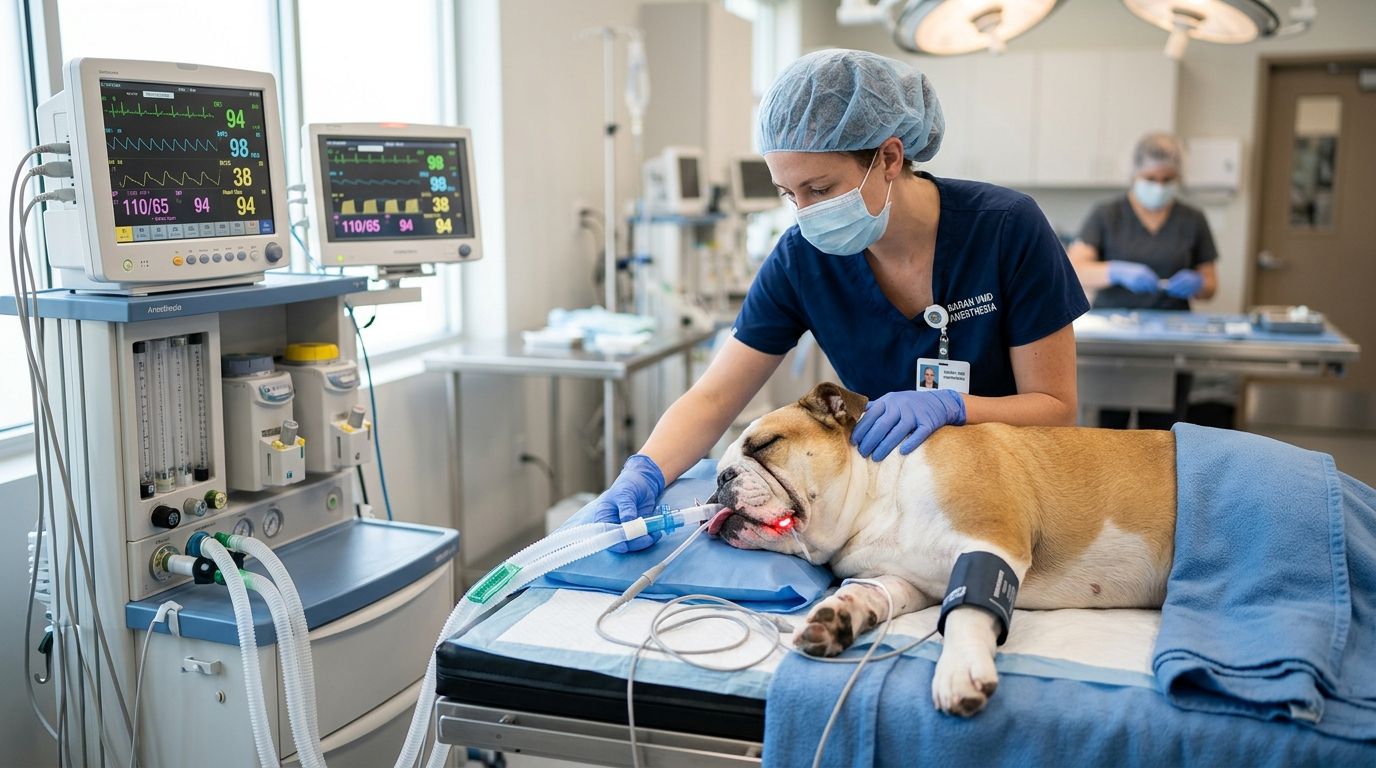
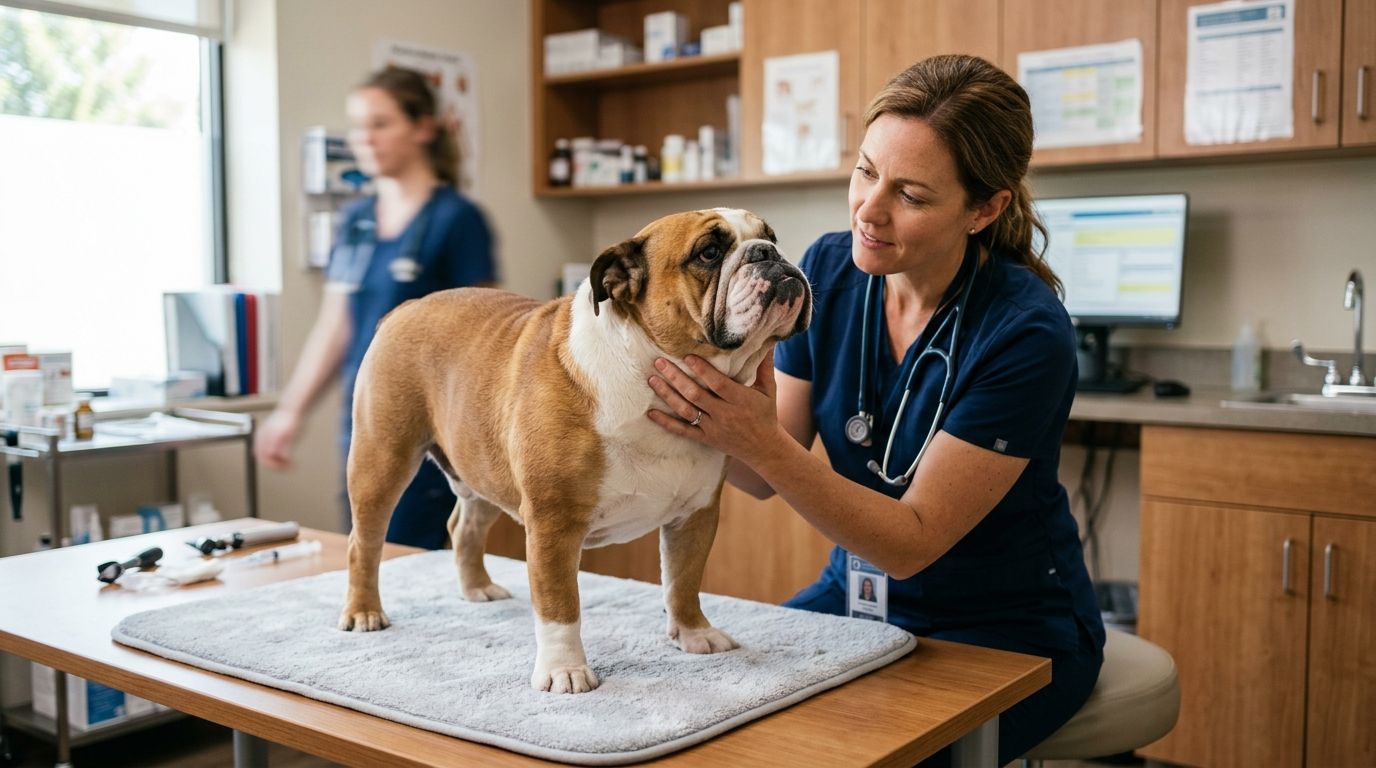
Bulldog anesthesia risk comes down to one thing: the airway. You lower it by picking a vet who works on brachycephalic breeds routinely, screening bloodwork before the procedure, shortening the pre-op fast, and staying in the room (or on the phone) through the first hours of recovery. The hidden cost most owners miss isn't the drug bill — it's the extended monitoring time a bulldog needs after extubation, which is where most complications actually happen.
TL;DR
Bulldog anesthesia risk drops most when the vet team specializes in brachycephalic airways, not just general small-animal surgery.
Shortening the pre-op fast to 4-6 hours cuts reflux and aspiration risk during induction.
Recovery, not surgery itself, is the highest-risk window — extubation timing matters as much as the drugs used.
English and French Bulldogs carry different airway risk profiles and need slightly different anesthesia plans.
Weight management before a scheduled surgery meaningfully reduces airway compromise under sedation.
Numbers that matter before surgery
4-6 hours
Recommended pre-op fasting window
Shorter than the old 12-hour standard
24 hours
Critical post-op monitoring window
Why this matters
English Bulldogs and French Bulldogs are brachycephalic — short-skulled, with narrowed nostrils, an elongated soft palate, and often a smaller windpipe than a longer-nosed dog of the same size. That anatomy is exactly what gives them the smoosh-faced look everyone loves, and it's exactly what makes anesthesia riskier for them than for a Labrador or a Beagle.
We've placed bulldog puppies into homes that later needed a soft palate correction, a cherry eye repair, or a routine spay, and the question we hear every single time is some version of "is this safe for a bulldog?" It can be, in 2026, with the right prep. Most of the danger isn't the anesthetic drug itself — it's airway management before, during, and especially after the drugs wear off.
If you haven't already lined up a vet who's comfortable with a bulldog's airway, that's step one, and choosing a vet experienced with brachycephalic breeds matters more for a Bulldog than for almost any other dog you'll ever own.
How to reduce anesthesia risk for a Bulldog's surgery
The steps below apply whether your Bulldog is going in for a spay, a soft palate revision, or an unrelated orthopedic procedure in 2026. Skip any of these and the risk climbs — they're not optional extras.
Book a vet or specialty hospital that handles brachycephalic breeds regularly. A team that intubates bulldogs weekly reacts faster than one that sees a smoosh-faced dog twice a year.
Run pre-anesthetic bloodwork and a physical exam within days of the surgery, not weeks. Kidney and liver values, red and white cell counts, and a listen to the heart and lungs all shape the drug protocol.
Shorten the fast to 4-6 hours instead of the traditional 12. Bulldogs reflux more easily under sedation, and fasting too long increases stomach acid buildup and aspiration risk.
Ask about pre-oxygenation before induction. A few minutes of oxygen through a mask before the sedative goes in buys the team time if intubation is difficult.
Confirm the clinic keeps the dog cool before and after the procedure. Stress and anesthesia both raise core temperature, and bulldogs already struggle to self-regulate heat.
Plan for a slow, awake extubation. Bulldogs should keep the breathing tube in longer than other breeds and come out of sedation with someone watching the airway the entire time.
Stay through the first hour of recovery, or ask for updates during it. Airway swelling and obstruction show up fastest in that window, not in the operating room.
English Bulldog anesthesia risk factors
English Bulldogs tend to carry more body mass relative to their airway diameter, and excess weight compresses the chest wall further, restricting normal breathing before anesthesia is even involved. A dog carrying extra pounds going into a 2026 surgery date starts from a worse baseline than one at a healthy weight — a diet plan for an overweight English Bulldog started months ahead of an elective procedure is not cosmetic, it's a risk-reduction step.
English Bulldogs also frequently need C-sections to whelp, meaning some dams face anesthesia during birth itself rather than as a scheduled event — a different risk calculation than an elective spay, and one your vet needs to know about in advance if she's ever been bred.
Verdict: English Bulldogs headed into surgery benefit most from weight management and extended pre-op airway assessment — book both well ahead of the surgery date.
French Bulldog anesthesia risk factors
French Bulldogs, especially heavily muzzled show-type dogs, have some of the narrowest tracheas relative to body size of any common breed. That's the primary reason soft palate and stenotic nares corrections get recommended for Frenchies more than for almost any other dog.
If your Frenchie is already scheduled for soft palate surgery, the anesthesia risk conversation and the airway-correction conversation are the same conversation — fixing the palate is often what lowers anesthesia risk for every procedure that dog needs afterward.
Verdict: French Bulldogs benefit most from an airway assessment that specifically checks nostril width and soft palate length before the anesthesia plan is finalized.
Find a vet who knows bulldog airways
Not every clinic handles brachycephalic anesthesia the same way.
Heart and kidney health — flagged on pre-op bloodwork, these change which drugs get used and at what dose.
Stress level going in — a dog panting and anxious in the waiting room enters anesthesia already breathing abnormally.
Ambient temperature — a hot clinic or a hot car ride beforehand raises the dog's baseline body temperature before the drugs are even given.
If the clinic can't answer specific questions about how they handle two or more of these factors, that's a reason to keep looking before the surgery date, not after it.
Is anesthesia more dangerous for Bulldogs than other breeds?
Yes — brachycephalic breeds like English and French Bulldogs face higher anesthesia risk than long-nosed breeds because narrowed airways and shorter tracheas make intubation and post-op breathing harder. The risk isn't the drug itself; it's airway management before and after the dog is sedated.
What age is safest for a Bulldog to have anesthesia?
Most bulldogs handle anesthesia best as healthy adults, roughly one to seven years old, once major growth is complete and before age-related organ decline sets in. Very young puppies and dogs past seven need extra bloodwork and a more conservative drug protocol.
Can a Bulldog with breathing problems safely have surgery?
A Bulldog with existing breathing problems can often still have surgery in 2026, but the anesthesia team needs to know well before the procedure date. In many cases, fixing the airway issue — an elongated soft palate, for instance — is the surgery that makes every future anesthesia event safer.
FAQ
How much does anesthesia risk go up for a Bulldog compared to other breeds?
Brachycephalic breeds like Bulldogs carry a higher anesthesia risk than longer-nosed breeds, driven mainly by narrowed airways and smaller tracheas rather than the anesthetic drugs themselves. A vet experienced with brachycephalic breeds manages that gap through airway-focused prep and extended recovery monitoring.
Is it safe to sedate a French Bulldog for a routine procedure like teeth cleaning?
Yes, routine sedation for a French Bulldog is generally safe when the clinic pre-oxygenates the dog, shortens the fasting window to 4-6 hours, and monitors closely through extubation. The same airway precautions that apply to major surgery apply to routine dental sedation.
How long should a Bulldog fast before anesthesia?
A Bulldog should typically fast 4 to 6 hours before anesthesia rather than the traditional 12-hour window used for other breeds. Shorter fasting reduces the stomach acid buildup that raises aspiration risk in brachycephalic dogs.
What is the riskiest part of anesthesia for a Bulldog, before or after surgery?
The riskiest window is usually after surgery, during extubation and the first hours of recovery, when airway swelling and obstruction are most likely to develop. Surgery itself, once the dog is stably intubated, is often the more controlled portion of the process.
Do overweight Bulldogs face higher anesthesia risk?
Yes, excess weight on a Bulldog compresses the chest wall and worsens airway compression already present from brachycephalic anatomy. Getting a Bulldog to a healthy weight before an elective surgery date is one of the most effective risk-reduction steps available.
Should I ask for pre-anesthetic bloodwork before my Bulldog’s surgery?
Yes, pre-anesthetic bloodwork run within days of the procedure should check kidney values, liver values, and red and white blood cell counts. Results directly shape which anesthesia protocol and dosing the vet uses on a Bulldog.
Can a Bulldog puppy safely go under anesthesia for spay or neuter?
Most Bulldog puppies safely handle spay or neuter anesthesia once they are old enough and cleared on pre-op bloodwork, a timeline your vet sets individually. A vet with brachycephalic experience will still extend the recovery monitoring window compared to a non-brachycephalic puppy.
One last thing
The single biggest anesthesia risk reducer isn't a drug choice at all — it's who's watching your Bulldog during the twenty minutes after the breathing tube comes out. Ask any clinic point-blank how they staff recovery for brachycephalic dogs specifically; a vague answer tells you more than any brand of anesthetic they mention.
We've fielded enough of these calls at Shrinkabulls over the years to know the families who ask this one question before booking surgery are almost always the ones who call back afterward with good news. Bulldogs make us happy precisely because they're built different — surgery day in 2026 just means planning for that difference instead of hoping it doesn't matter.
Every English Bulldog we raise at Shrinkabulls carries some risk of brachycephalic obstructive airway syndrome (BOAS), and picking the right english bulldog pet insurance breathing surgery plan in 2026 decides whether a soft palate or nares procedure costs you a few hundred dollars or several thousand out of pocket.
TL;DR
Trupanion ranks best overall for english bulldog pet insurance breathing surgery in 2026 because congenital conditions are covered standard, with no payout caps.
Healthy Paws is best for unlimited lifetime benefits if your bulldog needs a second airway procedure down the road.
ASPCA Pet Health Insurance’s accident-only tier will not pay for BOAS surgery — you need the complete plan.
Every insurer treats a diagnosed BOAS case as pre-existing, so enroll before your puppy shows any breathing symptoms.
Waiting periods delay illness coverage, so buy the policy the week you bring your bulldog puppy home.
Why this matters
Bulldogs are built the way we love them — that pushed-in face, that low-swung, stocky body — and that same structure narrows the airway. Soft palate resection, stenotic nares widening, and everted saccule removal are the three corrective surgeries most English Bulldogs eventually face, and how early you spot early signs of brachycephalic breathing issues directly affects which insurer will still cover the fix.
Here's the part nobody explains at the breeder counter: BOAS is a congenital, breed-related condition. Once a vet writes "labored breathing" or "stertor" in your dog's chart, that condition becomes pre-existing for every insurer you apply to after that date. The insurance decision has to happen before the symptom, not after. That's why this ranking weighs congenital-condition handling above almost everything else.
What makes the best pet insurance for bulldog breathing surgery
Congenital and hereditary conditions covered standard — not sold as a separate rider you have to remember to add
No or high per-incident and lifetime payout caps, since a two-stage airway surgery can run past a low annual ceiling fast
Short, disclosed waiting period between enrollment and the day illness coverage actually starts
Underwriting that doesn't auto-decline brachycephalic breeds at the application stage
Direct-to-vet payment or a fast reimbursement turnaround, so you're not floating a four-figure bill for weeks
State availability — several insurers price or restrict brachycephalic coverage differently by state
At a glance
Insurer
Best for
Standout feature
Key limitation
Trupanion
Congenital/hereditary coverage overall
No per-incident or lifetime payout caps
No wellness or routine-care add-on
Healthy Paws
Unlimited lifetime benefit
Fast app-based claims
No wellness plan option
Embrace
Multi-bulldog households
Diminishing deductible over time
Annual payout caps apply
Figo
Maximum reimbursement percentage
Up to 100% reimbursement tier
Congenital terms vary by state
Nationwide
Bundling surgery with wellness checks
Whole Pet with Wellness plan
Legacy benefit-schedule plans cap payouts
ASPCA Pet Health Insurance
Budget entry point before surgery is needed
Accident-only tier at lower cost
Accident-only won't touch BOAS surgery
1. Trupanion: best english bulldog pet insurance breathing surgery coverage overall
Trupanion writes congenital and hereditary condition coverage into the base policy instead of selling it as an add-on, which matters enormously for a breed where BOAS is baked into the skull structure. There's no per-incident or lifetime payout cap, so a soft palate resection followed years later by a revision surgery doesn't run into a ceiling.
Trupanion pros:
Congenital/hereditary conditions covered standard, not an optional rider
No payout caps, per-incident or lifetime
Direct-to-vet payment available at many clinics so you skip the reimbursement wait
Trupanion cons:
No wellness or routine-care add-on for vaccines and exams
Single reimbursement structure — less room to customize than Figo
Any breathing symptom noted before enrollment locks BOAS out as pre-existing
Trupanion pricing: check the current quote on Trupanion's site for your bulldog's age and location.
Best for: owners who want the deepest, most uncapped coverage for surgical airway correction. Verdict: Buy — enroll before any snoring or gagging shows up in the vet chart.
2. Healthy Paws: best for unlimited lifetime benefits after a bulldog's first airway surgery
Healthy Paws pays out with no lifetime dollar ceiling once your bulldog is enrolled, which is the feature that matters most if your dog needs a second procedure — nares widening after an earlier soft palate fix, for example. Claims move through a mobile app rather than mailed paperwork.
Healthy Paws pros:
Unlimited lifetime benefit, no dollar ceiling across the policy's life
Mobile app claims with a fast typical turnaround
Hereditary conditions covered as standard, same as Trupanion
Healthy Paws cons:
No wellness plan option at all
Underwriting can decline or exclude a dog with documented prior breathing issues
No direct-to-vet payment — you pay the clinic first, then file
Healthy Paws pricing: get a quote directly for your bulldog's breed and region.
Best for: households that already went through one surgery and want future revisions covered without a ceiling. Verdict: Buy — for lifetime unlimited coverage on a breed prone to repeat airway work.
3. Embrace: best for multi-bulldog households managing long-term cost
Embrace's diminishing deductible shrinks every year you don't file a claim, which rewards owners running a multi-dog household where one bulldog stays healthy while another needs surgery. Hereditary and congenital conditions are covered after the standard waiting period clears.
Embrace pros:
Diminishing deductible lowers your out-of-pocket cost year over year
Hereditary/congenital conditions covered once the waiting period passes
Separate wellness rewards add-on available for routine care
Embrace cons:
Annual payout caps apply, unlike Trupanion or Healthy Paws
Waiting period delays illness coverage if you enroll right as symptoms start
A breed-specific exam may be required before congenital coverage kicks in
Embrace pricing: confirm current rates and cap tiers for your state.
Best for: owners insuring more than one bulldog who want the deductible math to improve across policy years. Verdict: Hold — solid multi-pet economics, but check the annual cap against a realistic surgery estimate first.
4. Figo: best for maximizing reimbursement on a bulldog breathing surgery bill
Figo lets you dial reimbursement all the way up to a 100% tier, which is the single most useful lever when a surgery bill runs into the thousands. Claims submit through an app, and an unlimited annual benefit option exists alongside capped tiers.
Figo pros:
Reimbursement percentage is fully customizable, including a 100% option
Unlimited annual benefit tier available for owners who want no ceiling
App-based claim submission and tracking
Figo cons:
The unlimited tier costs more than the capped tiers
Congenital-condition terms vary by state, so read the state-specific policy wording
Fewer long-running customer reviews than Trupanion or Healthy Paws
Figo pricing: get a state-specific quote before comparing the reimbursement tiers.
Best for: owners who want to push reimbursement as close to 100% as their state allows. Verdict: Buy — if the top-tier reimbursement option is sold in your state.
5. Nationwide: best for bundling breathing surgery coverage with wellness checks
Nationwide's Whole Pet with Wellness plan is built to combine illness coverage with routine visits, which suits owners who want breathing checks, weigh-ins, and vaccine boosters tracked alongside the surgery policy in one place. Nationwide is one of the longest-running pet insurers in the US market.
Nationwide pros:
Wellness plan bundles routine brachycephalic checkups with illness coverage
Long operating history in the pet insurance market
Multiple plan structures to fit different budgets
Nationwide cons:
Some legacy benefit-schedule plans cap the payout per surgical procedure — confirm you're quoted the Whole Pet plan, not a schedule plan
Underwriting runs stricter for brachycephalic breeds than for non-flat-faced dogs
Nationwide pricing: ask specifically for the Whole Pet with Wellness quote, not the legacy schedule plan.
Best for: owners who want routine brachycephalic monitoring bundled with the surgery policy instead of buying wellness separately. Verdict: Hold — confirm plan type before you sign, since the two Nationwide products behave very differently.
6. ASPCA Pet Health Insurance: best budget entry point before surgery becomes necessary
ASPCA Pet Health Insurance sells an accident-only tier at a lower cost, which works fine for a young, symptom-free bulldog puppy while you save toward the complete plan. The complete plan covers hereditary conditions, but the accident-only tier flatly will not.
ASPCA pros:
Accident-only tier available at a lower entry cost
Complete plan covers hereditary conditions, including breathing-related surgery
Multiple deductible and reimbursement combinations to choose from
ASPCA cons:
Accident-only tier does not cover BOAS surgery since it isn't an accident
You need the complete plan to get any breathing-surgery coverage, which narrows the budget advantage
Standard waiting periods apply before illness coverage activates
ASPCA pricing: compare the accident-only and complete plan quotes side by side for your bulldog's age.
Best for: owners who want a lower-cost policy in place while they plan to upgrade before surgery is likely. Verdict: Wait — only the complete plan actually pays for breathing surgery.
“If your bulldog puppy already snorts or gags at eight weeks old, no insurer sold in 2026 will call the surgery anything but pre-existing.”
How we ranked these
Each insurer above is scored against the six criteria listed earlier: standard congenital coverage, payout caps, waiting period, underwriting flexibility for brachycephalic breeds, claims speed, and state availability. French Bulldog owners researching the same decision should also see the best pet insurance plans for French Bulldog puppies, since flat-faced breeds share nearly identical underwriting treatment across most carriers.
Which pet insurance should you choose for bulldog breathing surgery?
If your bulldog puppy is under a year old and symptom-free, Trupanion is the default pick for 2026 — no payout caps and congenital coverage built into the base plan. If you're past a first surgery and want a lifetime ceiling removed entirely, Healthy Paws takes that slot. If budget is the constraint today, buy ASPCA's accident-only tier now and plan to upgrade to the complete plan before symptoms appear, because waiting until surgery is scheduled closes every door at once.
FAQ
What’s the best pet insurance for English Bulldog breathing surgery in 2026?
Trupanion ranks best overall for english bulldog pet insurance breathing surgery in 2026 because congenital and hereditary conditions are covered in the base policy with no payout caps. Healthy Paws is the closest alternative if you want an unlimited lifetime benefit instead.
Does pet insurance cover BOAS surgery for bulldogs?
Yes, as long as you enroll before any breathing symptom is diagnosed or noted in a vet record. Once stertor, snoring, or gagging is documented, every major insurer treats brachycephalic obstructive airway syndrome as pre-existing and excludes it.
Is Trupanion better than Healthy Paws for bulldogs?
Trupanion offers direct-to-vet payment and no per-incident cap, while Healthy Paws offers an unlimited lifetime benefit through app-based claims. Both cover congenital conditions standard, so the better fit depends on whether you value faster vet payment or a lifetime ceiling removed entirely.
Will insurance cover BOAS if my puppy already snores?
Likely not, since audible snoring or labored breathing documented at a vet visit becomes a pre-existing condition on any new policy. Enroll before your bulldog puppy’s first sign of breathing trouble, not after.
How soon should I enroll my bulldog puppy in pet insurance?
Enroll within the first few weeks of bringing your bulldog puppy home, before any vet visit notes breathing irregularities. Waiting periods also mean the policy needs time to activate before an illness claim is eligible.
Do all pet insurers exclude brachycephalic syndrome?
No insurer excludes BOAS outright, but every insurer excludes it once it’s pre-existing. The condition itself is insurable; the timing of your enrollment relative to diagnosis is what determines coverage.
What’s the difference between accident-only and complete pet insurance plans?
Accident-only plans cover injuries like a broken bone or swallowed object, not illnesses or congenital conditions like BOAS. A complete plan is required for any breathing-surgery claim, which is why ASPCA’s lower-cost accident-only tier won’t help with a soft palate procedure.
How much does soft palate surgery cost for an English Bulldog?
Cost varies by clinic, region, and how many procedures — soft palate, nares, saccules — are combined into one surgery. Ask your vet for a written estimate before comparing insurance quotes so you know what payout cap actually matters.
One last thing
Ask the insurer for their exact underwriting wording on "congenital and hereditary conditions" before your bulldog puppy's first vet visit — the exam that confirms your dog is BOAS-free on that specific date is the single most valuable page in your insurance file, more valuable than any brochure comparing premiums. Pair that early exam with choosing a vet experienced with brachycephalic breeds, since a vet who knows what stertor sounds like at eight weeks old writes a cleaner baseline record than a general practice vet in 2026.
Reserve your bulldog puppy today
Lock in your English Bulldog puppy before deciding on an insurance start date.
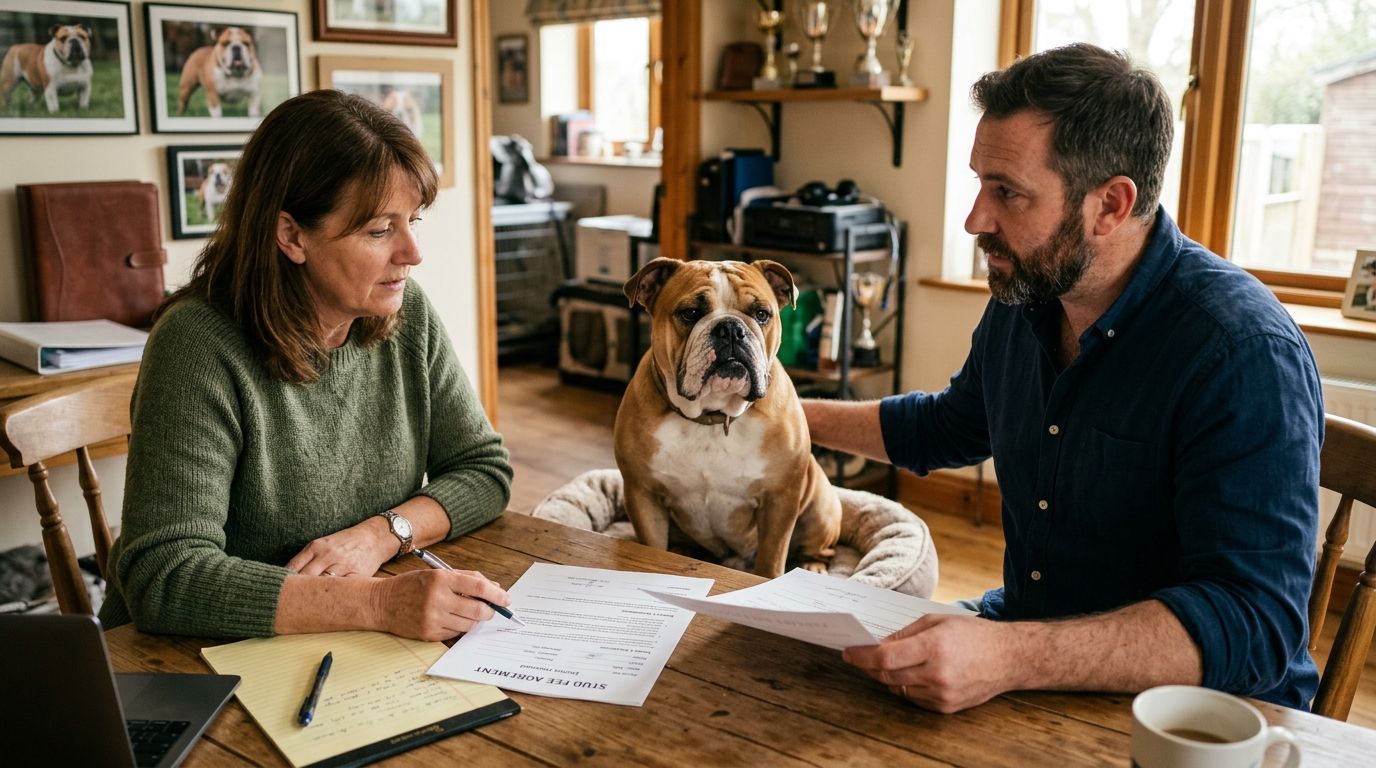
Negotiating a bulldog stud fee comes down to three decisions made before the first breeding attempt: how the stud owner gets paid, what health clearances protect both dogs, and what's written into a signed bulldog stud fee contract that spells out who owns what if the litter doesn't go as planned.
TL;DR
A bulldog stud fee contract settles on one of three payment structures: cash, pick of the litter, or a puppy-back split.
Health clearances for hips, patellas, cardiac, and tracheal grading belong in the contract before breeding, not after a litter is born.
Merle, lilac, and blue bulldog programs should add DNA color panels and AKC registration checks to the negotiation.
A repeat breeding clause protects both owners if the first attempt doesn’t produce a live litter in 2026.
Shrinkabulls treats every stud fee contract as a two-way health check first, a payment discussion second.
Why This Matters
Bulldogs aren't an easy breed to negotiate around. English Bulldogs often need artificial insemination and a scheduled C-section to deliver safely, and French Bulldogs frequently face the same structural limits. That reality changes what a fair stud fee contract looks like compared to a breed that whelps naturally.
A fee negotiated without a written contract puts both dogs at risk. If a stud owner and a dam owner only shake hands, there's no record of what happens when a breeding fails, when a puppy is stillborn, or when a color result doesn't match what the dam owner expected. Choosing a bulldog stud for your breeding program starts the process — the contract is what protects it once the stud is chosen.
How Do You Negotiate a Bulldog Stud Fee?
Most bulldog stud fee negotiations settle into one of three structures. Each shifts risk differently between the stud owner and the dam owner, and each belongs in writing before breeding happens.
Structure
How It Works
Best For
Cash stud fee
Stud owner is paid regardless of litter size or outcome
Stud owners who want predictable income and no stake in the puppies
Pick of the litter
Stud owner selects one puppy instead of cash payment
Stud owners actively building or expanding their own breeding program
Puppy-back guarantee
Partial payment now plus a puppy from a future litter
Owners who want some cash flow immediately but also want breeding stock
The right structure depends on what the stud owner actually needs — cash now, a puppy for their own program, or a mix of both. Negotiate the structure before discussing the amount.
Cash Stud Fee: Paid Before or At Breeding
A cash stud fee is the simplest structure and the easiest to enforce. The stud owner is paid in full, has no ownership claim on any puppy, and the dam owner keeps the entire litter.
This works well when the stud owner isn't running their own breeding program or doesn't want the responsibility of raising another puppy. Verdict: Buy — it's the cleanest structure for a dam owner who wants full control of the litter.
Pick of the Litter: Fee Paid in Puppies
Pick of the litter means the stud owner selects one puppy from the resulting litter instead of receiving cash. This structure only makes sense when the stud's color or bloodline is valuable enough that the stud owner would rather own a puppy than take a payment.
It shifts real risk onto the stud owner — if the litter is small, or if the color outcome (merle, lilac, blue) doesn't land in their favor, they may not get the puppy they wanted. Verdict: Hold — only agree to this if the contract specifies pick order and a fallback if the litter is smaller than expected.
Puppy-Back Guarantee: A Hybrid Approach
A puppy-back guarantee blends the two: a partial payment changes hands up front, and the stud owner also receives a puppy from a future litter, sometimes from a repeat breeding rather than the first one. This spreads risk more evenly than a pure pick-of-the-litter deal.
It requires the most detailed contract language of the three, since it involves two separate transactions stretched over time. Verdict: Buy — for stud owners and dam owners who both want a stake in the outcome, this is the fairest middle ground.
“A bulldog stud fee contract works best when it protects the puppies first and the payment second.”
What Goes Into a Bulldog Breeding Contract
A verbal agreement on price isn't a contract. A real bulldog stud fee contract in 2026 should include:
Health clearances required before breeding — hip and patella evaluations, cardiac clearance, and tracheal grading where applicable
AKC registration verification for both dogs, confirmed before any breeding attempt
DNA color panel results when merle, lilac, or blue is part of the pairing, since color outcomes affect value and health risk
A live litter guarantee clause defining what counts as a successful breeding
A repeat breeding clause allowing another attempt at no added stud fee if the first breeding doesn't produce a live litter
Pick order and timing if the payment structure includes pick of the litter or a puppy-back arrangement
Whelping location and vet-of-record agreed on in advance, since English Bulldogs frequently require a scheduled C-section
Before signing anything, confirm both dogs' paperwork independently rather than taking a breeder's word for it — verifying AKC registration papers takes minutes and prevents disputes months later.
Why Bulldog Stud Fees Vary
Stud fees swing widely across bulldog breeding programs, and the variation almost always traces back to a handful of factors:
Color rarity — merle, lilac, blue, and isabella bulldogs command more negotiating leverage than standard colors
Proven litter history — a stud with a track record of live, healthy litters is worth more than an unproven one
Championship or conformation titles — AKC conformation titles add weight to a stud's value
Breed differences — French Bulldogs almost always require artificial insemination, which adds a cost and logistics layer that English Bulldog breedings may not need
Health clearance completeness — a stud with a full panel of clearances is a safer bet and typically negotiates from a stronger position
Geographic demand — regional scarcity of a specific color or bloodline shifts leverage toward the stud owner
Anyone weighing a merle pairing specifically should look at what rare-color puppies actually cost before finalizing a fee structure, since color rarity is one of the biggest swing factors in any negotiation.
Do You Pay a Stud Fee Before or After Breeding?
Most contracts split the payment: a portion is paid to hold the stud's time before breeding, and the remainder is due only after a veterinarian confirms a live litter. This protects the dam owner from paying in full for a breeding that never produces puppies, while still compensating the stud owner for the dog's time and health screening.
What Happens If the Breeding Doesn't Produce a Litter?
A repeat breeding clause is the standard fix — most bulldog stud fee contracts allow a second attempt at no additional fee if the first breeding fails to produce a live litter. Without that clause written in, the dam owner has no recourse if the pairing doesn't take.
Can a First-Time Breeder Negotiate a Lower Stud Fee?
A first-time breeder can sometimes negotiate a reduced cash portion in exchange for a stronger puppy-back guarantee, since the stud owner takes on more of the long-term stake. It comes down to whether the stud owner values cash now or breeding stock later — that's a negotiating point, not a fixed rule.
Considering a Stud Service in 2026?
Rare-color programs need a contract built around color genetics and health clearances.
What is a fair stud fee structure for a bulldog in 2026?
A fair structure is one where the payment method matches what the stud owner actually needs — cash for owners who aren’t breeding themselves, pick of the litter or a puppy-back guarantee for owners building their own program. Fairness comes from clear contract terms, not a specific dollar figure.
Is pick of the litter better than cash for a stud fee?
Pick of the litter isn’t inherently better, it shifts risk onto the stud owner since litter size and color outcomes aren’t guaranteed. Cash is more predictable; pick of the litter only makes sense when the bloodline or color is valuable enough to justify the risk.
Do bulldog stud contracts need AKC paperwork?
Yes, AKC registration for both dogs should be verified before any breeding attempt and referenced in the contract. Unregistered or unverifiable paperwork is one of the most common sources of stud fee disputes.
What health tests should a stud dog have before breeding?
A stud dog should have hip and patella evaluations, cardiac clearance, and tracheal grading completed before breeding. Merle, lilac, or blue pairings should also include a DNA color panel to confirm the genetic outcome.
Does artificial insemination change a stud fee negotiation?
Yes, artificial insemination adds a logistics and veterinary layer that natural breeding doesn’t require, and French Bulldogs almost always need it. That added complexity is a common negotiating point in the contract, separate from the base stud fee.
What is a puppy-back guarantee in a bulldog contract?
A puppy-back guarantee combines a partial cash payment with a puppy owed from a future litter, often a repeat breeding rather than the first one. It spreads the financial risk between both owners instead of putting it all on one side.
Should a repeat breeding clause always be included?
Yes, a repeat breeding clause should be standard in any bulldog stud fee contract because it protects the dam owner if the first attempt doesn’t produce a live litter. Without it, a failed breeding leaves the dam owner with no recourse.
How do color genetics affect a bulldog stud fee negotiation?
Merle, lilac, and blue bulldogs carry more negotiating leverage because of color rarity and demand, which often pushes stud owners toward pick-of-the-litter or puppy-back structures instead of a flat cash fee. A DNA color panel before breeding confirms what outcomes are actually possible.
One Last Thing
Most disputes over a bulldog stud fee contract in 2026 don't come from the payment amount — they come from missing health guarantee language. Read a health guarantee before signing anything, not after a litter is already on the ground, since that's the document that decides who's responsible when a puppy develops a genetic issue later. Shrinkabulls builds every stud arrangement around that order: health clearances first, contract terms second, payment structure last.
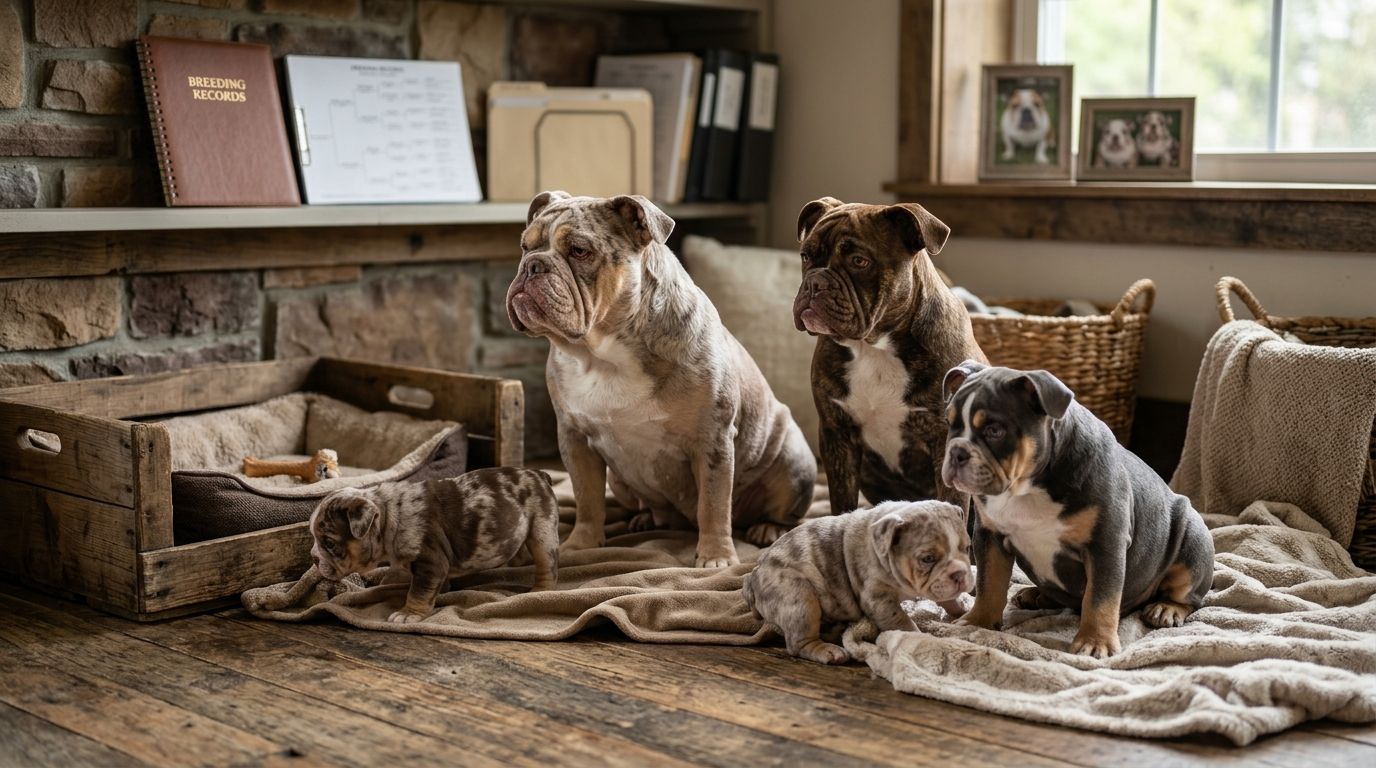
Planning a multi-generation rare-color bulldog breeding program means treating every litter as a data point in a genetics equation, not a one-off event. Get generation one wrong — the wrong founder pair, a skipped health panel, a merle-to-merle pairing — and every generation that follows inherits that mistake.
TL;DR
A real multi-generation rare-color bulldog breeding program runs 3 or more generations with full health clearances at every stage.
Merle-to-merle pairings carry a 25% double merle risk on paper genetics alone — never pair two merles.
Blue and lilac colors come from a recessive dilute gene, so both founder dogs need to carry it even if neither shows the color.
Each generation typically runs 12-18 months from pairing decision to a weaned litter, so a 3-generation program takes 3-4 years.
Pedigree tracking and DNA color panels matter more than how a single puppy looks in the litter.
Why this matters
Rare colors sell themselves in 2026 — merle, lilac, and blue bulldog puppies command attention the second photos go up. That demand is exactly why so many breeding programs skip steps: pair two pretty dogs, get a litter of eye-catching puppies, repeat without ever checking what's underneath the coat color.
The problem shows up two or three generations later. Dilute colors like blue and lilac are tied to a documented skin condition called color dilution alopecia in veterinary literature — not guaranteed, but common enough that responsible breeders track it across generations. Merle carries a bigger and faster risk: pair two merle dogs and roughly a quarter of the resulting litter can be born double merle, a combination linked to blindness and deafness. A program built without that math in generation one isn't a program — it's a gamble with a coat color as the prize.
How to plan a multi-generation rare-color bulldog breeding program
A breeding program works in stages, not single litters. Here's the sequence that holds up across generations:
Map the genotype of every founder dog before any pairing decision — coat color DNA panels tell you what's actually recessive versus visible.
Pull pedigree charts back at least three generations to confirm founder dogs aren't more related than they look on paper.
Run full health panels on both founders — hips, patellas, cardiac, and tracheal screening before generation one starts.
Never pair merle to merle, regardless of how rare the resulting litter would look.
Space litters to protect the dam, giving her body time to recover between pregnancies rather than breeding back-to-back.
Document every color outcome per generation so the next pairing decision is based on results, not hope.
Choosing the right stud matters as much as choosing the dam — a program lives or dies on that first pairing decision. If you're evaluating outside studs for a rare-color line, how to choose a bulldog stud for your breeding program walks through the health and pedigree checks worth doing before any contract gets signed.
Generation 1: Founder pair selection and color genetics
Generation one sets the ceiling for everything after it. Blue and lilac are recessive dilute colors — a dog can carry the gene without showing the color at all, which means genotype testing matters more than what you see standing in front of you. Two black-coated bulldogs that both carry the dilute gene can still produce blue or lilac puppies; two blue bulldogs bred together will only ever produce dilute-colored offspring, for better or worse on the health side.
Merle works differently — it's dominant, not recessive, which is exactly why merle-to-merle pairings are the single most common mistake in rare-color programs. One merle parent is enough to produce merle puppies in the litter; you never need two.
Generation 2: Testing color outcomes and health clearances
Generation two is where the program either confirms itself or exposes a problem. Puppies from generation one that get held back for breeding need their own full health clearances before they're paired again — genotype confirmed color doesn't override a joint or cardiac issue showing up independently. This is also the stage where litter size and color ratios start telling you whether generation one's genotype mapping was accurate.
A thorough health testing panel at this stage catches problems before they compound into generation three. Best health testing panels to request from a bulldog breeder lists what a serious program screens for at every generation, not just the first one.
Generation 3: Locking in the rare color line
By generation three, a well-run program has consistent, predictable color outcomes and a documented health record across every dog in the line. This is the point where a color line becomes something a breeder can stand behind with AKC-registered paperwork and a genotype history, rather than a lucky litter that happened to photograph well.
“If you can’t explain why a puppy looks the way it does on paper, you’re not ready to breed that pairing again.”
Why programs go off track
Most multi-generation programs don't fail because of bad luck — they fail because of shortcuts taken early and never corrected. The common failure points:
Skipping genotype testing and relying on visual color guessing instead of DNA panels.
Pairing merle to merle for a rarer-looking litter without accounting for the double merle risk.
Breeding too closely related founder dogs, shrinking the gene pool by generation two.
Rushing litter spacing, breeding a dam back-to-back without recovery time.
Not tracking outcomes, so the same avoidable pairing mistake repeats across generations.
Chasing rarity over health, prioritizing an unusual color combination over clearances that should disqualify a pairing.
Is it safe to breed two merle bulldogs together?
No — pairing two merle bulldogs produces roughly a 25% chance of double merle puppies in the litter, a combination associated with blindness and deafness. A single merle parent paired with a non-merle dog produces merle puppies without that risk, which is why responsible programs never repeat the merle-to-merle pairing regardless of demand for the resulting color.
How many generations does it take to establish a reliable rare color line?
Most rare-color bulldog programs need 3 to 4 generations to establish a reliable, predictable color line with confirmed health clearances at every stage. At roughly 12-18 months per generation, that puts a full program timeline at 3 to 4 years before the color and health outcomes are consistent enough to build a reputation on.
Do rare-color bulldog breeding programs cost more to run responsibly?
Yes — genotype panels, full health clearances at every generation, and smaller litter sizes from careful pairing decisions all add cost that a shortcut program skips. Buyers researching a merle, lilac, or blue puppy in 2026 should expect that cost to show up in the price, since a program that skipped those steps priced a puppy without the same guarantees behind it.
Asking about stud availability for a specific rare-color pairing is a normal part of planning generation two or three of a program.
Planning a rare-color pairing?
Explore stud options built for rare-color breeding programs.
What is a multi-generation rare-color bulldog breeding program?
It’s a breeding plan run across 3 or more generations with genotype testing and full health clearances at each stage, built to establish a consistent, predictable rare color line rather than a one-off litter.
Is it safe to breed two merle bulldogs together?
No, pairing two merle bulldogs carries roughly a 25% chance of double merle puppies, a combination linked to blindness and deafness. One merle parent is enough to produce merle puppies without that risk.
How many generations does it take to establish a rare color line?
Most programs need 3 to 4 generations, roughly 3 to 4 years at 12-18 months per generation, to confirm a reliable color outcome with consistent health clearances.
Can lilac and blue bulldogs be bred together?
Yes, both colors come from the same recessive dilute gene, so pairing them can produce dilute-colored puppies, but both founder dogs should still pass full health clearances before pairing.
How long does one generation take from pairing to litter?
One generation typically takes 12-18 months from the pairing decision to a weaned litter, accounting for gestation and recovery time for the dam.
Do rare-color bulldogs cost more to breed responsibly?
Yes, genotype panels and full health clearances at every generation add cost that a shortcut breeding program skips, and that cost typically shows up in the puppy price.
What is double merle and why does it matter?
Double merle happens when two merle-carrying parents are paired, producing offspring with two copies of the merle gene, a combination associated with blindness and deafness in the litature on the condition.
What health tests should every generation pass before breeding?
Every generation should clear hip, patella, cardiac, and tracheal screening in addition to a coat color DNA panel before that dog is paired again.
One last thing
The detail most rare-color programs miss in 2026: a dog's visible coat color tells you almost nothing about what it's carrying underneath. A black bulldog can carry the dilute gene and never show it; a merle bulldog only needs one copy to pass the trait on. Genotype testing before pairing, not after, is what separates a real multi-generation rare-color bulldog breeding program from a lucky litter that happened once.
Choosing a vet for a brachycephalic breed bulldog means finding a clinic that treats short-nosed dogs often enough to catch airway distress before it becomes an emergency, not just a general practice that happens to accept English and French Bulldogs. This guide breaks down exactly what separates a bulldog-ready vet from a generalist, plus the questions to ask before you book that first appointment in 2026.
TL;DR
A vet for brachycephalic breed bulldog care should grade airway function and use flat-face anesthesia protocols on every visit.
General practice vets with low bulldog caseloads often miss early stertor, stridor, and heat-stress warning signs.
Ask about oxygen support, extended anesthesia recovery, and BOAS surgery referral before your bulldog’s first exam.
Board-certified surgeons matter most for soft palate or nares surgery, not routine wellness checks.
Why this matters
English Bulldogs and French Bulldogs are built with shortened skulls, narrow nostrils, and elongated soft palates — anatomy that makes breathing, heat regulation, and anesthesia fundamentally different from a Labrador or a Beagle. A vet who treats mostly long-nosed breeds can miss the early signs of brachycephalic breathing issues because those signs look almost normal in a bulldog until they aren't.
At Shrinkabulls we place English Bulldog and French Bulldog puppies with families across the country, and the biggest health regret we hear from new owners in 2026 isn't about the puppy — it's about picking a vet who treated the bulldog like any other dog on day one. That gap shows up fastest during anesthesia and during a heat wave, two situations where a brachycephalic-experienced vet reacts completely differently than a generalist.
Bulldogs also can't cool themselves the way other breeds do. Panting is the primary canine cooling mechanism, and a shortened airway makes it less efficient — which is why a vet who understands the breed talks about heat management before you ask.
How to choose a vet for brachycephalic breed bulldog care
Start with caseload, not convenience. A clinic fifteen minutes farther that sees bulldogs weekly beats the one around the corner that sees one a year.
Vet type
Airway screening
Anesthesia approach
Best for
General practice, low brachy caseload
Rarely graded, relies on owner reports
Standard canine dosing and monitoring
Routine vaccines, nail trims, basic wellness
Brachycephalic-experienced general vet
Grades airway sounds at every exam
Pre-oxygenates before sedation, adjusted recovery monitoring
Annual exams, early breathing changes, weight management
Board-certified veterinary surgeon
Full BOAS workup including laryngeal exam
Extended recovery monitoring, oxygen support on standby
Soft palate surgery, stenotic nares correction
Verdict: a brachycephalic-experienced general vet handles the large majority of what an English or French Bulldog needs year to year, but keep a board-certified surgeon's contact on file before you ever need one — not after.
Before you commit to a clinic, ask these directly:
How many brachycephalic breed patients do you see in an average month?
What's your anesthesia protocol difference for a bulldog versus a mixed-breed dog?
Do you keep oxygen support and a cooling setup on-site for post-anesthesia recovery?
Can you grade BOAS severity, or do you refer that out?
What's your plan if my bulldog shows breathing distress or overheats during a visit?
Do you have a referral relationship with a board-certified veterinary surgeon for airway work or skull and jaw evaluations?
A vet who answers these without hesitation has treated enough bulldogs to trust with anesthesia. A vet who has to look it up hasn't.
“If a vet can’t describe a BOAS grading scale off the top of their head, they haven’t treated enough bulldogs to trust with anesthesia.”
Brachycephalic-experienced general vet: your default choice
This is the clinic you'll use for the vaccine series, weight checks, skin folds, ears, and every routine thing across your bulldog's life. What sets them apart is small and constant: they listen to the airway on purpose, they weigh your dog against breathing effort rather than a generic chart, and they don't schedule a dental for the hottest afternoon in July.
They also tend to be candid about weight. Extra pounds compress an already-narrow airway, which is why diet conversations come up early — see our guide to diet plans for overweight English Bulldogs for what that looks like at home.
Best for: wellness care, vaccine schedules, early airway monitoring. Verdict: Buy — this is the relationship you build first.
Board-certified veterinary surgeon: for airway procedures only
A surgeon with ACVS certification is who you want holding the scalpel if your bulldog needs an elongated soft palate shortened or stenotic nares widened. They do these procedures routinely, they have recovery setups built for flat-faced dogs, and their post-op monitoring is measured in hours, not minutes.
You don't need them for annual exams, and most families never see one. Set the referral up in advance anyway — hunting for a surgeon while your dog is in respiratory distress is the wrong time to start calling.
Best for: BOAS surgery, palate and nares correction. Verdict: Hold — line up the referral now, use it only if needed.
Emergency clinic with brachycephalic protocols
The third piece nobody sets up until it's too late. Find your nearest 24-hour emergency hospital in 2026, call them during a quiet weekday, and ask whether they stock oxygen support and have handled brachycephalic respiratory crises. Then put the address in your phone.
Best for: heat stress, sudden respiratory distress, post-surgical complications. Verdict: Buy — five minutes of research now, saved life later.
Why vet quality varies so much for brachycephalic breeds
The gap between clinics isn't about effort — it's about exposure and equipment. Factors that actually move the needle:
Caseload volume — a clinic seeing bulldogs and pugs regularly develops pattern recognition a low-volume practice never builds.
On-site equipment — oxygen support, pulse oximetry, and active cooling aren't standard everywhere.
Board certification access — some regions have a surgeon within an hour; others need a multi-hour drive for soft palate surgery.
Staff training — techs who can identify noisy breathing over the phone triage faster than techs who haven't heard it before.
Geographic density — urban areas generally offer more brachycephalic-experienced practices than rural regions.
Health records on file — a clinic that receives full parent health testing panel results can plan proactive care instead of reacting to surprises.
Meet health-tested bulldog puppies
Every Shrinkabulls puppy comes with parent health documentation to share with your vet.
Is anesthesia riskier for bulldogs than other breeds?
Yes — anesthesia carries elevated risk for English Bulldogs and French Bulldogs because narrow airways and excess soft palate tissue can obstruct breathing during sedation and, more often, during recovery. A brachycephalic-experienced vet manages this with pre-oxygenation, careful drug selection, and extended monitoring after the procedure instead of standard discharge timing.
How often should an English Bulldog see the vet?
Many brachycephalic-experienced vets recommend twice-yearly wellness visits for English Bulldogs and French Bulldogs rather than the once-a-year standard applied to most breeds. The second visit tracks weight, skin fold condition, and airway function over time, since small breathing changes in a bulldog matter more than they would in a longer-nosed dog.
What is BOAS grading?
BOAS grading is a functional scoring system vets use to classify how much a brachycephalic dog's anatomy interferes with normal breathing, running from unaffected to severely affected. A vet who can tell you where your bulldog falls on that scale is giving you real information. One who can't is guessing, and guessing is how airway problems get caught late.
FAQ
What makes a vet experienced with brachycephalic breeds?
A vet experienced with brachycephalic breeds sees English Bulldogs, French Bulldogs, or similar short-nosed dogs often enough to recognize airway distress early and adjust anesthesia protocols accordingly. Ask directly about monthly caseload and anesthesia differences before booking your first visit.
Do bulldogs need a specialist vet?
Bulldogs do not need a specialist for routine wellness care, but a board-certified veterinary surgeon matters for airway procedures like soft palate or nares correction. A brachycephalic-experienced general vet handles most annual care and refers out when surgery is needed.
How do I find a vet for brachycephalic breed bulldog care near me?
Call local clinics and ask how many brachycephalic patients they treat monthly and whether they grade BOAS severity in-house. Bulldog breeders, including Shrinkabulls, can often point new owners toward vets in their region with real brachycephalic caseload.
Should I switch vets if mine is not bulldog-experienced?
Switch if your current vet cannot answer specific questions about bulldog anesthesia protocols or BOAS grading, because those gaps show up hardest during emergencies. A wellness-only relationship can work short term, but surgery or a heat event needs someone who has handled it before.
Is pet insurance worth it for a French Bulldog?
Pet insurance can offset costs tied to brachycephalic-specific care such as airway surgery or emergency oxygen support, which occur more often in this breed than in longer-nosed dogs. Read the policy language on brachycephalic and pre-existing exclusions before enrolling.
What breathing signs should send me to the vet immediately?
Bluish gums, collapse, or breathing that does not settle after several minutes of rest are emergencies requiring immediate care, not a wait-and-see approach. Call the emergency clinic on the way rather than after you arrive.
Is a French Bulldog or English Bulldog harder on a vet relationship?
Both breeds need the same brachycephalic-aware approach, so one clinic can cover either. The practical difference is size and weight management, which affects how quickly airway strain shows up as the dog ages.
When should a bulldog puppy have its first vet visit?
Schedule the first vet visit within the first few days after your bulldog puppy comes home, while the breeder vaccine and deworming records are current. That first exam sets the baseline your vet compares every later visit against.
One last thing
The vet conversation should start before the puppy comes home, not after. Ask the breeder what health testing the parents received, request the paperwork, and bring it to that first appointment in 2026 — a clinic that gets full parent history walks in with a plan instead of a blank slate. That single folder changes the tone of every vet visit for the next decade, and it costs you nothing but the ask.
Picking the best microchip for a bulldog puppy comes down to one question: which registry will actually get your dog back if a shelter scans that chip in 2026? This guide ranks five identification options — four microchip brands and one physical ID tag — by what actually matters for a wrinkly, short-necked, escape-prone bulldog.
TL;DR
AKC Reunite is the best microchip for bulldog puppy owners with AKC paperwork already on file.
HomeAgain wins for families who travel or relocate across states with their bulldog.
PetLink suits breeding households tracking chip numbers for several dogs at once.
24PetWatch is the most budget-friendly nationwide registration option.
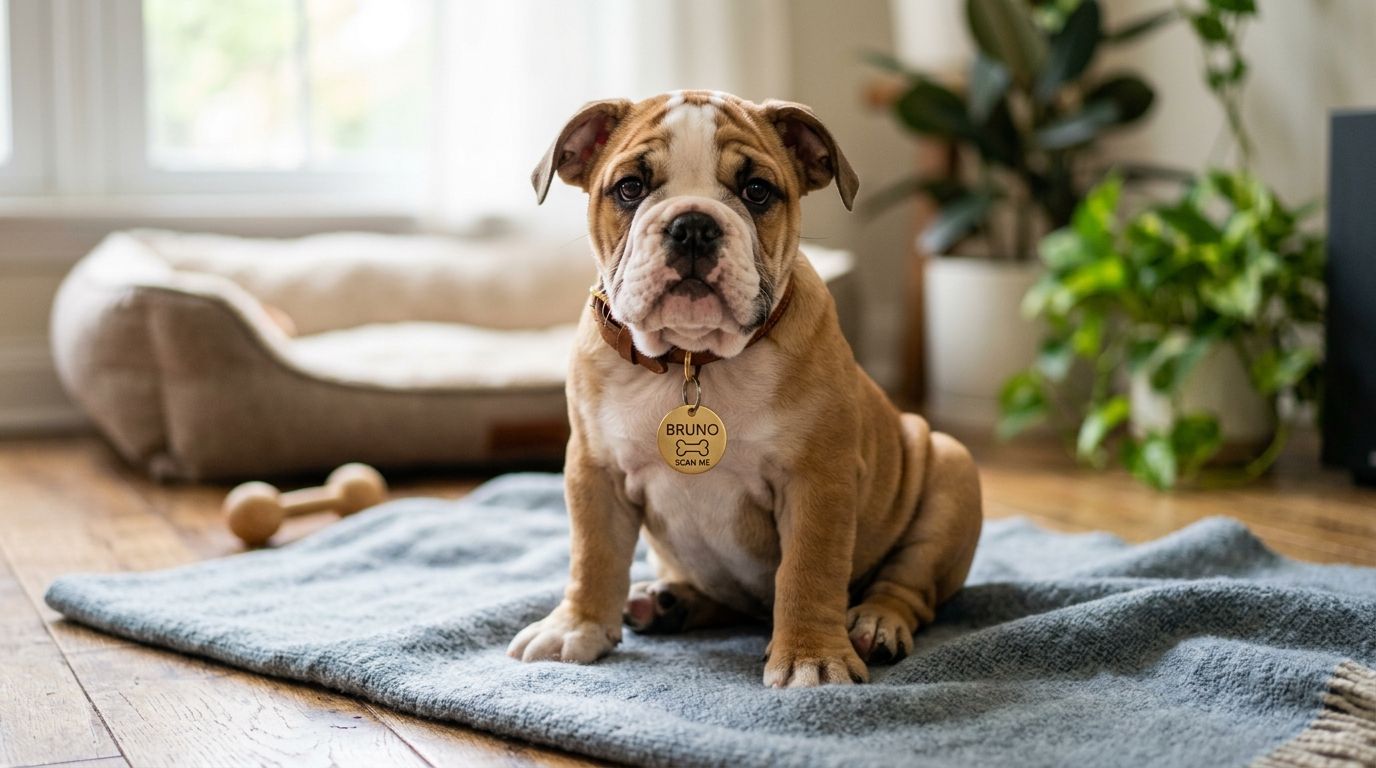
An engraved ID tag is not optional — it’s the backup that works before anyone finds a scanner.
Microchip basics for 2026
134.2 kHz
ISO scanning frequency
Standard for U.S. shelters and vets
15 digits
Standard chip ID length
6-8 weeks
Typical age for first chip
Usually done at the first vet visit
Why this matters for a bulldog specifically
A microchip is useless if nobody registers it, and an ID tag is useless if it's clipped to a collar that slides right off a bulldog's thick neck. Bulldogs also come with skin folds around the shoulders and neck that can make chip placement and tag fit trickier than on a lean, long-necked breed. Get the vaccination schedule squared away with your vet at the same visit — most clinics implant the microchip during that first round of shots, so you're not making a separate trip.
We've watched enough panicked "my bulldog got out the gate" calls to know this isn't a paperwork formality. It's the single fastest way a stranger, a shelter, or animal control gets your bully baby back to you.
What makes the best microchip for a bulldog puppy
ISO compliance — the chip must broadcast at 134.2 kHz so any U.S. shelter scanner reads it.
Registry reach — how many shelters, vets, and animal control offices actually check that specific database.
Update ease — how fast you can change your phone number or address after a move.
Recovery support — whether the provider runs an active lost-pet hotline or alert network.
Fit for brachycephalic breeds — does the enrollment process account for a squat, wrinkled dog, or is it one-size-fits-all.
Cost transparency — clear, upfront registration terms with no surprise renewal traps.
Microchip and ID tag options at a glance
Option
Best for
Standout feature
Key limitation
AKC Reunite
AKC-registered bulldog puppies
Direct tie to AKC paperwork and a 24/7 recovery line
Requires manual updates after a move
HomeAgain
Travel and relocation
Broad shelter and vet scanning network
Some recovery features need active membership
PetLink
Multi-pet or multi-litter households
One account tracks several dogs' chip numbers
Less name recognition with the general public
24PetWatch
Budget-conscious registration
Basic nationwide registry tier
Insurance upsells during signup
Engraved ID tag
Daily-walk backup ID
No scanner needed, instant visual contact info
Wears down and falls off if the collar slips
1. AKC Reunite: best microchip for AKC-registered bulldog puppies
AKC Reunite (also called AKC CAR) is the nonprofit pet recovery service affiliated with the American Kennel Club, running on standard ISO-compliant 15-digit chip technology. If you verify AKC registration papers on your bulldog puppy, enrolling the chip in the same ecosystem keeps everything under one name and one paper trail.
AKC Reunite pros:
Ties directly into AKC paperwork you already have
24/7 recovery hotline for lost-pet reports
Works with any standard ISO scanner, not just AKC-branded readers
AKC Reunite cons:
You still have to manually update your contact info after a move
No built-in GPS or real-time tracking
Registration only helps if you actually complete it — an unregistered chip is just a barcode
AKC Reunite pricing: check current enrollment terms directly with AKC Reunite, since fees and renewal structures change.
Best for: bulldog puppies with AKC paperwork who want one unified recovery system. Verdict: Buy.
2. HomeAgain: best microchip for bulldogs that travel or relocate
HomeAgain is one of the longest-running microchip brands in the U.S., built around a scanning network that spans vet clinics, shelters, and animal control offices nationwide. If your family moves states or you plan to travel with your bulldog puppy by car regularly, a widely recognized network matters more than a niche one.
HomeAgain pros:
Scanned by a large share of U.S. shelters and vet networks
Established brand that many rescue organizations already check first
Compatible with standard ISO scanners
HomeAgain cons:
Some premium recovery features require ongoing membership
No real-time GPS tracking built into the base chip
Recovery still depends on your info being current in the database
HomeAgain pricing: confirm current registration and any membership tiers on HomeAgain's own site before enrolling.
Best for: bulldog families who relocate or road-trip often. Verdict: Buy.
3. PetLink: best microchip for multi-pet or multi-litter households
PetLink is a widely accepted microchip and registration platform built for households juggling more than one dog's paperwork — a common situation for anyone running a breeding program or fostering alongside a resident pet. It handles registration for multiple chip numbers under a single login instead of forcing separate accounts.
PetLink pros:
One dashboard for tracking several dogs' chip numbers at once
Accepted by shelters and vets scanning for ISO-standard chips
Straightforward online contact updates
PetLink cons:
Less brand recognition with the general public than AKC Reunite or HomeAgain
No bulldog-specific guidance during enrollment
No advertised phone-based recovery concierge
PetLink pricing: check PetLink's current enrollment fees, since single-account and multi-pet pricing structures can differ.
Best for: breeders and multi-dog households managing several chip numbers. Verdict: Buy.
4. 24PetWatch: best budget-friendly microchip registration
24PetWatch runs a nationwide microchip registration service with a basic registration tier alongside optional add-on pet protection products. For an owner who just wants the chip registered and doesn't need extras, this is the leanest path.
24PetWatch pros:
Basic registration tier available without add-ons
Nationwide lost-pet database integration
Simple online signup flow
24PetWatch cons:
Signup flow pushes insurance and protection upsells
Fewer bulldog-specific resources than breed-focused registries
Doesn't include a physical ID tag in the base registration
24PetWatch pricing: confirm the current base registration fee versus any bundled protection tiers directly with 24PetWatch.
Best for: owners who want the cheapest complete registration and nothing else. Verdict: Hold — fine if budget is the only factor, but compare recovery network size first.
5. Engraved stainless steel ID tag: best backup ID for daily walks
A microchip does nothing until someone finds a scanner. An engraved stainless steel tag with your phone number does its job the second a neighbor spots your bulldog wandering the street. Because bulldogs have short, thick necks, tag placement matters — a tag clipped to a poorly fitted collar or a brachycephalic-friendly harness needs to sit where it won't rub against neck folds.
Engraved ID tag pros:
No scanner required — anyone can read a phone number
Cheap addition to gear you already own
Instant visual proof the dog belongs to someone
Engraved ID tag cons:
Engraving wears down over a couple of years
Useless if the collar or harness slips off
Can snag on fabric or fencing if it hangs too loose
Engraved ID tag pricing: most pet stores and online engravers list current pricing at checkout — costs vary by material and size.
Best for: every bulldog puppy, as a companion to a microchip, not a replacement. Verdict: Buy.
“A microchip only works if someone registers it — an unregistered chip is just a barcode nobody can read.”
How we ranked these options
Each option was weighed against the six criteria above — ISO compliance, registry reach, update ease, recovery support, fit for a brachycephalic breed, and cost transparency. AKC Reunite, HomeAgain, and PetLink all pass ISO compliance and reach; the split comes down to which paperwork ecosystem and household setup fits your situation. The engraved tag isn't competing on the same axis — it's the analog backup every list needs.
Which microchip should you choose?
If your bulldog puppy already has AKC papers, AKC Reunite is the default pick — it keeps registration and pedigree paperwork under one roof. If you move often or travel with your dog, HomeAgain's broader scanning network is worth the switch. Whatever registry you land on, pair it with an engraved tag on day one. Skipping that step is the single most common regret owners mention after a bulldog puppy slips out an open gate in 2026.
Bringing home a Shrinkabulls puppy?
See available English and French Bulldog puppies before you plan your ID setup.
What’s the best microchip for a bulldog puppy in 2026?
AKC Reunite is the best overall pick for AKC-registered bulldog puppies because it ties directly into paperwork you already have and runs a 24/7 recovery hotline. HomeAgain and PetLink are strong alternatives depending on travel habits or multi-pet households.
Is a microchip better than an ID tag for a bulldog?
Neither replaces the other. A microchip is permanent proof of ownership once scanned at a vet or shelter, while an ID tag gets your bulldog home the moment a neighbor spots them, no scanner needed.
How much does it cost to microchip a bulldog puppy?
Costs vary by veterinarian and provider, so ask your vet for current pricing during the first puppy visit around 6 to 8 weeks. Registration fees also differ between AKC Reunite, HomeAgain, PetLink, and 24PetWatch.
When should a bulldog puppy get microchipped?
Most vets implant the chip at the 6-to-8-week puppy visit alongside the first round of vaccinations. It can be done later too, but earlier means one less separate trip.
Can a bulldog’s microchip stop working?
Chip failure is rare, but recovery still depends entirely on the registration staying current. A working chip with an outdated phone number won’t get your dog back any faster than no chip at all.
Do bulldogs need a special collar for ID tags because of their neck folds?
Yes. A bulldog’s short, thick neck and skin folds mean a poorly fitted collar can rub or let a tag snag. A properly sized harness keeps the tag positioned away from neck folds.
Is AKC Reunite only for AKC-registered dogs?
No, AKC Reunite accepts any pet’s microchip enrollment, but it pairs especially well with a bulldog puppy that already has AKC paperwork on file.
How do I update my bulldog’s microchip information after I move?
Log into your provider’s online registry account and update your address and phone number directly. Do this the same week you move, not months later.
One last thing
Most owners don't know shelters and vets use the AAHA Universal Pet Microchip Lookup tool, which cross-references major U.S. registries so a scanned chip can be traced back to you regardless of which brand you enrolled with. That's the safety net behind every option on this list — but it only works if the registration step actually got completed. Do that step this week, not "eventually."
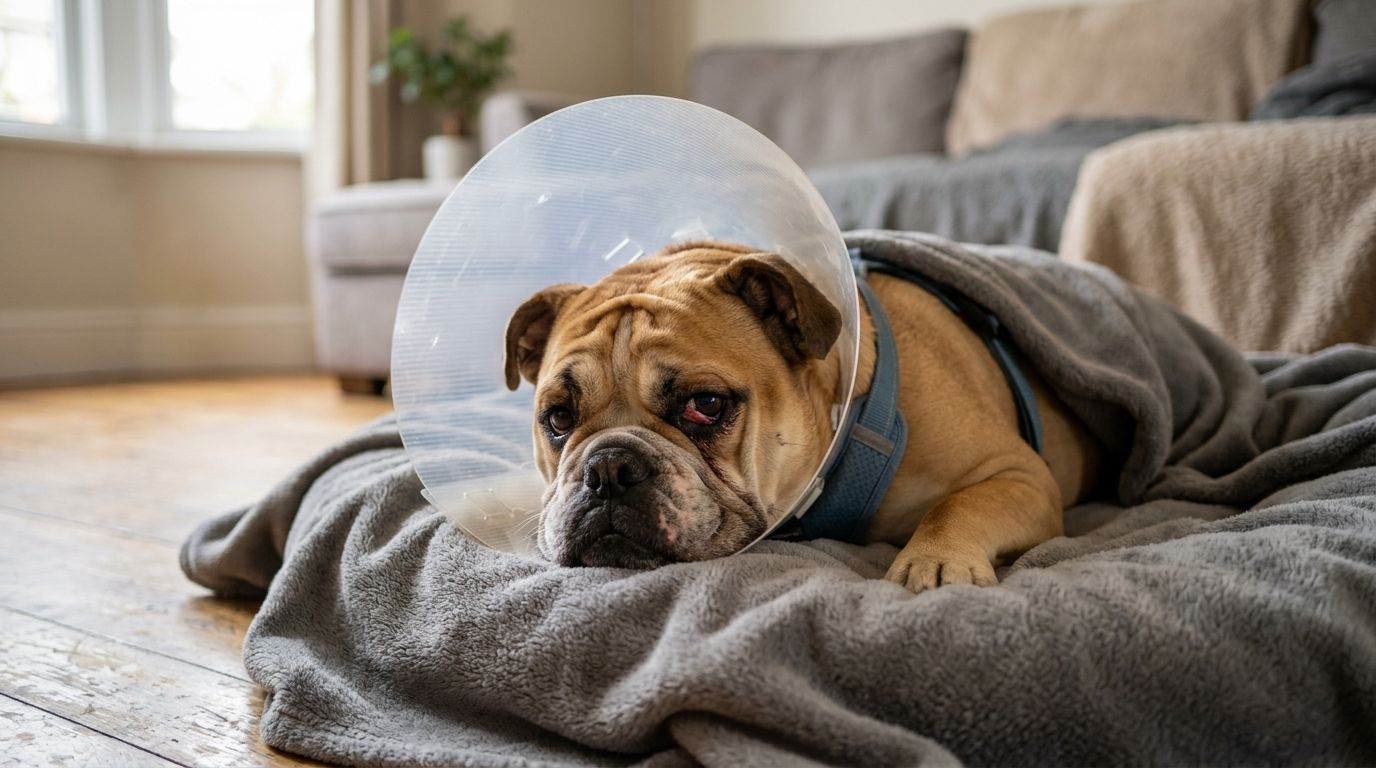
If your Bulldog just had cherry eye surgery, the next two weeks matter more than the operation itself. Cherry eye surgery recovery in a Bulldog runs about 10-14 days with a cone or inflatable collar worn around the clock, prescribed eye drops on a strict schedule, and a follow-up vet check near day 7-10 to confirm the gland stayed put. The part owners underestimate isn't the surgery — it's how much the collar and activity restriction wear on a Bulldog puppy who wants to play, rub its face, and generally act like nothing happened.
TL;DR
Cherry eye surgery recovery bulldog cases run 10-14 days with an E-collar worn 24/7, no exceptions.
Swelling peaks at 48-72 hours post-op, then eases through the first week.
A follow-up vet visit around day 7-10 confirms the gland reattached instead of prolapsing again.
Recurrence is more common after gland removal than after the pocket/imbrication technique vets now prefer.
Shrinkabulls screens breeding lines for eye conditions before puppies ever go home.
Recovery timeline at a glance
10-14 days
Total E-collar recovery window
48-72 hours
Peak post-op swelling
7-10 days
Follow-up vet check timing
Why this matters
Bulldogs and French Bulldogs are built with shallow eye sockets and loose connective tissue holding the third eyelid gland in place — that combination is exactly why cherry eye shows up so often in this breed. Surgery corrects the prolapse, but a botched recovery undoes the work fast: a puppy that rubs its eye against a bed or another dog can pop the gland loose again inside days.
Getting ahead of it early matters too. Knowing how to recognize cherry eye in an English Bulldog puppy before it fully prolapses gives you a shot at catching it while it's still manageable, rather than after a full surgical repair is the only option left in 2026.
How do you manage cherry eye surgery recovery in a Bulldog?
Follow these steps in order, starting the moment you bring your Bulldog home from the clinic:
Keep the E-collar on 24/7 for the entire 10-14 day window — during meals, sleep, and especially unsupervised time.
Apply prescribed drops on schedule, usually antibiotic or anti-inflammatory formulas dosed 2-4 times daily.
Restrict activity completely — no running, no rough play with resident pets, no jumping on furniture for the full two weeks.
Check the eye daily for excessive swelling, discharge, or any sign the gland is bulging again.
Block face-rubbing against bedding, carpet, or paws; a puppy playpen away from rough surfaces helps here.
Return for the follow-up exam at day 7-10 so the vet can confirm the repair held before the collar comes off.
Stage
What's happening
What you do
Day 1-3
Swelling and redness peak
Collar on, drops on time, minimal handling
Day 4-7
Swelling drops, itching rises
Watch for rubbing, keep collar on regardless
Day 8-14
Healing tissue settles
Vet clears collar removal at follow-up
Days 1-3: the swelling peak
Expect the eye to look worse before it looks better — redness and puffiness peak in the first 48-72 hours after surgery. This is normal tissue response, not a sign the procedure failed, but it's also the window where a Bulldog is most tempted to paw at its own face.
Days 4-7: swelling drops, itching increases
As inflammation eases, the healing site starts to itch, and that's when collar discipline matters most. Bulldogs are notorious for finding the one gap in an E-collar, so an inflatable donut-style collar sometimes works better than a hard cone for this breed's flat face.
Days 8-14: collar comes off if the vet clears it
By the second week, most Bulldogs are cleared for the collar to come off, but only after the follow-up exam confirms the gland is holding. Pulling the collar early because "it looks fine" is the single most common reason recovery drags into a third week.
Why cherry eye recovery time varies
Not every Bulldog bounces back on the same schedule. A few factors push recovery longer or shorter:
Age of the puppy — younger dogs sometimes heal faster but are harder to keep still.
Surgical technique used — pocket or imbrication repairs generally recover cleaner than older tack-down methods.
One eye vs. both eyes affected — bilateral cases mean double the restriction and double the watching.
Collar compliance — a puppy that fights the cone constantly extends healing simply through repeated irritation.
Other brachycephalic issues on board — a Bulldog already dealing with skin fold infections or breathing strain tends to have a bumpier overall recovery.
First surgery vs. repeat procedure — a second surgery after recurrence typically needs closer follow-up than a first-time repair.
Buying a puppy from screened bloodlines
See how a vetted breeder reduces avoidable eye and joint issues down the road.
Does cherry eye come back after surgery in a Bulldog?
Recurrence can happen, and it's more common after older gland-removal techniques than after the pocket or imbrication methods most vets use now. Removing the gland outright also raises the long-term risk of dry eye, which is exactly why repositioning surgery is the current standard for Bulldogs.
Can a Bulldog puppy still see normally during recovery?
Yes — cherry eye and its surgical repair affect the third eyelid gland, not the actual eye or vision. A Bulldog wearing a cone for 10-14 days is dealing with restricted movement and mild irritation, not impaired sight.
Do both eyes need surgery if only one has cherry eye?
Not automatically, but many vets flag the second eye for close monitoring since Bulldogs frequently develop cherry eye on both sides over time given the same underlying anatomy. If you're watching a puppy closely already, pair that habit with checking for early signs listed on the cherry eye recognition guide so you're not caught off guard by the second eye later.
Bulldogs with existing airway strain sometimes show more visible discomfort during collar restriction simply because breathing already takes more effort — worth reviewing signs of brachycephalic breathing issues if your dog seems unusually stressed during the cone period.
FAQ
What’s the best way to manage cherry eye surgery recovery in a Bulldog?
Keep the E-collar on 24/7 for 10-14 days, apply prescribed drops on schedule, and restrict activity until the day 7-10 follow-up confirms the gland reattached. Skipping any of these three steps is the most common reason recovery drags out.
Is cherry eye surgery necessary for Bulldogs?
Yes, in most cases, because an untreated prolapsed gland stays irritated and swollen indefinitely. Surgical repositioning is now preferred over gland removal since removal raises the long-term risk of dry eye.
How long does a Bulldog wear a cone after cherry eye surgery?
A Bulldog typically wears an E-collar for 10-14 days after cherry eye surgery. The collar stays on the entire time, including during meals and sleep, until the vet clears removal at the follow-up exam.
Can cherry eye return after surgery in a Bulldog?
Cherry eye can return, though it’s less common with modern pocket or imbrication repair techniques than with older gland-removal methods. A second procedure is sometimes needed if the gland re-prolapses.
What are the first signs of cherry eye in a Bulldog puppy?
The first sign is a small red or pink mass appearing in the corner of the eye, which can look like a small cherry-colored bump. Catching it early, before the gland fully prolapses, gives you more treatment options.
Is cherry eye surgery painful for a Bulldog?
Bulldogs recovering from cherry eye surgery show mild discomfort and swelling in the first 48-72 hours, managed with prescribed drops and rest. Most dogs are back to normal eating and activity levels within the two-week recovery window.
What breeds are most prone to cherry eye?
Bulldogs, French Bulldogs, Boston Terriers, and Cocker Spaniels are among the breeds most commonly affected by cherry eye. The shared trait is loose connective tissue anchoring the third eyelid gland.
One last thing
The surgical technique your vet chooses matters more for long-term success than anything you do at home during recovery. Repositioning methods that keep the gland's tear-producing function intact have largely replaced outright removal, because dogs who lost the gland years ago showed up later with chronic dry eye that never fully resolved. A well-managed 10-14 day recovery protects a good surgery — it can't fix a bad one.
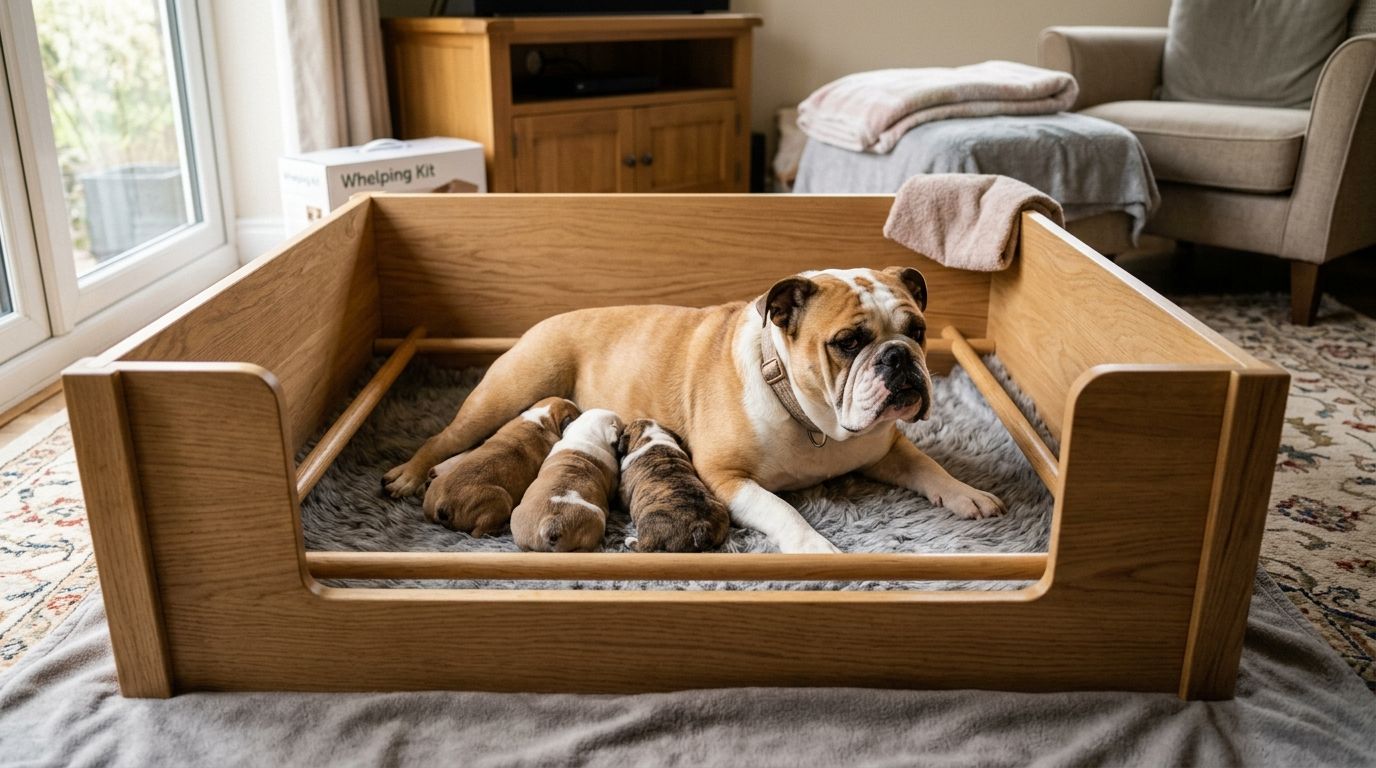
If you're setting up for a litter this year, the whelping box you choose determines whether your dam recovers well and your bulldog puppies survive the first fragile week. The best bulldog whelping box in 2026 is a low-sided, non-slip box with pig rails, room for the dam to stretch out fully, and a heat source that holds newborns at 85-90°F for the first several days. The hidden cost most breeders miss isn't the box itself, it's the bedding and heat lamp setup you'll go through daily until the litter is weaned, plus the laundry.
TL;DR
A bulldog whelping box needs pig rails set 3-4 inches off the floor to stop overlay deaths.
Bulldog litters average 3-6 puppies delivered by C-section, so the box has to work for a groggy, recovering dam from hour one.
Ambient box temperature should sit at 85-90°F for the first week, then step down as puppies grow.
Wood and reinforced plastic whelping boxes both work in 2026 – the material matters less than the rails and the flooring.
Puppies open their eyes around day 10-14, which is roughly when you can start easing the box size down.
Whelping box numbers that matter
85-90°F
Box temperature, days 1-7
3-4 inches
Pig rail height off the floor
3-6 puppies
Typical bulldog litter size
Why this matters
We've whelped a lot of litters over the years, and the box is never the part new breeders think hard enough about. English Bulldogs and French Bulldogs almost always need a C-section to deliver, which means your dam comes home groggy, sore, and clumsy for the first day or two. A whelping box built for a breed that whelps naturally standing up isn't built for that. Get the box wrong and you're looking at crushed puppies, chilled puppies, or a dam who can't settle because she can't get comfortable.
How do you choose the best whelping box for a bulldog breeding program?
Start with the rails, not the size. Pig rails (sometimes called guard rails) run along the inside walls a few inches off the floor and give a newborn puppy somewhere to squeeze when a heavy, recovering dam rolls or shifts her weight. Without them, overlay is one of the top causes of early puppy loss in short, wide-bodied breeds like bulldogs.
Box type
Best for
Verdict
Solid wood whelping box
Breeders who whelp the same room every season
Buy
Reinforced plastic/kiddie pool style
Easy cleanup between litters, smaller programs
Buy
Cardboard or DIY box
One-time or emergency use only
Skip
Open-top plastic tub with no rails
Any bulldog litter
Skip
A solid box with rails, non-slip flooring, and enough surface area for the dam to lie fully extended with room to spare is the baseline. Everything past that is preference.
Wood whelping boxes
Wood holds heat better than plastic and doesn't slide around on a hardwood or tile floor, which matters when a heavy English Bulldog dam is climbing in and out. It's harder to disinfect between litters and it will eventually need replacing if you're running multiple litters a year. Verdict: Buy, especially if this is a box you'll reuse season after season in the same whelping room.
Reinforced plastic or kiddie-pool style boxes
These wipe down fast, don't absorb odor the way wood does, and work well for breeders running more than one litter through the same space in a given year. The tradeoff is they hold less heat on their own, so you're leaning harder on a heat lamp or heating pad to keep the box in that 85-90°F range for the first week. Verdict: Buy, if you're prioritizing sanitation over insulation.
DIY or cardboard boxes
We get why new breeders reach for these, they're free and fast. But cardboard collapses when wet, has no rails, and won't hold a heat source safely. Verdict: Skip, this isn't the place to improvise for a breed that already needs extra help surviving week one.
Why bulldog whelping box needs vary
No two litters need the exact same setup, and the differences aren't random. Factors that change what your box needs to do:
Litter size – a litter of 6 needs more usable floor space than a litter of 3, even in the same breed.
C-section recovery – a dam coming off surgery needs lower sides she can step over without straining her incision.
Brachycephalic breathing – bulldogs overheat fast, so ventilation and a way to regulate the heat lamp matters more than in longer-nosed breeds.
Flooring at home – tile and hardwood need a box with real grip on the bottom or the whole thing skates when the dam shifts.
Room temperature outside the box – a drafty whelping room means you need a stronger heat source inside the box to hold that 85-90°F range.
How many litters you whelp per year – programs running several litters lean toward easy-clean plastic over wood.
“The rails matter more than the material – a beautiful wood box with no pig rail is still the wrong box for a bulldog litter.”
How big should a whelping box be for a bulldog?
The box needs to be large enough for the dam to lie down fully stretched out with room left over, not just curled up. Undersized boxes are one of the fastest ways to end up with crushed or chilled puppies in a litter this size. If you're unsure, size up rather than down, since a bulldog dam recovering from a C-section needs room to maneuver without straining.
When do you set up the whelping box before a bulldog gives birth?
Get the whelping box set up and the dam sleeping in it at least a week before her due date so she's comfortable with it before labor starts. This also gives you time to test the heat source and confirm the box holds a steady 85-90°F range before you actually need it.
Do bulldogs need a heat lamp in the whelping box?
Yes, bulldogs need a heat source in the whelping box for the first one to two weeks, since newborn puppies can't regulate their own body temperature yet. Keep the lamp positioned so puppies can move away from it if they get too warm, and start stepping the temperature down gradually as the puppies' eyes open around day 10-14.
If you're serious about running a breeding program past a single litter, the box is one piece of a much bigger picture that includes choosing the right stud. Our guide on how to choose a bulldog stud for your breeding program walks through what actually matters in that decision beyond pedigree paperwork.
Planning your next litter?
Reserve a puppy from an upcoming litter with a deposit.
What is the best whelping box for a bulldog in 2026?
The best bulldog whelping box in 2026 has pig rails 3-4 inches off the floor, non-slip flooring, and enough room for the dam to lie fully extended. Wood and reinforced plastic both work well, the rails matter more than the material.
How much space does a bulldog need in a whelping box?
A bulldog dam needs enough space to lie down fully stretched out with room to spare, not just curled up. Undersized boxes increase the risk of crushed or chilled puppies in a litter of 3-6.
Do you need pig rails for a bulldog whelping box?
Yes, pig rails set 3-4 inches off the floor are one of the most important safety features in a bulldog whelping box. They give newborn puppies somewhere to squeeze when a recovering dam shifts her weight.
How warm should a bulldog whelping box be?
A bulldog whelping box should stay at 85-90°F for the first week after birth. Step the temperature down gradually as puppies grow and start regulating their own body heat.
Is wood or plastic better for a bulldog whelping box?
Wood holds heat better and grips better on hard floors, while plastic cleans faster between litters. Both are a Buy for 2026 bulldog litters as long as the box has pig rails and non-slip flooring.
When should you set up a whelping box before a bulldog’s due date?
Set up the whelping box at least a week before the due date so the dam is comfortable sleeping in it before labor starts. This also gives you time to confirm the heat source holds a steady 85-90°F.
How many puppies does a bulldog litter usually have?
Bulldog litters typically run 3-6 puppies, smaller than many breeds, largely because English and French Bulldogs are delivered by C-section. Box size should still account for the higher end of that range.
Can you use a cardboard box for whelping bulldog puppies?
No, cardboard collapses when wet, has no pig rails, and can’t safely hold a heat lamp. It’s a Skip for any bulldog litter, use a solid wood or reinforced plastic box instead.
One last thing
The detail breeders skip most often isn't the box, it's testing the heat source for a full 24 hours before the dam ever goes into labor. A heat lamp that drifts even a few degrees below 85°F overnight is enough to chill a newborn bulldog puppy fast, and you won't know it's happening until you're already troubleshooting a distressed litter at 3 a.m. Run the test now, not the night labor starts.
Picking a healthy bulldog puppy from a litter comes down to five checks you can run in about ten minutes: eyes, breathing, gums, body condition, and movement. Get those right at the breeder's home and you skip most of the surprises that show up as vet bills six months later.
TL;DR
Bright clear eyes, quiet breathing at rest, and pink gums are the fastest health signals in a litter.
Ask for hip, patella, and tracheal screening results before you choose a puppy, not after.
A healthy bulldog puppy in 2026 still needs an independent vet check within 72 hours of pickup.
Skip any puppy that’s lethargic, pot-bellied, or breathing loudly while resting.
Weight and energy vary naturally within a litter — health markers matter more than size.
Why this matters
Bulldogs carry more built-in health variables than most breeds — narrow airways, tight skin folds, compact spines. That means the difference between a thriving puppy and a puppy headed for vet visits in year one often shows up in the first eight weeks, before any paperwork gets signed.
A reputable breeder vets themselves as much as they vet buyers, which is really the first filter. But even from a solid breeder, litters aren't uniform — some puppies nurse better, some come out with slightly different jaw or hip development, and picking blind means picking on looks alone. 2026 buyers have more access to genetic testing and video calls than buyers did even five years ago, so there's no excuse for skipping the checks below.
How to pick a healthy bulldog puppy from a litter
Run this sequence in person or over video before you commit to a specific puppy:
Watch the whole litter play for 10 minutes first. A healthy bulldog puppy is curious, mobile, and recovers fast after a stumble. One that hangs back, sleeps through the group, or gets knocked over and stays down is worth a second look, not an automatic pick.
Check eyes and ears. Eyes should be clear with no green or yellow discharge; a cloudy film or squinting can point to early cherry eye, which is common enough in the breed that breeders should already be watching for it.
Check gums and teeth. Gums should be solid pink, not pale or bluish. Pale gums at 8 weeks can signal parasites or poor nutrition transfer from the dam.
Listen to breathing at rest. Bulldog puppies snore and grunt — that's normal anatomy. Loud, labored breathing while calm and asleep is not, and it's an early flag for brachycephalic airway issues that get worse, not better, with age.
Feel the body condition. Ribs should be felt but not seen, and the belly shouldn't look tight and distended after eating — a hard, swollen belly at 8 weeks is a classic parasite sign.
Watch the walk. A slight bulldog waddle is normal breed movement. A hop, a hitch in one back leg, or reluctance to put weight on a leg is not, and it deserves a hip and patella conversation before you go further.
Ask for the paperwork. Health testing results, vet records, and AKC registration papers should exist before you pick, not get promised after.
"The pushiest puppy in the litter isn't always the healthiest one — energy and confidence are a personality trait, not a health score."
“The pushiest puppy in the litter isn’t always the healthiest one — energy and confidence are a personality trait, not a health score.”
What health screening should back up your checklist
A visual check tells you what's happening at 8 weeks. Genetic and orthopedic screening tells you what's coming later. Ask which of these the breeder actually runs, and get the results in writing, per the health testing panels reputable breeders should offer:
Verdict: a bulldog puppy that passes the 10-minute physical check and comes with documented hip, patella, and parent screening is the safer pick — a puppy that's cute but has none of that paperwork is a gamble, not a guarantee.
Why puppies in the same litter differ in health
Same parents, same birth date, same environment — and litters still vary. The reasons are consistent across bulldog litters:
Birth order and birth weight. Puppies born later or smaller in a large litter sometimes start with less colostrum and take longer to catch up developmentally.
Nursing position. Puppies that consistently nurse on stronger teats tend to gain weight faster in the first two weeks.
Parent genetics. Hip, patella, and airway traits are inherited — a sire or dam with clean screening results lowers the odds across the whole litter, but doesn't guarantee uniformity.
Individual anatomy. Skull and jaw structure varies puppy to puppy even within one litter, which is why evaluating skull and jaw health before buying matters as much as the general physical check.
Age at evaluation. A puppy assessed at 6 weeks looks different than the same puppy at 9 weeks — most reputable placements happen at 8 weeks for a reason.
Related questions
What age should you evaluate a bulldog puppy before choosing?
Eight weeks is the standard age to evaluate and place a bulldog puppy, since it's old enough for a full physical check and initial vaccinations but early enough that habits and socialization are still forming. Evaluating earlier than 6 weeks makes health markers less reliable because puppies are still developing basic coordination.
Is a smaller puppy in the litter less healthy?
Size alone does not equal poor health in a bulldog litter — some puppies are simply smaller by genetics or birth order and catch up fine on the standard bulldog puppy vaccination schedule. What matters more than size is energy level, breathing, and gum color, all of which apply regardless of a puppy's spot on the scale.
Should you pick the most active puppy in the litter?
The most active puppy is not automatically the healthiest one — activity reflects temperament and confidence more than physical health. A quieter puppy that eats well, breathes quietly, and moves without a limp can be just as sound as the one bouncing off the walls.
Once you've picked a puppy that clears every check above, lock the paperwork down before anything changes hands.
Reserve before the litter fills
Hold your spot with a deposit once you’ve picked your puppy.
Shrinkabulls runs health checks and screening on every litter before puppies are ever matched to a home, which is exactly the standard this checklist assumes a buyer should expect from any bulldog breeder in 2026. A healthy bulldog puppy from a screened litter and a healthy-looking bulldog puppy from an unscreened one can look identical at 8 weeks — the paperwork is what tells them apart.
FAQ
How do you pick a healthy bulldog puppy from a litter?
Check clear eyes, quiet breathing at rest, pink gums, a soft (not distended) belly, and a steady walk without a limp. Ask for hip, patella, and parent DNA screening results before choosing, not after.
What are warning signs of an unhealthy bulldog puppy?
Loud labored breathing at rest, pale or bluish gums, a hard swollen belly, discharge from the eyes, and reluctance to bear weight on a leg are the main warning signs. Any one of these is worth a vet opinion before you commit.
What age is best to choose a bulldog puppy?
Eight weeks is the standard age for evaluating and placing a bulldog puppy. It’s old enough for a reliable physical check and initial vaccinations, but early enough that the puppy hasn’t fully set its habits with its litter.
Do bulldog puppies need genetic testing before you buy?
Reputable bulldog breeders test parents for hip, patella, and inherited conditions before breeding and share results with buyers. A puppy without any documented parent screening is a bigger unknown regardless of how healthy it looks at 8 weeks.
Is snoring normal in a bulldog puppy?
Yes, mild snoring and grunting are normal bulldog anatomy tied to their shorter airway. Loud, labored breathing while resting and calm is not normal and should get a vet opinion.
Can you tell a bulldog puppy’s health over a video call?
A video call shows you activity level, breathing sounds, gum color, and movement, which covers most of the visual checklist. It can’t replace a hands-on vet exam, so treat video screening as the first filter, not the final one.
Should you avoid the runt of a bulldog litter?
Not automatically — a smaller puppy isn’t unhealthy by default, since size often comes down to birth order rather than a health defect. Judge the runt on the same eyes, gums, breathing, and movement checklist as every other puppy in the litter.
One last thing
The single most overlooked check isn't visual at all — it's asking to see the dam interact with her litter. A dam that's alert, at a healthy weight, and comfortable around her puppies at 8 weeks tells you more about the litter's overall care than any single puppy's individual checklist score.
Pied English Bulldog puppies are the coat that stops color enthusiasts mid-scroll — a white base broken up by uneven patches of fawn, brindle, black, or blue — and no two pups in the same litter wear the pattern identically. That unpredictability is exactly why collectors chase pied over a standard solid coat: every puppy is a one-off, and the appeal is visual first, pedigree second.
TL;DR
Pied English Bulldog puppies get their patched look from a recessive piebald spotting gene, not a fad trend.
Best for collectors who want a coat no littermate matches — skip it if you need a guaranteed symmetrical pattern.
Reserve early in 2026: patterned litters at Shrinkabulls move faster than solid-color litters.
Health screening matters more than pattern rarity — ask for the same panels you’d request on any English Bulldog puppy.
Why pied English Bulldog puppies matter for color enthusiasts
Color enthusiasts don't shop the way a first-time owner shops. They're not just picking a puppy — they're picking a specific pattern expression, and pied delivers something merle, lilac, and blue can't: visible, individual variation within a single litter. Two pied littermates from the same parents can carry patches in completely different placements, which is the entire draw for someone building a collection or simply wanting a bulldog that photographs like no one else's.
At Shrinkabulls, this is the crowd that reads a pedigree chart before they ask about temperament. They already know pied is a recessive spotting pattern, and they want proof it's bred intentionally rather than accidentally landed on. That's a different buyer than someone choosing between merle, lilac, or blue for the first time — the pied buyer is usually further along in the decision, comparing patterns against each other, not colors against a plain fawn coat.
Finding and buying a pied English Bulldog puppy
Learn the pied pattern genetics before you shop
Piebald spotting in bulldogs comes from a recessive gene at the S locus — both parents can carry it without showing heavy patching themselves, which is why pied puppies sometimes appear in litters where neither parent looks strongly pied.
Ask whether the sire and dam are pattern-tested or just visually pied
Understand that patch placement can't be predicted or reserved before birth
Know that pied is a coat pattern, not a separate breed variety, so structure and health standards don't change
Recognize that heavier patching (more white) is not automatically "rarer" or healthier than lighter patching
Compare pied against other rare English Bulldog colors
Color enthusiasts rarely stop at one pattern in their research — they cross-shop pied against blue, lilac, merle, and tri before deciding.
List the two or three patterns you're actually deciding between, not five
Weigh predictability (solid colors) against uniqueness (pied, merle, tri)
Check whether the breeder actually has both patterns available, not just marketing photos of one
Factor in that some patterns, like merle, carry documented health considerations that pied does not
Vet the breeder's pedigree and papers
A pied puppy is only as good as the lines behind it. Pull the paperwork before you get attached to a photo.
Request the full four-generation pedigree, not just the parents' names
Confirm AKC registration status directly rather than trusting a listing photo
Cross-check the breeder's claimed lines against public AKC records when possible
Ask health-specific questions before you commit
Pattern is cosmetic. Structure and airway health are not. Don't let a striking coat distract you from the questions that actually matter for a bulldog's quality of life.
Ask what health testing panels were run on both parents
Ask directly about hip, skull, and airway screening, not just "they're healthy"
Ask for vet records on the specific puppy, not just the litter in general
Ask how the breeder handles a puppy that develops an issue after sale
Reserve your puppy the right way
Patterned litters at popular breeders sell out faster than solid-color litters in 2026, simply because there are fewer visually distinct puppies per litter to go around.
Confirm what a deposit actually secures — a spot in line, or a specific puppy
Get the reservation terms in writing before sending any money
Ask when photos and pattern updates get sent as the puppy develops
Understand the pickup or delivery timeline before you commit a deposit
Budget for the true cost of a patterned puppy
Rare patterns often carry a premium over solid colors, and color enthusiasts need to budget for that before falling for a specific puppy. A breakdown of what rare color puppies really cost is worth reading before you start comparing listings, since pattern rarity pricing varies more than most first-time buyers expect.
Separate the puppy cost from ongoing vet, food, and grooming costs
Ask what's included in the price — health guarantee, first vaccinations, microchip
Compare pricing across at least two or three reputable breeders before deciding
Budget for skin fold and wrinkle care, which applies to every English Bulldog regardless of pattern
Prepare your home before pickup day
A pied puppy needs the exact same setup as any other English Bulldog puppy — the pattern doesn't change the care requirements.
Set up a designated potty and crate area before the puppy arrives
Puppy-proof low cabinets and cords the way you would for any breed
Stock flooring that won't slip under a heavy, low-slung body
Line up a vet appointment for the first week home
Pied vs. other rare English Bulldog colors
Option
Best for
Key limitation
Pied English Bulldog
Collectors who want visible pattern variety within a litter
Patch placement can't be predicted or reserved in advance
Solid-color English Bulldog (fawn, red, white)
Buyers who want a predictable, uniform coat
Less visual rarity, so it blends into a broader collection
Merle English Bulldog
Enthusiasts chasing the rarest documented coat genetics
Carries known health considerations that require careful breeder vetting
Black tri English Bulldog
Buyers who want dark, high-contrast markings
Tri points can shift slightly in shade as the puppy matures
Verdict: pied is the best pick for color enthusiasts who want a coat that reads as one-of-a-kind without the added health scrutiny that comes with merle.
Common mistakes color enthusiasts make
Choosing pattern over pedigree. A striking patch layout means nothing if the parents weren't health tested.
Assuming heavier white patching is automatically rarer. Patch coverage varies litter to litter and isn't a rarity metric on its own.
Skipping the AKC verification step. A pattern-focused buyer can get so excited about the coat that they forget to confirm registration is legitimate.
Underbudgeting for the premium. Patterned puppies often cost more than solid colors, and buyers who don't plan for that end up rushing a decision.
Reserving before reading the deposit terms. Excitement over a specific photo leads some buyers to send a deposit before understanding what it actually guarantees.
Reserve your pied puppy the right way
See how deposits and pattern updates work before a litter arrives.
What makes a pied English Bulldog puppy different from a solid-color one?
A pied English Bulldog puppy carries a recessive piebald spotting gene that breaks up the coat into irregular white and colored patches, while a solid-color puppy carries a uniform base coat. Both are the same breed and structure standard — only the pattern differs.
Is pied rarer than merle in English Bulldogs?
Merle is generally considered the rarer and more heavily scrutinized pattern in 2026 due to associated health risks, while pied is a recessive but more commonly bred pattern. Rarity in pied comes from the specific patch layout, not the gene itself.
Can two solid-color parents produce a pied puppy?
Yes, if both parents carry the recessive piebald gene without showing heavy patching themselves. A breeder with a documented pedigree can usually tell you whether this is likely in a given litter.
How much does a pied English Bulldog puppy cost compared to a standard fawn puppy?
Pattern rarity typically adds a premium over a standard fawn or white puppy, though exact pricing varies by breeder and litter. Check current listings directly with the breeder rather than relying on outdated estimates.
Do pied English Bulldogs have more health issues than solid-color ones?
No, pied patterning on its own is not linked to additional health issues the way merle-to-merle breeding is. Health outcomes depend on the parents’ testing and pedigree, not the coat pattern.
How do I verify a pied puppy’s AKC registration before buying?
Request the registration paperwork directly from the breeder and cross-check the parents’ names against AKC records rather than trusting listing photos alone. A reputable breeder will provide this without hesitation.
Should I reserve a pied puppy before it’s born?
Reserving early is common for patterned litters since demand outpaces solid-color litters, but confirm what the deposit actually secures first. A written agreement should specify whether it holds a spot in line or a specific puppy.
What questions should I ask a breeder about a pied litter?
Ask about the health testing panels run on both parents, the AKC registration status, and how patch placement is determined once puppies are born. Pattern questions should come after health questions, not before.
One last thing
The piebald spotting gene is recessive, which means a litter can produce a mix of heavily patched, lightly patched, and near-solid puppies from the exact same two parents — so if you're set on a specific look, ask to see updated photos as the litter grows rather than committing off a newborn picture, since patch coverage often shifts in the first few weeks.



 REVIEWS