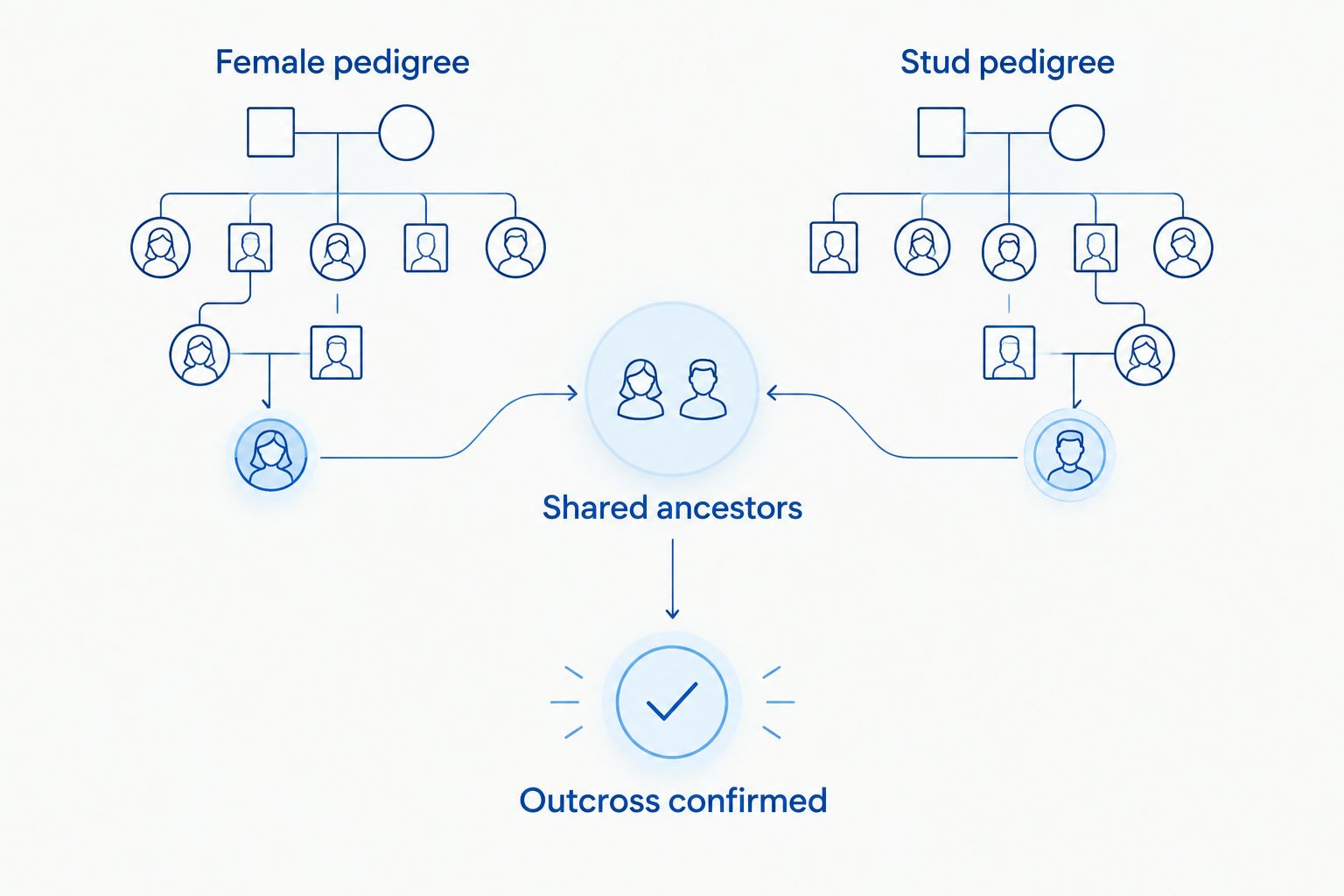
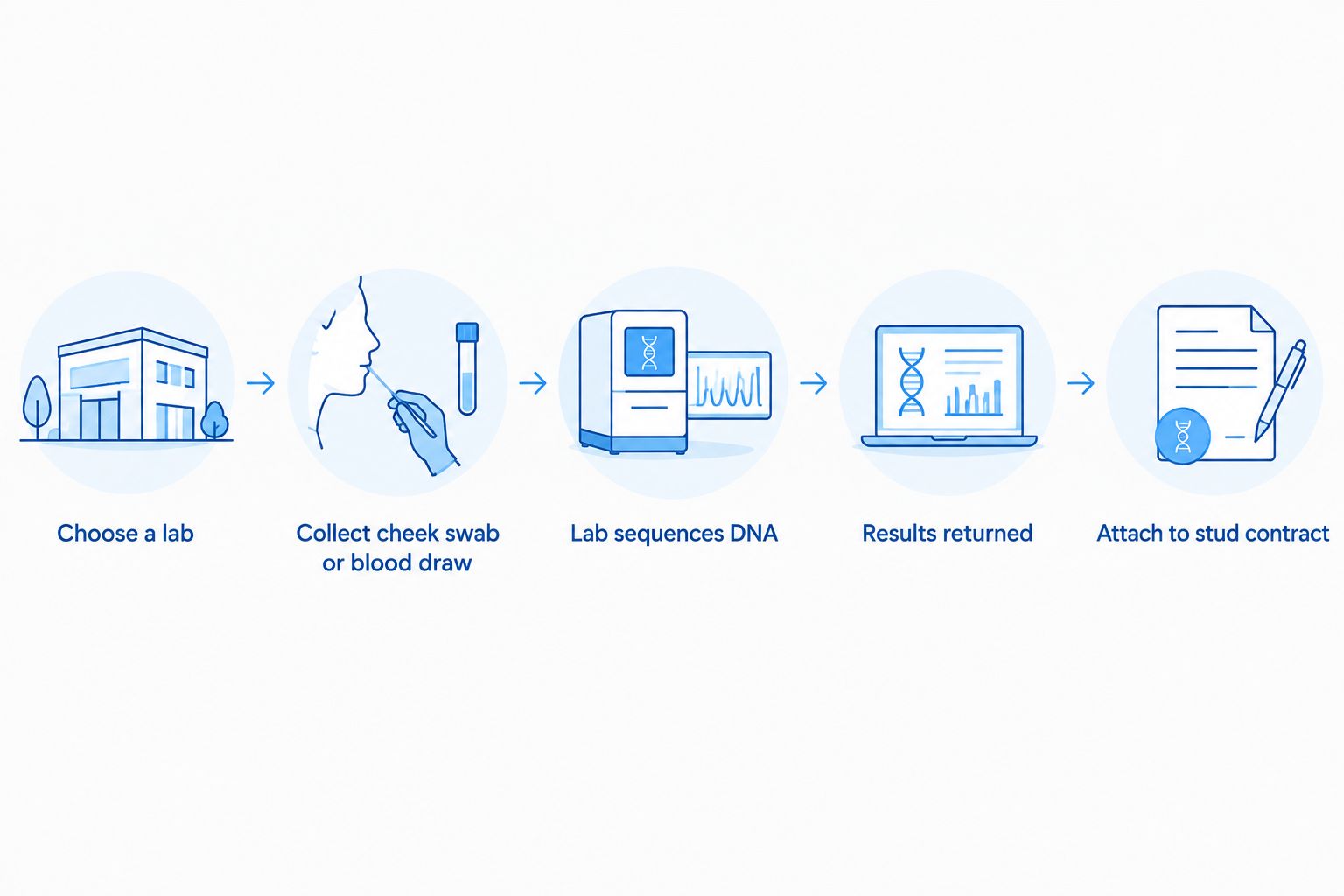
French Bulldog stud service for outcross genetic diversity means booking a male from a bloodline with no shared ancestors in your female's pedigree, specifically to widen the gene pool and pull down the coefficient of inbreeding in the resulting litter. Breeders reach for this when a closed line starts throwing narrower color options or the same health flags generation after generation.
TL;DR
An outcross stud pairing needs zero shared ancestors across 5 generations, not just a different kennel name on the papers.
French Bulldog stud service outcross pairings work best when both dogs carry full DNA color panels, not a visual color guess.
A coefficient of inbreeding at or below 6.25% is the common breeder benchmark before calling a pairing an outcross at all.
A stud contract without a written health-testing clause is the most common outcross mistake breeders make in 2026.
Limited AKC registration on either dog blocks litter registration no matter how far apart the pedigrees run.
Why French Bulldog stud service matters for outcross breeders
Breeders chasing color rarity — merle, lilac, isabella — tend to work inside a small pool of imported or domestic lines, and that pool tightens with every generation of the same handful of studs. A French Bulldog stud service built around outcross genetics exists to break that cycle: the stud is chosen because the pedigree diverges for 5 generations or more, not because he lives two counties over.
That distinction matters more here than for a breeder just looking for convenience. A coefficient of inbreeding (COI) at or below 6.25% — the math equivalent of avoiding a half-sibling match — is the benchmark serious outcross breeders use before calling a pairing anything other than linebreeding with extra steps. Shrinkabulls' french bulldog stud service for rare color breeding programs lists studs by bloodline origin first, because that's the detail an outcross breeder actually needs before color even enters the conversation.
Sign the contract before you arrange travel or shipping, not after
6. Plan whelping and registration paperwork for the outcross litter
Confirm both parents show full, not limited, AKC registration before the litter is whelped
Line up a vet or breeder mentor for a possible C-section consult — brachycephalic litters often need one
Register the litter with both sire and dam papers attached, plus DNA color panel results if the colors are unusual
Have whelping box supplies and monitoring gear ready at least a week before the due date
7. Track the outcome and feed it back into your next pairing
Recalculate the actual COI after the litter arrives, not just before the breeding
Log temperament, structure, and color outcomes against the sire's own line
Decide whether to repeat this exact cross or rotate to a new outcross stud next season
Keep a running file per stud so the next decision isn't starting from zero
Comparing outcross stud options for French Bulldog breeders
Option
Best for
Key limitation
In-house co-owned male
Breeders who already share a bloodline partner
Usually doesn't solve the outcross problem — shared ownership often means shared ancestry
Local outside stud (same region)
Breeders avoiding travel or shipping logistics
Regional gene pools overlap more than owners expect — run the COI first
Shipped semen / AI outcross
Breeders targeting a specific out-of-region or imported bloodline
Requires a vet comfortable with canine AI and a female that settles under sedation
Shrinkabulls French Bulldog stud service
Breeders who want documented pedigree distance and DNA color data upfront
Availability depends on which studs are active in the program when you ask
Common mistakes outcross breeders make
Confusing "different breeder" with "different bloodline." Two kennels can both be selling puppies from the same imported litter three generations back.
Skipping the DNA color panel and getting a surprise merle or dilute carrier. A visual guess at coat genetics isn't a substitute for a panel result.
Booking a stud before confirming full AKC registration. A limited-registration sire blocks the litter from being registered at all, no matter how the pairing looks on paper.
Ignoring the COI math because the stud "looks" unrelated. Distance across 5+ generations with zero shared ancestors is the only number that counts in 2026.
Skipping a written clause for a failed tie or single-puppy litter. Verbal agreements on stud fees fall apart exactly when they're needed most.
“If the COI reads above 6.25%, that pairing isn’t an outcross — it’s a rebrand of the same bloodline.”
Planning an outcross pairing?
Check bloodline and health details before you commit to a stud.
What does "outcross" mean in French Bulldog stud service?
An outcross pairing uses a stud whose pedigree shares no ancestors with the female’s for at least 5 generations. The goal is a lower coefficient of inbreeding and a wider gene pool than a linebred pairing produces.
How do I calculate the COI for a French Bulldog stud pairing?
Pull a full 5-generation pedigree for both dogs and run it through a free COI calculator, the same math breed clubs use. Anything at or below 6.25% is the common benchmark for calling a pairing an outcross.
Is a French Bulldog stud service outcross pairing safer than a linebred one?
An outcross pairing lowers the odds of doubling up on recessive health issues that concentrate in a closed line. It doesn’t remove breed-wide risks like brachycephalic airway issues, which affect outcross and linebred litters alike.
What health tests should a French Bulldog stud have before an outcross breeding?
OFA hip, patella, and cardiac clearances at minimum, plus a DNA color panel and BOAS airway screening if either dog shows visible signs. Ask for dates on every clearance — retest anything older than 2 years.
Can a limited-registration French Bulldog be used as an outcross stud?
No. Limited AKC registration on either parent blocks the resulting litter from being registered at all, regardless of how far apart the pedigrees are.
How many generations back should an outcross stud’s pedigree diverge?
Most serious breeders check 5 generations minimum. Shared ancestors frequently hide in generation 4 or 5 even when a 3-generation pedigree looks completely unrelated.
Does an outcross pairing guarantee healthier French Bulldog puppies?
No pairing guarantees outcomes. An outcross lowers the statistical odds of concentrated recessive issues, but individual puppies still need their own health testing and monitoring.
What’s the difference between a local stud and a shipped-semen outcross?
A local stud is easier logistically but often shares more regional ancestry than owners assume. Shipped semen or AI opens access to a specific out-of-region or imported bloodline but needs a vet experienced with canine AI.
One last thing
A stud that looks completely unrelated on a 3-generation pedigree can still share a great-great-grandsire once the full 5-generation chart comes out. Ask for 5 generations minimum, never 3 — the shared ancestor almost always hides in generation 4 or 5, and that's the detail that turns a planned outcross back into an accidental linebreed.
A French Bulldog stud without documented DNA health clearances is a liability to every litter he sires — this ranks the five panels serious breeders actually pull results from before signing a stud contract in 2026.
TL;DR
Embark Breed + Health Kit is the strongest overall dna health clearance panel french bulldog stud owners should run first, screening 250+ conditions.
UC Davis VGL wins for confirming single-gene risks like DM and HUU with lab-grade accuracy.
OFA stays mandatory for hip, patella, and cardiac certification even though it isn’t a DNA swab test.
Wisdom Panel Premium is the budget combo pick for breed verification plus health screening in one swab.
Paw Print Genetics/Neogen paperwork gets accepted fastest by breed clubs and puppy buyers asking for proof.
Numbers that matter for stud clearances
250+
Conditions in Embark’s panel
24 months
Minimum age for OFA hip rating
2 genes
SOD1 and SLC2A9 confirm DM, HUU
Why this matters
A stud dog with no documented clearances is a gamble for every owner who breeds to him. HUU (hyperuricosuria) and DM (degenerative myelopathy) are both single-gene conditions that show up in French Bulldog lines at higher rates than most owners expect, and neither one is visible on a physical exam.
Breeders vetting a health testing panel to request from a breeder need to know which lab actually tests for which mutation, because "DNA tested" on a stud listing means almost nothing without a named condition and a lab report attached. The wrong assumption here gets passed straight into the next generation of puppies.
Results need to land in the contract, not just in an inbox.
What makes the best DNA health-clearance panel
Breed-relevant mutation coverage — does the panel actually include DM (SOD1) and HUU (SLC2A9), the two mutations most cited in French Bulldog lines
Registry integration — do results feed into OFA/CHIC so buyers can verify them independently
Sample collection method — cheek swab versus blood draw changes cost, stress on the dog, and turnaround
Report clarity — a report a stud owner can attach directly to a breeding contract beats a raw data file
Confirmatory versus broad screening — a wide panel flags risk; a single-gene confirmatory test proves it
Best DNA health-clearance panels for a French Bulldog stud — at a glance
Panel
Best for
Standout feature
Key limitation
Embark Breed + Health Kit
Broad screening before a first stud contract
Screens 250+ genetic conditions from one swab
Doesn't replace OFA hip/patella imaging
UC Davis VGL
Confirming DM and HUU status
Academic-grade single-gene accuracy
No bundled multi-condition panel
OFA
Hip, patella, and cardiac certification
Required for CHIC certification and public registry
Requires the dog to reach 24 months for a final hip rating
Wisdom Panel Premium
Budget-conscious breed ID plus health screen
One swab covers ancestry and health together
Narrower condition list than Embark
Paw Print Genetics/Neogen
Documentation buyers ask for by name
Clean certificate-style report for contracts
Overlaps with Embark/UC Davis if both are ordered
1. Embark Breed + Health Kit: best for broad screening before a first stud contract
Embark's Breed + Health Kit is a cheek-swab test that screens for more than 250 genetic health conditions across breeds, plus breed-mix verification. For a French Bulldog going into stud work for the first time in 2026, it's the widest net available from a single sample.
Embark pros:
Screens a broad panel from one swab instead of ordering conditions one at a time
Simple at-home collection, no vet visit required for the sample itself
Results portal is easy to hand to a prospective breeding partner
Embark cons:
Doesn't cover hip, patella, or cardiac status — that's still an OFA job
A flagged variant of unknown significance can alarm an owner without a genetic counselor's context
Some newly identified French Bulldog-specific markers may lag behind academic research labs
Embark verdict: Buy. Run it first on any stud before he's offered publicly.
2. UC Davis VGL: best for confirming single-gene risks like DM and HUU
The UC Davis Veterinary Genetics Laboratory offers individual, disease-specific DNA tests rather than a bundled panel — order the SOD1 test for DM or the SLC2A9 test for HUU directly. It's the reference lab most veterinary geneticists point to when a broad panel flags something worth confirming.
UC Davis VGL pros:
Diagnostic-grade accuracy trusted for confirmatory testing, not just screening
Pay only for the specific mutation you need tested
Results are widely accepted in academic and veterinary circles
UC Davis VGL cons:
No single all-in-one panel, so you need to already know which genes matter
Sample submission is more manual than a consumer swab kit, and turnaround runs slower
UC Davis VGL verdict: Buy for confirmation, not a first-pass screen.
3. OFA: best for hip, patella, and cardiac certification
The Orthopedic Foundation for Animals isn't a DNA test — it grades radiographs for hips and patellas and reviews cardiac exams, then publishes results to a public registry. A stud dog needs an OFA hip rating alongside his DNA results before he qualifies for CHIC certification.
OFA pros:
Required for CHIC certification, which most serious breeding programs check before booking a stud
Public, searchable registry lets a prospective owner verify results independently
Standardized grading across board-certified radiologists nationwide
OFA cons:
Final hip rating requires the dog to be at least 24 months old, so it can't happen on a young stud's timeline
Radiographs mean sedation and a vet visit, unlike a mail-in swab
Doesn't test for single-gene mutations like DM or HUU on its own
OFA verdict: Buy — non-negotiable before any stud contract closes.
4. Wisdom Panel Premium: best for a budget breed-plus-health combo
Wisdom Panel Premium combines breed-mix verification with a health screening panel in one cheek swab, aimed at owners who want purebred confirmation and a health snapshot without ordering two separate products.
Wisdom Panel Premium pros:
One swab covers both breed verification and a genetic health screen
Straightforward consumer app and report format
Useful as a lower-cost starting point before deeper testing
Wisdom Panel Premium cons:
Covers fewer conditions than Embark's broader panel
Some French Bulldog-relevant mutations may not be included
Less commonly cited in formal stud contracts than Embark or UC Davis results
Wisdom Panel Premium verdict: Hold as a starting screen, not a final answer.
5. Paw Print Genetics/Neogen Canine Genetic Health Panel: best for documentation buyers ask for by name
Neogen's Canine Genetic Health Panel (built from the former Paw Print Genetics lab) produces certificate-style reports for named mutations, the format most often requested when a puppy buyer or breed club wants clearances attached to a contract in writing.
Paw Print Genetics/Neogen pros:
Clean, certificate-style reports that attach directly to a stud contract
Covers many of the same French Bulldog-relevant mutations as competing labs
Accepted as documented proof by breed clubs
Paw Print Genetics/Neogen cons:
No breed-mix ancestry component the way consumer kits offer
Ordering it after already running Embark or UC Davis is redundant coverage
Turnaround depends heavily on how many mutations are requested
Paw Print Genetics/Neogen verdict: Buy when a contract specifically calls for a named-mutation certificate.
How we ranked these
Each panel was weighed against the five criteria above: French Bulldog-relevant mutation coverage, registry integration, sample method, report clarity, and whether it screens broad or confirms a specific gene. No panel wins on every axis — that's why serious breeders run more than one across a stud's working life, and why picking a bulldog stud for a breeding program means checking documentation, not just a listing photo.
Which DNA health-clearance panel should you choose?
For most French Bulldog stud owners in 2026: run Embark first for broad screening, confirm any flagged single-gene risk through UC Davis VGL, and never skip OFA hip and cardiac clearance before a contract is signed. Add a Paw Print Genetics/Neogen certificate only when a specific buyer or breed club asks for that exact document format.
Planning a stud match this season?
Walk through clearance documentation before you commit to a breeding.
What is a DNA health clearance panel for a French Bulldog stud?
It’s a lab test, usually from a cheek swab, that screens for genetic health conditions like DM and HUU before a dog is used for breeding. Results get attached to stud contracts so owners can verify a dog’s genetic health status in writing.
Is Embark or Wisdom Panel better for a French Bulldog stud test?
Embark screens a wider list of conditions from one swab, which makes it the stronger first-pass test. Wisdom Panel Premium works as a lower-cost combined breed-and-health screen but covers fewer conditions overall.
Does a French Bulldog stud need OFA clearance if he already has DNA results?
Yes. DNA panels don’t evaluate hips, patellas, or cardiac status, so OFA radiograph clearance stays required for CHIC certification alongside any DNA results.
How much does a DNA health-clearance panel cost?
Pricing varies by lab and by how many conditions are tested, so check current pricing directly with the lab before ordering.
What genetic diseases matter most for French Bulldog studs?
DM (degenerative myelopathy, tied to the SOD1 gene) and HUU (hyperuricosuria, tied to the SLC2A9 gene) are the two most commonly cited single-gene risks in French Bulldog lines. Chondrodystrophy-related spinal risk is also worth screening.
How old does a French Bulldog need to be for OFA hip certification?
OFA requires a dog to reach 24 months of age before a final hip rating is issued. Preliminary evaluations can happen earlier but aren’t the certified result breeders rely on.
Can DNA test results be added to a stud contract?
Yes, and they should be. A named-mutation report from a lab like UC Davis VGL or Paw Print Genetics/Neogen attaches cleanly to a written stud contract as documented proof.
What is HUU and why does it matter for French Bulldogs?
HUU (hyperuricosuria) is a genetic condition tied to the SLC2A9 gene that raises the risk of urate bladder stones. French Bulldog lines carry this mutation at higher rates than many breeds, making it a priority test for any stud.
One last thing
OFA hip certification can't happen until a dog is 24 months old, but DNA-based HUU and DM results can be run as early as 8 weeks — meaning genetic clearances on a French Bulldog stud start years before he's even old enough for a hip rating. Order the DNA panel first, then build the OFA timeline around it, not the other way around.
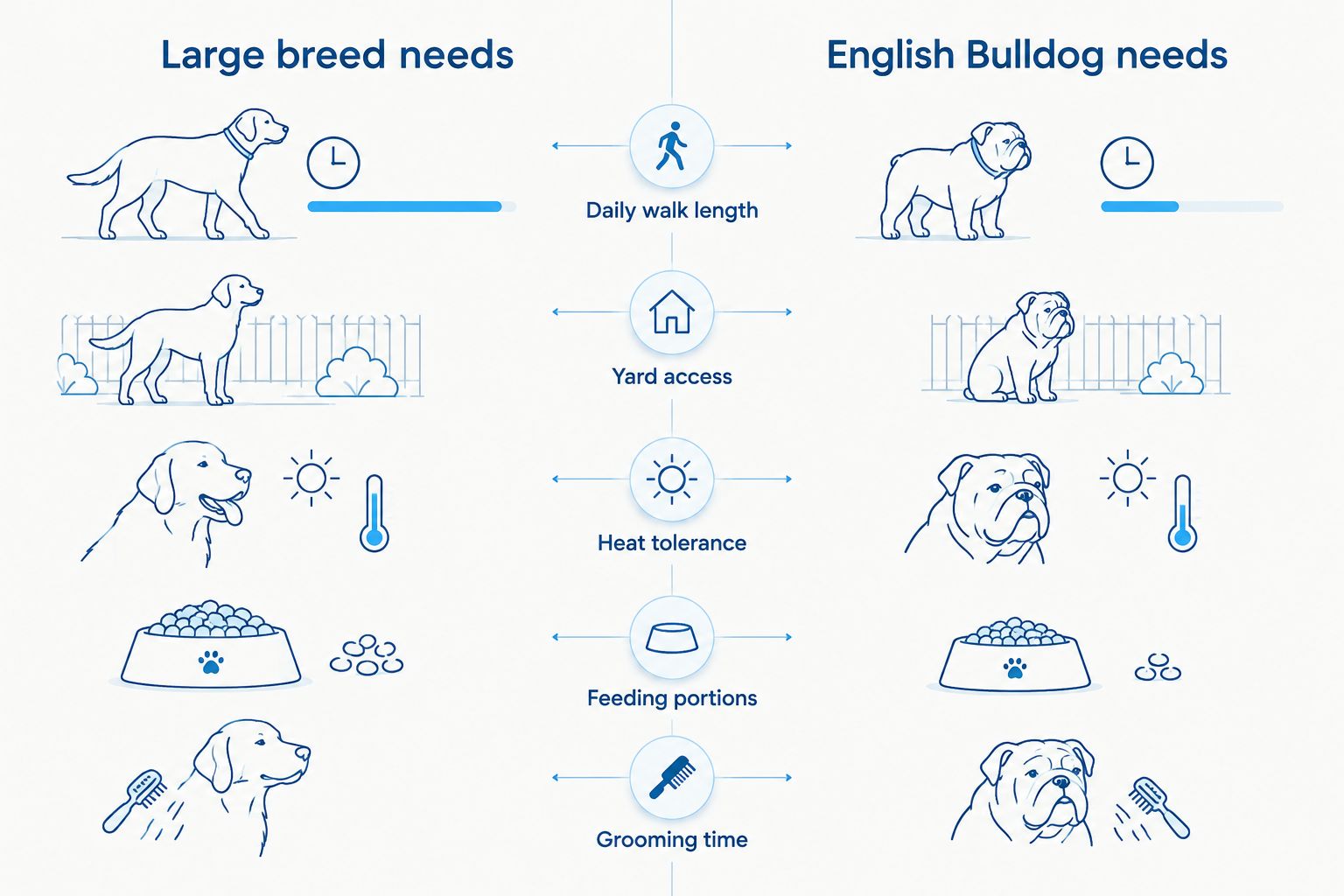
Owners downsizing from a larger breed to an English Bulldog puppy in 2026 are trading a 55-90 lb dog for a compact companion built for smaller homes, shorter walks, and a calmer daily rhythm. The transition isn't just about size on paper — exercise tolerance, heat sensitivity, and feeding volume all shift at the same time, and most of the mistakes downsizing owners make come from assuming "smaller dog" means "same care, less of it."
TL;DR
English Bulldog puppies for owners downsizing from a larger breed swap a 55-90 lb dog for a 40-50 lb companion with lower exercise needs.
Shrinkabulls breeds AKC-registered English Bulldog puppies suited to smaller living spaces and shorter, gentler walks.
Heat and airway sensitivity replace stamina and yard space as the top planning concern after downsizing.
Litters at Shrinkabulls fill on deposit before birth, so early reservation matters more than breed size when timing your switch.
Size shift at a glance
40-50 lbs
Typical adult English Bulldog weight
55-90 lbs
Common large-breed adult weight
Why English Bulldog puppies matter for owners downsizing from a larger breed
Most downsizing conversations start after a knee surgery, a move to a smaller property, or simply not wanting to walk 60 lbs of Labrador at 6am anymore. The empty-nest household is one of the most common downsizing profiles we see, and the reasons are almost always physical: less yard, less time, less tolerance for a dog that pulls on the leash.
An English Bulldog puppy in 2026 solves that with a body built low and wide rather than tall and fast. There's no invented magic here — it's the AKC breed standard doing the work: a thick-set, low-swung frame that simply doesn't need the mileage a working or sporting breed does.
That doesn't mean lower maintenance across the board. Skin folds, breathing, and heat all need attention that a Labrador or a German Shepherd owner never had to think about. The segment that struggles most isn't the one that under-researches — it's the one that assumes the downsizing math only runs in one direction.
Step 1: Reset your exercise expectations
Drop the mileage habit first. A large breed owner is used to structuring the day around a 30-45 minute walk or a yard sprint session; an English Bulldog puppy does better on frequency over distance.
Swap one long walk for two or three short 10-minute walks
Move outdoor time to early morning or evening once temperatures climb
Watch for open-mouth breathing or gagging sounds as a stop signal, not a push-through signal
Keep play sessions on soft or shaded ground, not asphalt in direct sun
Track panting recovery time — a bulldog that doesn't settle in 10-15 minutes after light play needs a vet check, not more exercise
The line items that change most when downsizing are exercise length and heat tolerance, not the dog’s overall workload.
Step 2: Right-size your home setup
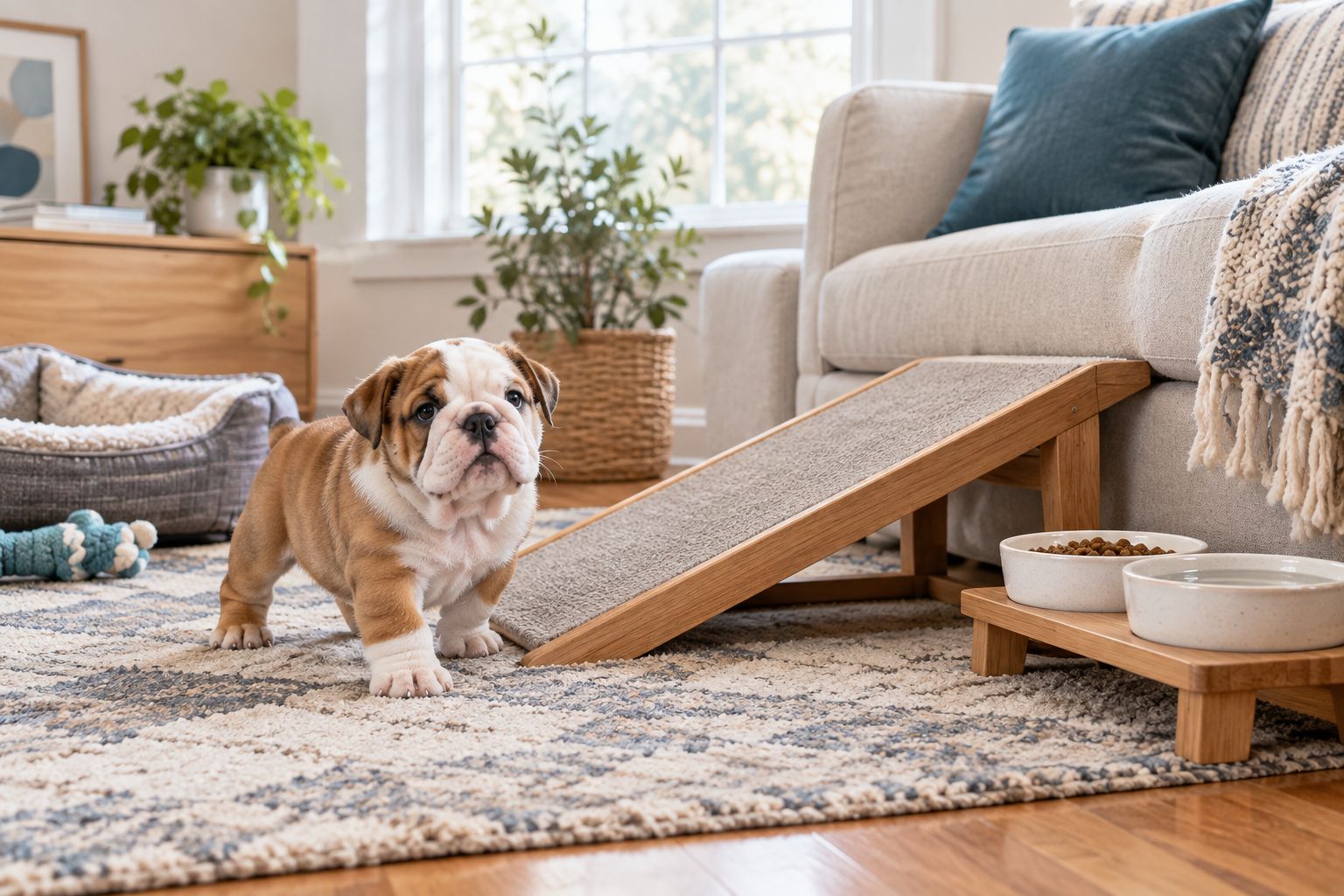
A large-breed household usually has wide floor space and maybe a dog door to a yard. That layout doesn't automatically suit a bulldog puppy — hardwood and tile are harder on a low, heavy-chested frame than most owners expect, and jumping on and off furniture puts real strain on young joints.
Add rugs or rubber-backed runners on any hard flooring the puppy crosses daily
Use a low ramp or step for couches and beds instead of allowing jumps
Set the water and food bowls at a slightly raised height to ease neck strain during eating
Keep the sleeping area away from heating vents and direct sun through windows
Traction and joint protection matter more than square footage once the household downsizes to a bulldog.
Step 3: Adjust your budget line items
A smaller dog doesn't mean a smaller bill — it means a different bill. Large-breed owners are used to budgeting for volume: more food, bigger crates, higher-dose flea and heartworm treatment. English Bulldog owners redirect that budget toward skin care, wrinkle maintenance, and breathing-related vet visits instead.
Plan for wrinkle and fold cleaning supplies as a recurring cost, not a one-time purchase
Set aside funds for a vet familiar with brachycephalic anatomy, since routine visits often run longer
Price pet insurance early, before any condition becomes pre-existing
Budget for a smaller food volume but a potentially pricier limited-ingredient formula if skin sensitivity shows up
Reprice your annual vet reserve using a true first-year estimate rather than your last dog's numbers
Rare-color English Bulldog lines carry their own cost structure that has nothing to do with size — worth a separate look if a merle, lilac, or blue puppy is on your shortlist.
Step 4: Prepare for brachycephalic health differences
This is the step most large-breed owners skip, and it's the one that matters most. A Labrador or a Shepherd rarely struggles to breathe on a warm afternoon. An English Bulldog puppy can, and 2026 heat advisories don't care what breed you're used to managing.
Learn the early signs of overheating specific to short-nosed breeds: loud snoring-like breathing at rest, blue-tinged gums, collapse after mild activity
Keep a cooling mat or damp towel on hand for warm-weather months
Schedule outdoor time around temperature, not habit
Ask about airway assessment at the first vet visit, not just vaccinations
Learn to recognize skin fold irritation early, since it's far more common in bulldogs than in most large breeds
Step 5: Vet the breeder before you reserve
Downsizing owners often research the breed heavily and the breeder lightly, because their last dog came from a shelter or a big-box pet store. A purebred English Bulldog puppy needs the opposite order of operations.
Confirm AKC registration paperwork before any deposit changes hands
Ask to see both parents' health testing, not just photos of the litter
Request a video call with the breeder if an in-person visit isn't possible
Get the health guarantee in writing before signing anything
Ask directly about hip, elbow, and airway screening results on the sire and dam
Shrinkabulls breeds AKC-registered English Bulldog puppies with full health documentation available before a deposit is placed — the same standard should apply no matter which breeder a downsizing family chooses.
Step 6: Plan the homecoming transition
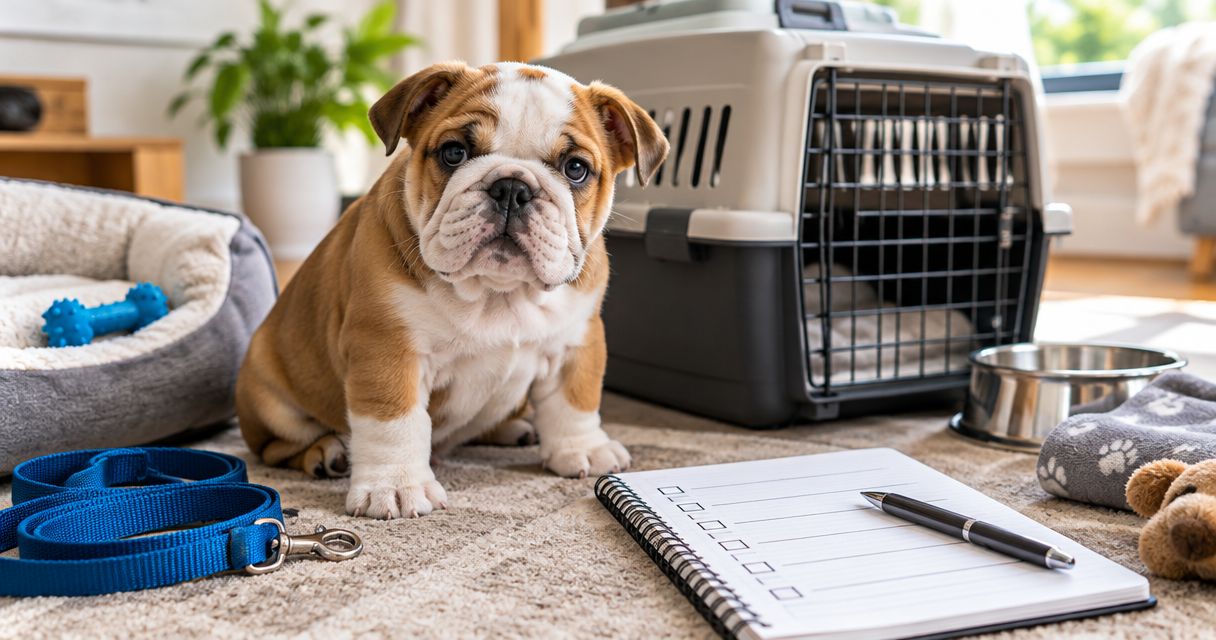
The last mile of downsizing is logistical, not medical. A large-breed household typically has an oversized crate, a heavy-duty leash setup, and feeding gear scaled for a much bigger dog — almost none of it transfers.
Downsize crate hardware before puppy pickup day, not after
Swap any harness or collar gear built for pulling strength to a brachycephalic-safe design
Introduce resident pets slowly over the first week rather than in one meeting
Keep the first few days low-stimulation — new smells and a new house are enough change on their own
Confirm pickup or delivery logistics with the breeder at least two weeks ahead
Reserve your puppy before birth
Lock in a spot on an upcoming English Bulldog litter with a deposit.
Which bulldog option fits a downsizing household best
Option
Best for
Key limitation
Standard English Bulldog puppy
Owners wanting the full breed-standard size and temperament
Heat sensitivity and breathing management required year-round
Miniature English Bulldog
Smaller living spaces where floor space is the top constraint
Fewer breeders specialize in the smaller line
Retired adult English Bulldog
Owners who want to skip the puppy stage entirely
Limited availability compared to puppies
French Bulldog puppy
Owners downsizing further, into apartments or single-room living
Even more airway sensitivity than an English Bulldog
Verdict: a standard English Bulldog puppy is the right downsizing move for most large-breed owners in 2026 — the breed's low-swung, thick-set frame delivers the size reduction without asking the household to relearn an entirely different temperament.
Common mistakes downsizing owners make
Assuming lower energy means lower attention. English Bulldog puppies still need daily skin, fold, and breathing checks a Labrador owner never had to run.
Buying large-breed gear "just in case." Oversized crates and harnesses built for pulling strength don't fit a bulldog's frame or temperament.
Skipping the heat conversation. A dog that used to handle a midday yard session in July can't do the same thing as a bulldog.
Underbudgeting the vet line. Brachycephalic-experienced vets often charge more per visit, and visits happen more often in year one.
Rushing the reservation. Downsizing families sometimes treat the breeder search like a shelter visit — walk in, pick a puppy, leave. A reputable English Bulldog breeder runs on a reservation and health-testing timeline instead.
FAQ
What’s the best bulldog breed for someone downsizing from a large dog in 2026?
A standard English Bulldog puppy is the most direct downsize from a 55-90 lb breed, landing at roughly 40-50 lbs with a similarly loyal, home-based temperament. Owners wanting an even smaller footprint often move to a French Bulldog instead.
How much smaller is an English Bulldog puppy than a large breed dog?
Adult English Bulldogs typically run 40-50 lbs under the AKC breed standard, compared to 55-90 lbs for many common large breeds. The difference shows up most in exercise needs and feeding volume, not just weight on a scale.
Do English Bulldog puppies need less exercise than large breeds?
Yes, English Bulldog puppies do better on several short walks than one long one, unlike most large breeds built for distance. Heat and airway limits, not laziness, are the reason exercise sessions stay short.
Is an English Bulldog easier to manage in an apartment or small home?
An English Bulldog’s compact, low-energy build generally fits smaller living spaces better than a large breed does. Flooring and joint support still need adjustment, since bulldogs are heavier per inch of height than they look.
What should a downsizing owner budget differently for an English Bulldog puppy?
Expect the budget to shift toward skin fold care, wrinkle maintenance, and a vet experienced with brachycephalic breeds rather than large-volume food and gear. First-year vet visits often run more frequent than a large-breed owner is used to.
Can an English Bulldog puppy live well with an older, downsizing couple?
Yes, the breed’s low exercise requirement and home-based temperament suit retired or empty-nest households well. The main planning point is heat management during outdoor time, not activity level.
What health issues should downsizing owners watch for in English Bulldogs?
Watch for skin fold infections, breathing difficulty in heat, and joint sensitivity given the breed’s heavy, low-swung frame. None of these are unique to downsizing, but large-breed owners often aren’t trained to spot them early.
How do I reserve an English Bulldog puppy before it’s born?
Most reputable breeders, including Shrinkabulls, take a deposit against an upcoming litter once health testing on the parents is confirmed. Ask for AKC registration details and a written health guarantee before the deposit changes hands.
One last thing
The part downsizing owners underestimate most isn't the exercise or the budget — it's the skin. A large-breed dog with a flat coat rarely needs fold cleaning; an English Bulldog puppy does, on a schedule, starting in the first weeks home. Build that habit before pickup day instead of learning it after the first infection, and the rest of the downsize goes smoother than most owners expect in 2026.
Pickup day for a bulldog puppy comes down to seven things: a secured crate for the ride, written health and vaccination records, verified AKC paperwork, a vet appointment booked for 48 to 72 hours out, an overnight bag, a quiet arrival space, and a feeding schedule from the breeder. Skip the paperwork check before you leave the property and you're the one chasing a signed health guarantee three weeks later instead of getting it handled in person.
TL;DR
A bulldog puppy pickup day checklist needs seven items: crate, health records, AKC paperwork, vet appointment, overnight bag, quiet space, feeding schedule.
Verify registration papers and health records in person before leaving the breeder’s property, not after.
Book the first vet visit for 48 to 72 hours after pickup, not weeks later.
English and French Bulldog puppies handle heat and long car rides worse than most breeds, so plan the drive around breathing, not just comfort.
Pickup day numbers
8 weeks
Minimum age at pickup
48-72 hours
Recommended first vet visit window
Why this matters
Bulldogs are brachycephalic, which means heat stress and travel stress hit them harder than most breeds pick up on day one. A puppy pulled from its litter, driven for hours in a warm car, then handed a sudden diet change in the same 24 hours is set up for a rough first week.
Getting the checklist right on pickup day, starting with how you prepare your home for a new French Bulldog puppy, heads off most of the "won't eat" and "won't stop panting" calls breeders field in week one. None of it is complicated. Most of it just needs to happen in the right order, before the drive starts.
Bulldog puppy pickup day checklist
Step
What it covers
Timing
Crate or carrier
Sized for an 8-12 week old bulldog, secured in the back seat
Before you leave home
Health records
Written vaccination and deworming history from the breeder
At pickup
AKC paperwork
Registration verified against markings and microchip
At pickup, in person
Vet appointment
First checkup booked
48-72 hours after pickup
Overnight bag
Puppy pads, current food, a blanket that smells like the litter
Before you leave home
Quiet space
Gated-off area away from other pets and noise
Set up before arrival
Feeding schedule
Written times and amounts from the breeder
At pickup
That table is the whole checklist. The order matters more than the list, though, so walk through it as three phases: before you leave the breeder, the ride home, and the first 24 hours.
Before you leave the breeder
Don't drive off without the paperwork in hand. Ask to see the puppy's AKC registration application, health guarantee, and vaccination record before you sign anything or hand over payment. Verify the microchip number matches the paperwork right there — it takes two minutes and it's the single step new owners skip most often.
Ask for a small bag of the current food too. Bulldog puppies have sensitive digestion, and switching food cold on the same day as a stressful car ride is a fast way to end up with diarrhea by evening. A slow transition over 7 to 10 days works better than a hard swap, and the bulldog puppy vaccination schedule is worth reading before you go so you know what's already been given and what's still due.
The ride home
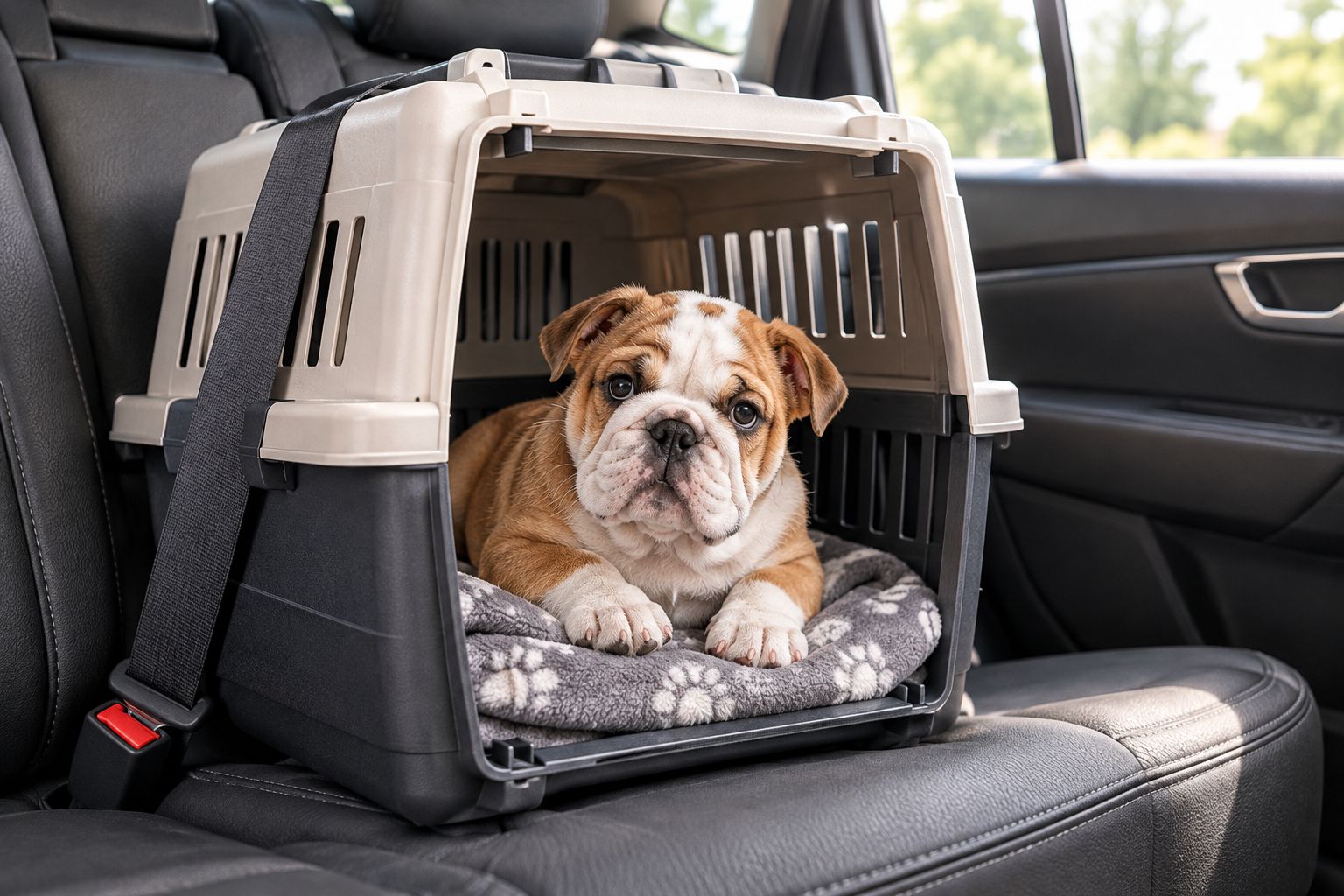
Keep the crate in the back seat, buckled or wedged so it can't slide. Bulldogs overheat fast because their airways don't move air as efficiently as longer-nosed breeds, so the car needs to run cool even on a mild day — never let a bulldog puppy ride in a hot car, even for five minutes at a gas stop.
A crate in the back seat, not a lap or the trunk, is the safest spot for the ride home.
Keep the drive as short and direct as reasonably possible. A puppy that's just left its litter is already stressed; a two-hour drive with three stops adds to that stress, it doesn't relieve it. Bring water and offer small sips if the ride runs long, but skip food until you're home and settled.
The first 24 hours at home
Set the quiet space up before you walk in the door, not after. A bulldog puppy needs somewhere small and enclosed — a pen or gated room, not the run of the house — for the first few hours while it adjusts to new smells and sounds.
Let the puppy sniff and explore at its own pace. Skip the parade of visitors on day one; a houseful of excited people is a lot for an 8-week-old puppy that was with its littermates that morning. Feed on the breeder's schedule, offer water, and expect some whining the first night — that part is normal and usually settles within a few nights.
“If the paperwork isn’t verified before you leave the driveway, it’s twice as hard to fix after.”
Why pickup day plans vary
No two pickup days look identical. A few things shift the checklist:
Distance from the breeder — a 30-minute drive needs less prep than a 6-hour one.
Puppy age at pickup — most reputable breeders release bulldog puppies no earlier than 8 weeks.
Season and weather — summer pickups need extra cooling precautions for a brachycephalic breed.
Shipping vs. in-person pickup — a flight nanny delivery changes almost every step on this list.
Other pets at home — introducing a puppy to a resident dog or cat needs its own slower plan than a puppy-only household.
First-time vs. experienced owner — first-timers usually need the vet appointment and paperwork review to happen sooner, not later.
How old should a bulldog puppy be at pickup?
8 weeks is the minimum age most reputable breeders release a bulldog puppy, and some hold puppies to 9 or 10 weeks for smaller litters. Pulling a puppy earlier than 8 weeks risks under-socialization and weaning problems that show up later as anxiety or resource guarding.
What paperwork should you get at pickup?
AKC registration paperwork, a written health guarantee, and vaccination records are the three documents to leave with on pickup day. Reading through how to verify AKC registration papers before you go tells you exactly what fields to check against the puppy in front of you.
Should you feed a bulldog puppy on pickup day?
A small meal on the breeder's usual schedule is fine, but skip feeding right before or during the car ride. Bulldogs are prone to motion sickness and a full stomach on a bumpy drive is a near-guaranteed mess.
Planning a pickup with Shrinkabulls?
Reserve your bulldog puppy with a deposit or see what’s currently available.
What age should a bulldog puppy be for pickup day?
8 weeks is the standard minimum age for bulldog puppy pickup. Some breeders hold puppies to 9 or 10 weeks depending on litter size and weaning progress.
What paperwork should you get at pickup?
AKC registration paperwork, a signed health guarantee, and written vaccination records are the three documents to verify before leaving. Check the microchip number against the paperwork in person.
How long should the drive home be for a new bulldog puppy?
Keep the drive as short and direct as possible since bulldogs overheat and stress faster than most breeds. A drive under 2-3 hours with minimal stops is easier on a puppy just separated from its litter.
Should you feed a bulldog puppy on pickup day?
A small meal on the breeder’s usual schedule is fine before the drive, but skip feeding right before or during the car ride. Bulldogs are prone to motion sickness on a full stomach.
When should the first vet visit happen after pickup?
48 to 72 hours after pickup is the recommended window for the first vet visit. This confirms the puppy is healthy and lets your vet start their own vaccination and deworming records.
Do bulldog puppies need a crate for the ride home?
Yes, a secured crate in the back seat is the safest way to transport a bulldog puppy. A lap or unsecured seat risks injury if you brake hard.
Is it normal for a bulldog puppy to cry the first night?
Yes, some whining the first night or two is normal as a puppy adjusts to new sounds and smells away from its littermates. It usually settles within a few nights once a routine sets in.
Should you bring anything from the breeder for pickup day?
A small bag of the current food and a blanket that smells like the litter both help ease the transition. Switching food cold on pickup day often causes stomach upset in bulldog puppies.
One last thing
The blanket trick works better than most owners expect. A piece of bedding that still smells like the litter, tucked into the crate for the first week, cuts down on whining more than a new toy or a heating pad does — bulldog puppies key off scent more than sound in those first few nights.
One more thing worth saying plainly: pickup day sets the tone for the whole first year, not just the first night. A rushed handoff with no paperwork check and no vet appointment booked tends to snowball into bigger problems by month two. A slow, deliberate pickup day doesn't.
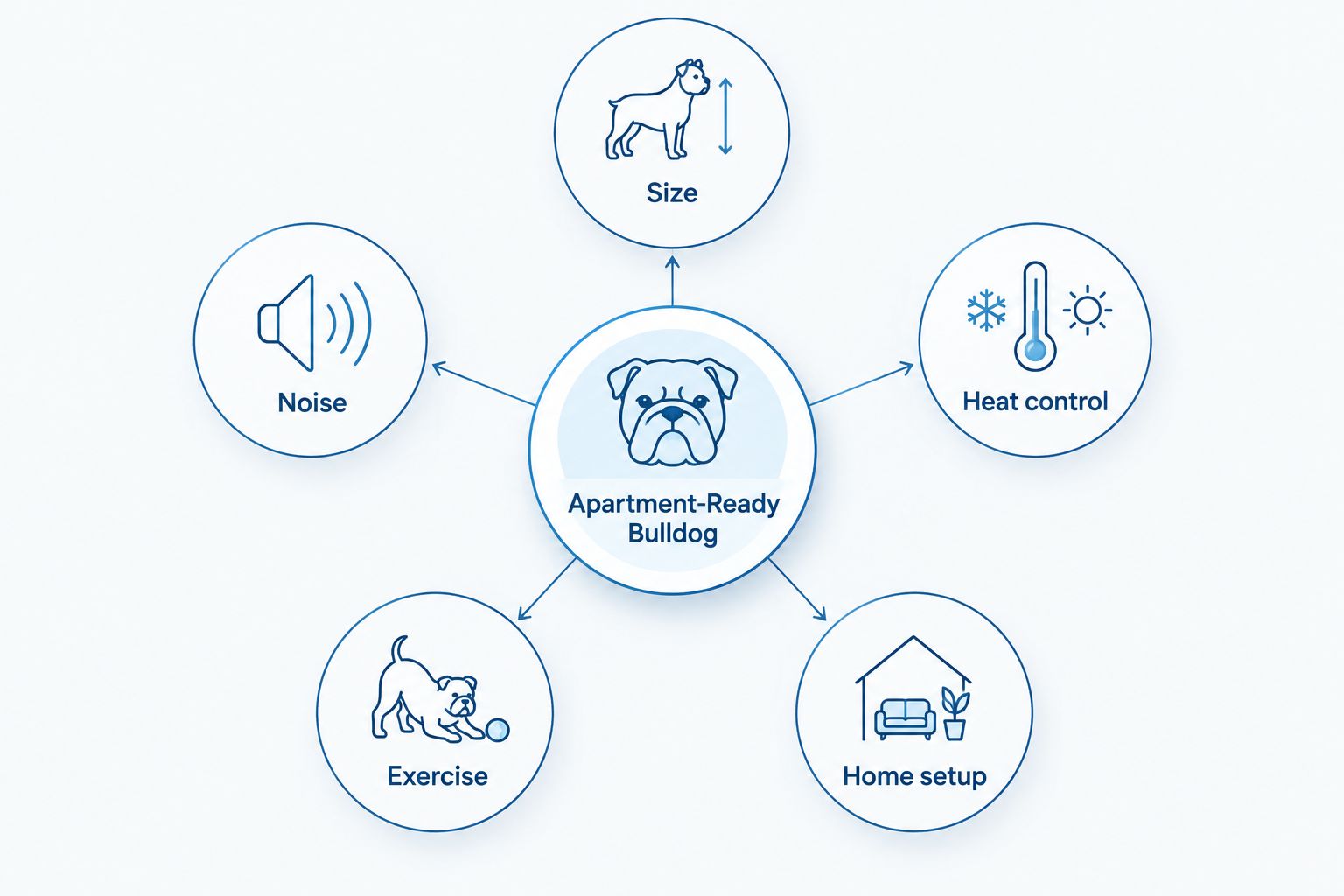
English Bulldog puppies for apartment dwellers are a workable fit in 2026 once you plan for heat, noise, and square footage before the puppy comes home, not after the first hot afternoon on the fourth floor. Apartment living strips away the yard, so exercise, potty routines, and cooling all have to run on a schedule instead of on demand.
TL;DR
English Bulldog puppies for apartments do best in one-bedroom-plus units with AC control and a nearby patch of grass or a set elevator routine.
Shrinkabulls carries Miniature English Bulldog and French Bulldog lines built for a smaller footprint than the standard English Bulldog.
AKC breed standard puts adult male English Bulldogs around 50-55 lbs; French Bulldogs run 16-28 lbs, the lighter apartment option.
Snoring, reverse sneezing, and shared-wall noise matter more in apartments than houses; crate placement matters as much as breed choice in 2026.
Weight ranges that matter for small floor plans
50-55 lbs
Adult male English Bulldog weight
AKC breed standard
16-28 lbs
Adult French Bulldog weight
AKC breed standard
Why apartment living changes the English Bulldog equation
An English Bulldog bred for a house with a yard behaves differently once the yard disappears. Potty breaks turn into elevator rides, panting after stairs becomes a bigger deal, and a snoring 50-pound dog three feet from a shared wall is a different conversation with a neighbor than the same dog in a detached house. Shrinkabulls' Blue French Bulldog puppies for apartment living line exists for exactly this question: a lighter-bodied option built around a small footprint rather than yard access.
Buyers searching for English Bulldog puppies for apartments in 2026 are really asking one thing: which bulldog line and which daily routine keeps the dog comfortable and the neighbors quiet. That answer changes depending on floor level, AC setup, and whether anyone works from home to break up the day.
Each of these five factors gets its own step below.
How to raise an English Bulldog puppy in an apartment
Match the bulldog's size to your square footage
Size decides more than any other factor once yard access is off the table.
Standard English Bulldog males run 50-55 lbs at maturity per AKC breed standard – comfortable in a one-bedroom, tight in a studio
Miniature English Bulldog puppies come from smaller-statured lines and maneuver easier around furniture and narrow hallways
French Bulldog adults sit at 16-28 lbs, the lightest option if floor space is the deciding factor
Walk the actual apartment layout before falling for a puppy photo online; a bulldog needs one dedicated flat rest spot clear of foot traffic
Ask the breeder about projected adult weight for the specific litter, not just the breed average
One dedicated flat rest spot, clear of the main walking path, beats a bed that gets moved daily.
Plan the crate location around shared walls
Put the crate against an interior wall, not the wall shared with a neighbor's bedroom
English Bulldogs snore and can have reverse sneezing episodes; a white-noise machine or fan softens both for adjoining units
Crate train early so the puppy settles fast instead of barking at every hallway noise
Give neighbors a heads-up before move-in day if the building has thin walls; a five-minute conversation beats a noise complaint later
Build a no-yard potty routine
Set a fixed schedule: morning, midday, evening, and a last call before bed, four trips minimum for a puppy under six months
Time elevator rides for low-traffic building hours during the first few house-training weeks
A washable potty pad or turf box on a balcony covers emergencies during storms or elevator outages
Track the last meal time against the last potty trip to cut overnight accidents
Fit exercise into a smaller footprint
Bulldogs are a low-to-moderate energy breed; two 10-15 minute walks a day cover most adult English Bulldogs
Skip the midday walk in summer heat – brachycephalic dogs overheat faster than longer-nosed breeds
A properly fitted harness matters more than a collar for a short-muzzled breed; Shrinkabulls' guide on harnesses for brachycephalic breeds covers fit specifics
Rotate indoor puzzle toys on days when weather cuts walks short
Control heat without a yard to retreat to
Keep indoor temperature below 75°F during the day; bulldogs overheat before a person notices the room feels warm
A cooling mat or a fan aimed at the crate helps units without zoned air conditioning
Never leave a bulldog puppy in a car or on a hot balcony, even for five minutes, through a 2026 summer
Watch for heavy panting that doesn't slow down after five minutes of rest; that's a heat-stress sign, not normal recovery
Set up a compact, bulldog-safe living space
Hard flooring with good traction under rugs prevents slipping for a heavy-bodied dog on hardwood or tile
An orthopedic bed supports the joints better than a standard cushion, especially once the puppy reaches adult weight
Keep cords, blind pulls, and baseboards out of reach during the teething months
Designate one low-traffic corner as the permanent bed and food area so the puppy isn't underfoot in a small kitchen
A bulldog that has one predictable spot to eat, sleep, and cool down adjusts to apartment life faster than one that gets shuffled around the unit.
Comparing bulldog options for apartment living
Color genetics add another layer to the decision. Merle, lilac, and blue lines carry extra health-testing requirements on top of the standard breed considerations, and the real cost breakdown belongs in its own resource – see what rare color puppies really cost before comparing litters side by side.
Option
Best for
Space needs
Key limitation
English Bulldog (standard)
apartment dwellers who want a sturdy, low-energy companion
one-bedroom or larger
heavier body, higher heat sensitivity
Miniature English Bulldog
small one-bedrooms and studios
studio or larger
still brachycephalic, same breathing caution as standard
French Bulldog
the smallest footprint in the group
studio or larger
prone to separation anxiety when left alone long hours
Rare color (merle, lilac, blue) lines
color enthusiasts ready to budget extra health screening
same as base breed
added genetic testing and pigment-related sun sensitivity
Verdict: a Miniature English Bulldog or a French Bulldog wins on floor space; a standard English Bulldog wins on temperament predictability if the unit has room.
Common mistakes apartment dwellers make with English Bulldog puppies
Skipping the landlord conversation first. Pet deposits, breed restrictions, and weight caps catch buyers off guard after they've already committed to a puppy.
Underestimating shared-wall noise. Snoring, reverse sneezing, and the occasional bulldog grumble carry through drywall more than owners expect; a bedroom-adjacent crate causes more complaints than the dog itself.
Letting teething run unmanaged in a small space. Baseboards, blind cords, and door frames take the damage faster in a compact unit than in a house with more room to redirect chewing. Reaching for anti-chew sprays for dogs before the destructive phase starts protects the trim and the security deposit.
No heat plan for units without central air. A window AC unit cooling the living room doesn't always reach the crate corner; check airflow in the exact spot where the puppy sleeps.
Skipping exercise instead of shortening it. Low energy doesn't mean zero exercise; a bulldog that never walks gains weight fast in a unit where it already moves less than a house dog would.
“If the crate sits against a shared bedroom wall, the noise complaint arrives before the house-training does.”
Ready to reserve an apartment-ready pup?
A deposit secures a spot on the litter before the puppies are born.
A French Bulldog or a Miniature English Bulldog is the best fit for a small apartment because both carry a lighter build than a standard English Bulldog. Standard English Bulldogs still work in a one-bedroom or larger unit with AC control.
Are English Bulldogs good apartment dogs?
Yes, English Bulldogs are good apartment dogs because of their low-to-moderate energy level, but they need heat management and a fixed potty schedule since there’s no yard. Snoring and noise through shared walls are the main adjustment for neighbors.
How much exercise does an apartment bulldog need?
Two 10-15 minute walks a day cover most adult English Bulldogs and French Bulldogs. Skip midday walks in summer heat since brachycephalic breeds overheat faster than longer-nosed dogs.
Can French Bulldogs handle apartment noise complaints?
French Bulldogs bark less than many breeds but can develop separation anxiety when left alone for long stretches, which produces its own noise complaints. Crate placement away from shared walls reduces both snoring and anxiety-related barking.
Do bulldogs overheat in apartments without central air?
Yes, bulldogs overheat faster than most breeds because of their short airways, and a unit without central air needs a window AC or fan aimed directly at the dog’s rest spot. Heavy panting that doesn’t slow after five minutes of rest signals heat stress.
Is a Miniature English Bulldog better for a studio?
A Miniature English Bulldog fits a studio better than a standard English Bulldog because of its smaller body, though it carries the same brachycephalic breathing caution. Floor space, not temperament, is the main difference between the two.
How many potty breaks does an apartment bulldog puppy need per day?
A puppy under six months needs at least four potty breaks a day: morning, midday, evening, and a last call before bed. Elevator wait time and floor level should factor into that schedule.
One last thing
The biggest apartment-living variable isn't square footage – it's floor level and elevator wait time. A fifth-floor walk-up turns a four-times-a-day potty schedule into a workout, and that detail gets skipped until move-in week when it's too late to change units.
An underweight French Bulldog puppy needs a calorie-dense food fed on a fixed schedule, a body condition score check every two weeks, and a vet visit to rule out parasites, dental pain, or airway restriction before you add a single extra calorie. The plan only works if you weigh your Frenchie on the same scale at the same time of day — inconsistent weigh-ins hide both real gains and real problems.
TL;DR
Weigh and score your French Bulldog puppy before changing food — a vet visit rules out parasites, dental pain, or airway issues first.
Calorie-dense puppy food split into 3 to 4 small meals works better than one big bowl for underweight Frenchie puppies.
Adult French Bulldogs typically settle between 16 and 28 lbs — use that range, not one target number, to judge progress.
Re-weigh every two weeks on the same scale; two flat check-ins in a row means call the vet, not adjust the food again.
Key numbers
16-28 lbs
Typical adult French Bulldog weight
Varies by build and bone density
1-9
Body condition score scale
5 is the ideal midpoint
8 weeks
Typical weaning age
Why this matters
French Bulldogs are brachycephalic, which means a puppy that seems "just picky" can actually be dealing with restricted airflow that makes eating tiring, or a dental issue that makes chewing painful. Underweight isn't a food problem by default in 2026 any more than it was in past years — it's a symptom with several possible causes, and treating it that way is what separates a plan that works from a bigger bag of kibble that doesn't.
Shrinkabulls sees this question constantly from new French Bulldog owners in the first few months home. If you're also moving off breeder-provided food, pair this plan with a gradual diet transition so the switch itself doesn't stall the gain you're trying to build.
How to build a weight-gain plan for an underweight French Bulldog puppy
Weigh and body-condition-score the puppy first. Use one scale you'll reuse every time, and score on the 1-9 BCS scale before touching the food bowl.
Book a vet visit before you add calories. Ask specifically about intestinal parasites, dental pain, and airway restriction — Shrinkabulls recommends asking about all three by name, since each is common and treatable in the breed.
Move to a calorie-dense puppy formula. Switch over one to two weeks, mixing old and new food, to avoid the GI upset that undoes any weight gained.
Split the day into 3 to 4 small meals. Brachycephalic puppies tire out mid-meal. Smaller, more frequent portions keep intake up without the panting and reflux that stop a single big bowl halfway through.
Switch to a raised or slow-feed bowl if the puppy eats too fast or quits early. A raised feeding bowl reduces the awkward neck angle that makes some flat-faced puppies abandon a meal before it's finished.
Re-weigh every two weeks, same scale, same time of day. Log the number. One low week means nothing; two flat weigh-ins in a row means the plan needs a vet, not another food swap.
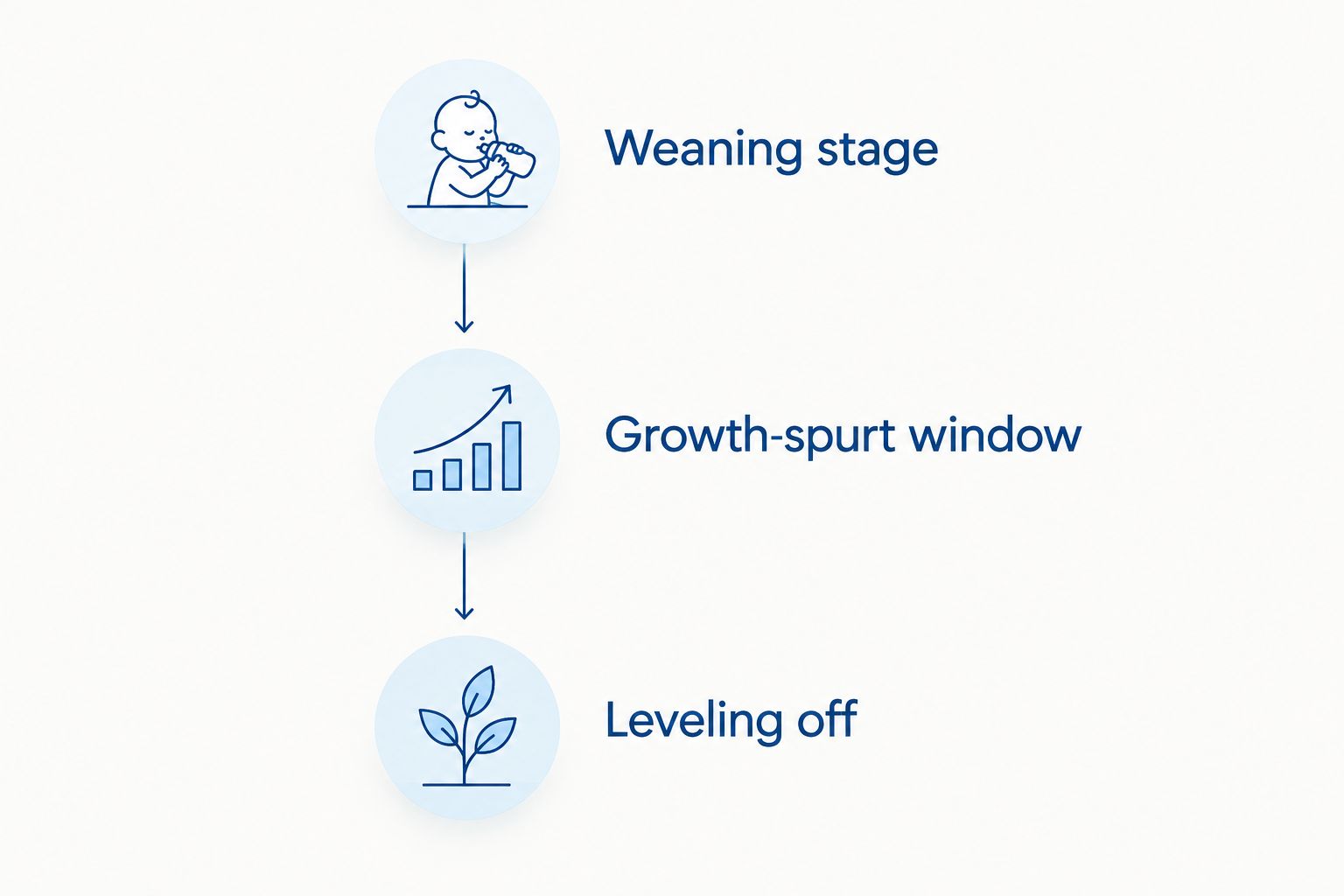
Weaning stage (8 to 12 weeks): building the calorie base
Most French Bulldog puppies wean around 8 weeks old and arrive at a new home already carrying whatever weight the breeder's care produced — that's the base you're building from, not a blank slate. A puppy that was smallest or last to nurse in the litter often starts a step behind, and that's normal, not a red flag on its own.
The first two weeks home should stabilize weight, not necessarily add fast to it. Body condition matters more than the number on the scale this early, since French Bulldog puppies at 8 weeks vary a lot in starting size depending on the parents.
Growth-spurt window (3 to 6 months): where most catch-up happens
This is the fastest bone and muscle growth window in a French Bulldog puppy's first year, and calorie needs rise sharply with it. An underweight puppy on a corrected plan usually closes the gap fastest here, because the body is already primed to add mass — the plan just has to supply enough calorie density to keep pace with it.
A puppy that stalls flat through this window, rather than just gaining slower than expected, is the clearest signal something medical is interfering and it's time to go back to the vet.
Leveling off (6 to 12 months): confirming the gain held
Growth rate slows here, and weight gain becomes steadier and smaller week to week. By 12 months most French Bulldogs are within reach of their adult range of 16 to 28 lbs, though frame size varies a lot between individual dogs and even between littermates from the same litter.
This is also the point to drop from 3 to 4 meals a day down to 2, once weight is trending in the right direction — not before, and not just because the puppy is getting older.
Most catch-up weight happens in the growth-spurt window, not the weaning stage.
Why French Bulldog puppies fall behind on weight
Intestinal parasites — worms rob calories before they're absorbed, even on a good food.
Dental pain or a retained baby tooth — makes chewing hard kibble uncomfortable enough to skip meals.
Airway restriction — narrow nostrils or an elongated soft palate make the act of eating itself tiring.
Littermate competition — the last puppy to the bowl in a litter often stays behind on weight for months after leaving.
Stress after rehoming — a new home, new pets, and new sounds can suppress appetite for a week or two on their own.
Wrong-life-stage food — an adult-formula food fed to a growing puppy under-delivers calories per cup.
A raised bowl keeps the neck angle comfortable for a puppy that quits meals early.
See current French Bulldog litters
AKC-registered French Bulldog puppies from health-tested lines.
How do I know if my Frenchie puppy is actually underweight, not just lean?
Run a hands-on check, not just a number on the scale — you should feel ribs easily under a thin layer of fat but not see them, and the waist should tuck in slightly behind the ribs when viewed from above. A body condition score of 4 or below on the 1-9 scale is the practical cutoff for "underweight" rather than "naturally lean."
Is a long lean stage before filling out normal for a French Bulldog puppy?
A lean stretch during the 3 to 6 month growth spurt is normal, since bone and frame often grow ahead of muscle and fat. It's only a concern if the body condition score sits at 3 or below for more than a couple of consecutive check-ins, not just one lean-looking week.
FAQ
What is a healthy weight for an adult French Bulldog?
A healthy adult French Bulldog typically weighs 16 to 28 lbs, though frame size varies between individual dogs. Body condition score matters more than the exact number, since bulldogs carry weight in a dense, low-slung frame.
How can I tell if my French Bulldog puppy is underweight?
Feel for ribs that are easy to find under a thin fat layer but not visible, and look for a slight waist tuck from above. A body condition score of 4 or below on the 1-9 scale points to underweight rather than naturally lean.
Is it safe to free-feed an underweight French Bulldog puppy?
Free-feeding usually works against a weight-gain plan because it hides whether the puppy is actually eating enough at each sitting. Scheduled meals, 3 to 4 a day, make it easier to track intake and catch a stalled meal early.
Can parasites cause a French Bulldog puppy to stay thin?
Yes, intestinal parasites are one of the most common reasons a puppy stays thin despite eating normally, because worms take calories before the body absorbs them. A vet fecal check should be step one of any weight-gain plan.
Should I switch foods to help my Frenchie gain weight?
A calorie-dense puppy formula, switched gradually over one to two weeks, is usually the right move for an underweight French Bulldog puppy. Switching food without ruling out a medical cause first often just delays finding the real problem.
When should I take an underweight Frenchie puppy to the vet?
See a vet before starting any weight-gain plan, and again if two consecutive two-week weigh-ins show no gain. A vet experienced with brachycephalic breeds will check for dental, airway, and parasite causes specifically.
Does a soft palate or airway issue affect a puppy’s weight gain?
Yes, an elongated soft palate or narrow nostrils can make the physical act of eating tiring enough that a puppy quits meals early. This shows up as a puppy who seems interested in food but doesn’t finish portions.
One last thing
Bulldogs carry weight differently than long-legged breeds because of their dense bone and short frame, which is exactly why a bathroom scale number means less than a body condition score. A 24 lb Frenchie with a visible waist and easy-to-feel ribs is in better shape than a 20 lb Frenchie carrying it all in the chest and belly. Track the score through 2026, not just the pounds, and the plan tells you the truth faster than the scale alone.
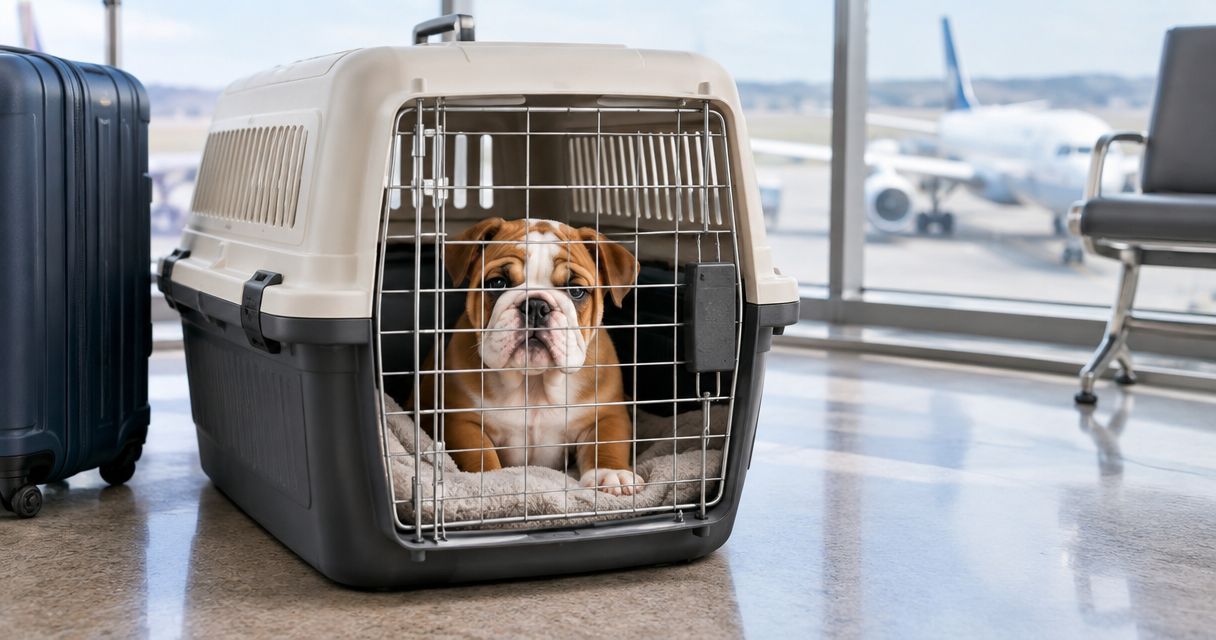
Shipping a bulldog puppy by air cargo is not the safe option most people assume it is — the best travel crate for shipping a bulldog puppy is an IATA-compliant hard-sided kennel used for ground transport or as a flight nanny's carry-on, not a crate booked into an airline's cargo hold.
TL;DR
The Petmate Sky Kennel is the best overall travel crate for shipping a bulldog puppy on ground transport routes in 2026.
The Sleepypod Air is the best in-cabin carrier for a flight nanny moving a French Bulldog puppy under airline seat limits.
Most major U.S. carriers restrict or ban brachycephalic breeds like English and French Bulldogs from cargo holds — plan ground transport or a flight nanny instead.
Gunner Kennels G1 wins on escape-proof durability; Pet Cargo Maximum Security fits XL English Bulldog puppies that outgrow standard crates fast.
Numbers that matter
2019
Delta banned snub-nosed breeds from cargo
50 lbs
AKC standard adult male English Bulldog weight
16-28 lbs
AKC standard French Bulldog weight range
Why this matters
Brachycephalic breeds — English Bulldogs and French Bulldogs included — struggle to regulate body temperature and breathe efficiently under stress, and a pressurized, unmonitored cargo hold makes both problems worse. Delta banned snub-nosed dogs and cats from cargo in 2019. United's BreedWatch program, running since 2017, still flags both English Bulldogs and French Bulldogs as high-risk cargo passengers in 2026.
That's why most reputable bulldog breeders skip air cargo entirely and move puppies by ground transport or a professional flight nanny who carries the puppy in-cabin. The crate you pick still matters enormously for either method — it's where the puppy spends hours of the trip.
What makes the best travel crate for shipping a bulldog puppy
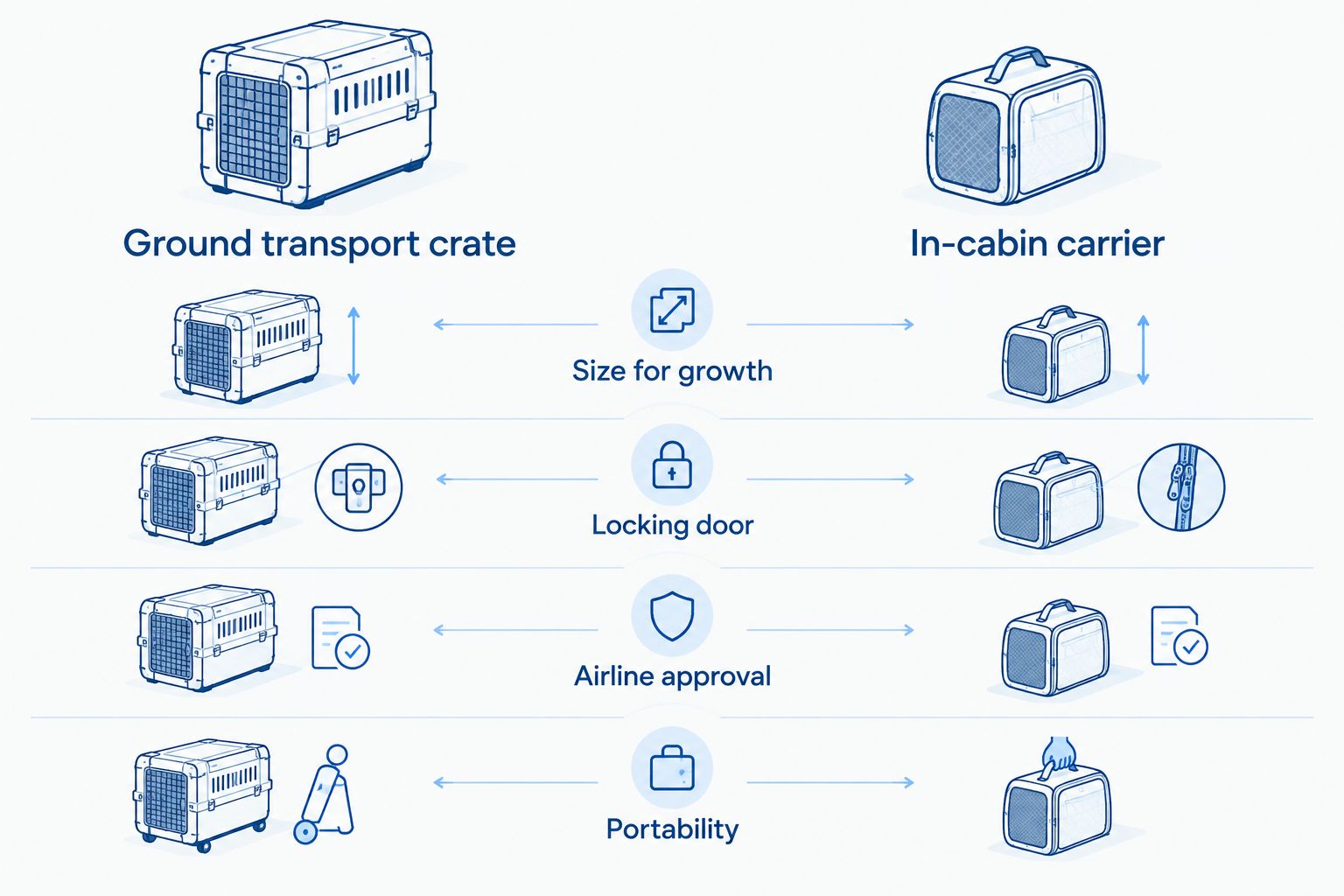
Growth room: enough space to stand, turn around, and lie down flat without touching the walls — the IATA Live Animals Regulations standard.
Ventilation on three sides: bulldogs already breathe harder than most breeds; airflow is not optional.
A metal or heavy-composite locking door: puppies chew, paw, and panic — a flimsy latch fails at the worst moment.
Non-toxic, washable interior: accidents happen on long trips.
Weight the handler can actually carry: a flight nanny boarding with a crate needs something that clears under-seat dimensions or fits airline carry-on rules.
A documented size chart: guessing a crate size for a fast-growing puppy wastes money twice.
The right crate depends on whether the puppy travels by car or flies in-cabin with a nanny.
Travel crates for a bulldog puppy at a glance
Crate
Best for
Standout feature
Key limitation
Petmate Sky Kennel
Ground transport overall
IATA-compliant hard shell, wide size range
Bulky for a small sedan trunk
Sleepypod Air
Flight nanny, in-cabin
Collapses flat, fits under most airline seats
Too small once a puppy passes early growth stages
Gunner Kennels G1 Intermediate
Heavy-duty, escape-proof transport
Rotomolded shell rated for rough handling
Heaviest option on this list
Pet Cargo Maximum Security
XL English Bulldog puppies
Reinforced door for a breed that outgrows crates fast
Overkill for a single short local trip
Petmate Two Door Top Load
Budget, local pickup
Two entry points, lightweight
Less structural rigidity for long routes
1. Petmate Sky Kennel: best travel crate for ground shipping overall
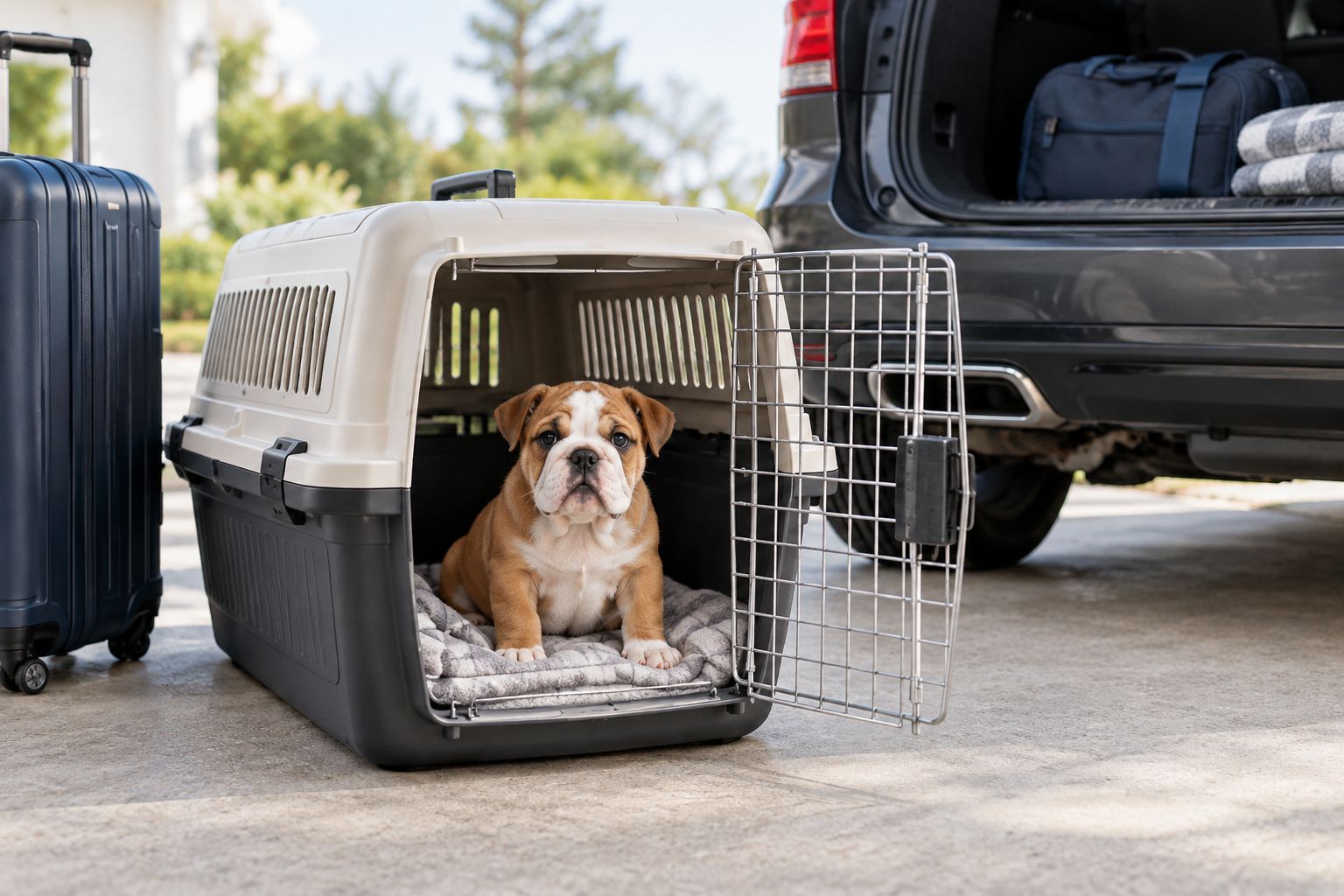
The Petmate Sky Kennel (also sold as the Ultra Vari Kennel) is the hard-sided crate most professional pet transport drivers already carry, and it meets IATA sizing and ventilation standards without modification. It's built in a wide enough range of sizes to fit a bulldog puppy through several growth stages before a family needs to size up.
Petmate Sky Kennel pros:
Meets IATA dimensions out of the box, no retrofitting
Ventilated on three sides, which matters for a breed that already runs hot
Wide size range covers puppy through adolescent bulldog
Petmate Sky Kennel cons:
Too large and heavy to double as an in-cabin carrier
Hard plastic shell takes up significant trunk space on a road trip
A hard-sided kennel like this is the default choice for a professional ground transport route.
Best for: breeders and buyers using a ground transport service for the puppy's home delivery. Verdict: Buy.
2. Sleepypod Air: best in-cabin carrier for flight nanny delivery
The Sleepypod Air is a soft-sided carrier built to collapse flat and slide under an airline seat, which is the only realistic way a bulldog puppy flies safely in 2026 — in the cabin, with a flight nanny, never in the hold. It works well for young French Bulldog puppies still within airline under-seat dimensions.
Sleepypod Air pros:
Designed specifically for under-seat airline placement
Padded and structured enough to hold shape mid-flight
Light enough for one person to carry through an airport for hours
Sleepypod Air cons:
Outgrown quickly — an English Bulldog puppy clears this size window fast
Soft sides offer less structure than a hard kennel for a wriggly puppy
Best for: flight nanny transport of a smaller French Bulldog puppy. Verdict: Buy.
3. Gunner Kennels G1 Intermediate: best for heavy-duty, escape-proof transport
The Gunner Kennels G1 is a rotomolded, thick-walled crate built originally for hunting dogs riding in truck beds, and that same durability makes it the choice for a bulldog puppy on a long multi-day ground route with several handoffs. It's the crate you pick when you can't personally verify every leg of the trip.
Gunner Kennels G1 pros:
Rated for rough handling and vehicle vibration
Locking door hardware resists paws and shipping-crew mishandling
Double-wall construction adds temperature buffering
Gunner Kennels G1 cons:
Heaviest crate on this list, awkward for one person to lift
Costs more to ship as freight itself if it needs to travel empty afterward
Best for: long-haul ground transport with multiple drivers or a relay handoff. Verdict: Buy if the route is genuinely long; Skip for a same-day local delivery.
4. Pet Cargo Maximum Security: best for XL English Bulldog puppies
English Bulldog puppies can pack on weight fast, and the Pet Cargo Maximum Security line runs larger and sturdier than most standard airline-style kennels, which matters for a puppy already brushing against a 40-50 lb adult weight range per AKC breed standards. The reinforced door earns its name.
Pet Cargo Maximum Security pros:
Larger interior volume than most IATA crates in its class
Reinforced door hardware built for a strong, stocky breed
Solid choice for a puppy that's already outgrown a standard kennel once
Pet Cargo Maximum Security cons:
Overbuilt and unnecessary for a short local trip
Bulk makes it a poor fit for anything but a full-size vehicle
Best for: a large-boned English Bulldog puppy nearing its adult size. Verdict: Buy for XL puppies; Wait if the puppy is still small enough for a standard kennel.
5. Petmate Two Door Top Load: best budget option for local pickup
When a new owner is driving to pick up the puppy directly rather than arranging shipping at all, the Petmate Two Door Top Load covers a short trip without the cost or bulk of a full IATA-rated kennel. It's not built for long-distance shipping and shouldn't be treated as one.
Petmate Two Door Top Load pros:
Lightweight, easy for one person to load and unload
Two entry points make loading a squirmy puppy easier
Lower cost than the hard-shell shipping-grade options above
Petmate Two Door Top Load cons:
Less rigid construction than a true shipping crate
Not built for multi-hour or multi-day transport
Best for: a same-day local pickup, not cross-country shipping. Verdict: Buy for local trips only; Skip for shipping distances.
How we ranked these crates
Each crate was weighed against the six criteria above — growth room, ventilation, door security, interior material, handler weight, and documented sizing — with the trip type as the deciding factor. A crate that scores well for a multi-day ground route can be the wrong pick for an in-cabin flight nanny leg, which is why this list splits recommendations by use case instead of naming one universal winner.
Planning a puppy’s trip home?
Reserve your English or French Bulldog puppy before working out delivery logistics.
If the puppy is traveling by ground transport, the Petmate Sky Kennel is the default pick — it's IATA-compliant, ventilated, and sized for a growing bulldog puppy without extra cost. If a flight nanny is carrying a smaller French Bulldog puppy in-cabin, the Sleepypod Air wins on under-seat fit. Reach for the Gunner Kennels G1 only when the route is genuinely long and unsupervised, and size up to the Pet Cargo Maximum Security once an English Bulldog puppy is closing in on adult weight. Skip air cargo altogether in 2026 — the airline policies haven't loosened, and a bulldog's airway can't afford the risk.
FAQ
What is the best travel crate for shipping a bulldog puppy?
The Petmate Sky Kennel is the best overall crate for ground-shipping a bulldog puppy in 2026 because it meets IATA sizing and ventilation standards without modification. For flight nanny in-cabin travel, the Sleepypod Air is the better fit.
Can a bulldog puppy fly in an airline’s cargo hold?
Most major U.S. airlines restrict or ban brachycephalic breeds like English and French Bulldogs from cargo holds; Delta banned snub-nosed breeds from cargo in 2019. A flight nanny carrying the puppy in-cabin is the safer route.
Is a hard-sided or soft-sided crate better for shipping a puppy?
A hard-sided crate like the Petmate Sky Kennel is better for ground transport because it holds structure over hours of travel. A soft-sided carrier like the Sleepypod Air only makes sense for in-cabin flight nanny trips with a small puppy.
How big should a travel crate be for a bulldog puppy?
The crate needs enough room for the puppy to stand, turn around, and lie flat without touching the walls, per IATA Live Animals Regulations. Adult English Bulldogs run roughly 40-50 lbs and French Bulldogs 16-28 lbs per AKC standards, so size up before the puppy outgrows the crate.
What is a flight nanny and why do bulldog breeders use one?
A flight nanny is a person who flies with a puppy in the cabin as a carry-on, avoiding the cargo hold entirely. Bulldog breeders use this option because airline cargo policies restrict brachycephalic breeds from the hold.
Do I need an IATA-approved crate for ground transport?
IATA approval is not legally required for ground transport, but the same sizing and ventilation standards make ground trips safer and more comfortable for a bulldog puppy regardless of the method.
How much does it cost to ship a bulldog puppy?
Cost varies by distance, transport method, and provider, so check current rates directly with a ground transport service or flight nanny before booking.
One last thing
The crate is never the actual bottleneck in shipping a bulldog puppy safely — the transport method is. A perfect Petmate Sky Kennel loaded into an airline cargo hold still carries the same breathing and heat-stress risk that got brachycephalic breeds restricted from cargo in the first place; the crate only protects a puppy that's already traveling the right way. Pick the method first, then match the crate to it.
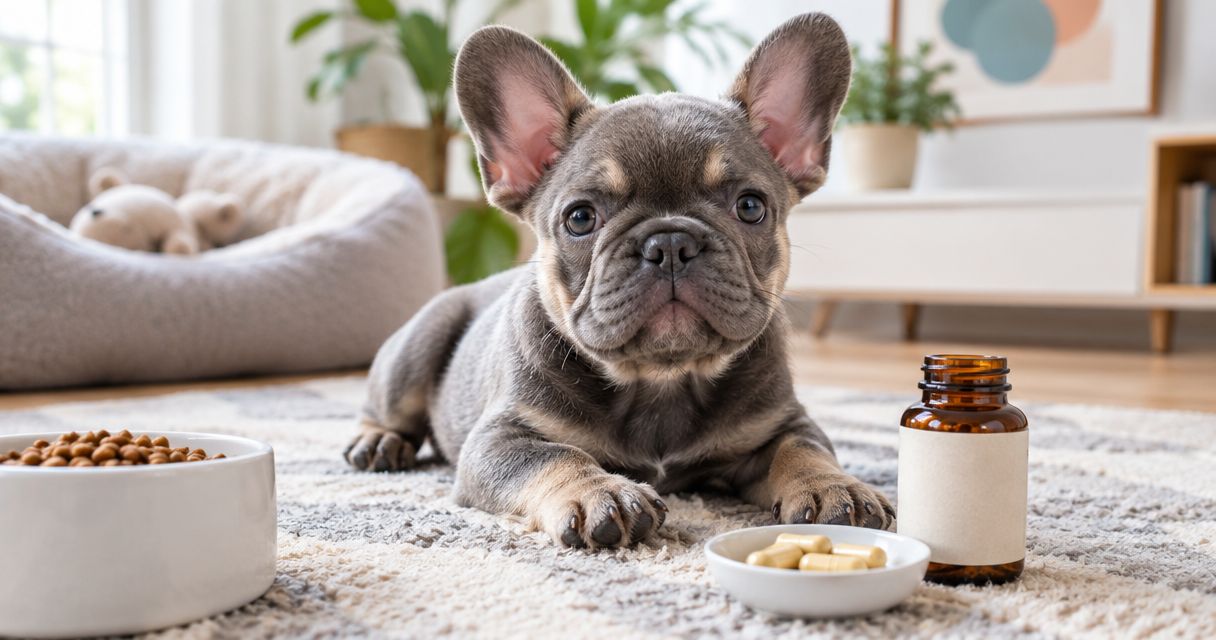
Loose stool, gas, and a puppy who won't touch breakfast are common in the first few weeks after a French Bulldog leaves the litter — and a probiotic is usually the fastest, cheapest fix a new owner can try before calling the vet. This guide ranks the formats and products that actually hold up for a Frenchie's sensitive gut in 2026, not the ones with the loudest marketing.
TL;DR
FortiFlora is the best probiotics for French Bulldog puppies pick for everyday gut support — most vets already carry it.
Proviable is the right call after antibiotics, deworming, or a diarrhea flare, not for daily use.
Vetri Mega Probiotic covers daily maintenance on a budget but has thinner clinical backing than FortiFlora.
PetLab Co Probiotic Chews only make sense if your puppy spits out powders — convenience over dosing precision.
Best overall probiotic for French Bulldog puppies: Purina Pro Plan FortiFlora. Best for gut recovery after antibiotics or a diarrhea flare: Nutramax Proviable. Best budget daily powder: VetriScience Vetri Mega Probiotic. Best for picky puppies who refuse powders: PetLab Co Probiotic Chews.
Why this matters
French Bulldogs are a breed known for food sensitivity, and a puppy's gut microbiome is still forming during the first months after birth — which is exactly when most families bring a new Frenchie home. Add a diet switch away from the breeder's food, a stressful car ride, and a new environment, and you've got the three most common triggers for puppy diarrhea in one week. A gut-health supplement is not a substitute for good food; it's insurance while a puppy's digestive system catches up.
Budgeting for a probiotic is a small line item next to everything else a French Bulldog puppy costs in year one, and the puppy starter supplies checklist covers where a gut supplement fits alongside bowls, crates, and food. Rare-color puppies in particular carry a higher upfront investment, and the true cost breakdown for what rare color puppies really cost is worth reading before you add up ongoing supplement spend on top of the purchase price.
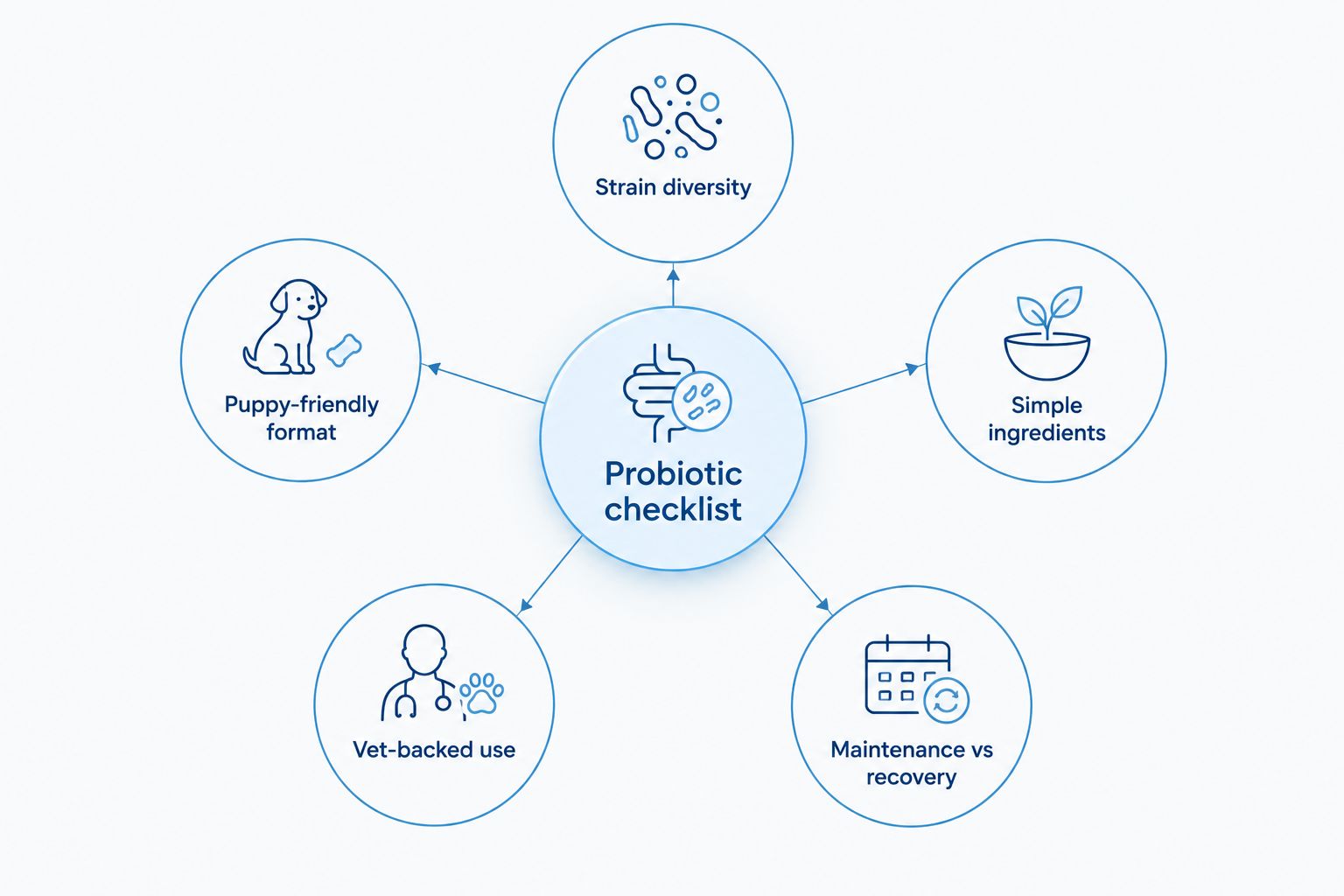
What makes the best probiotic for a French Bulldog puppy
Strain diversity — single-strain powders handle everyday maintenance, multi-strain blends do more work during a GI flare
A format the puppy will actually eat — a powder or chew Bulldogs tolerate beats a capsule that gets spit out
Simple ingredient lists — Frenchies already run high on food sensitivities, so added dyes and fillers are a liability, not a bonus
Veterinary track record — a strain with years of clinical use behind it is a safer bet than a new-to-market blend
Built for maintenance or for recovery, not both — the products that try to do everything usually do neither job well
Shelf stability — no refrigeration required is a real convenience for a puppy on a daily supplement
Rank a probiotic against these five points before the price tag.
Best probiotics for French Bulldog puppies at a glance
Product
Best for
Standout feature
Key limitation
Purina Pro Plan FortiFlora
Everyday gut support
Single well-studied strain (Enterococcus faecium SF68)
Narrower strain spectrum than multi-strain blends
Nutramax Proviable
Post-antibiotic or diarrhea recovery
Multi-strain blend, DC capsules pair enzymes with probiotics
Capsule format is harder to hide in food
VetriScience Vetri Mega Probiotic
Budget daily maintenance
Multi-strain powder built for long-term use
Less documented in veterinary literature
PetLab Co Probiotic Chews
Picky puppies, travel
Treat-style chew, no mixing
Flavoring/fillers can bother sensitive tummies
1. Purina Pro Plan FortiFlora: best probiotic for daily gut maintenance
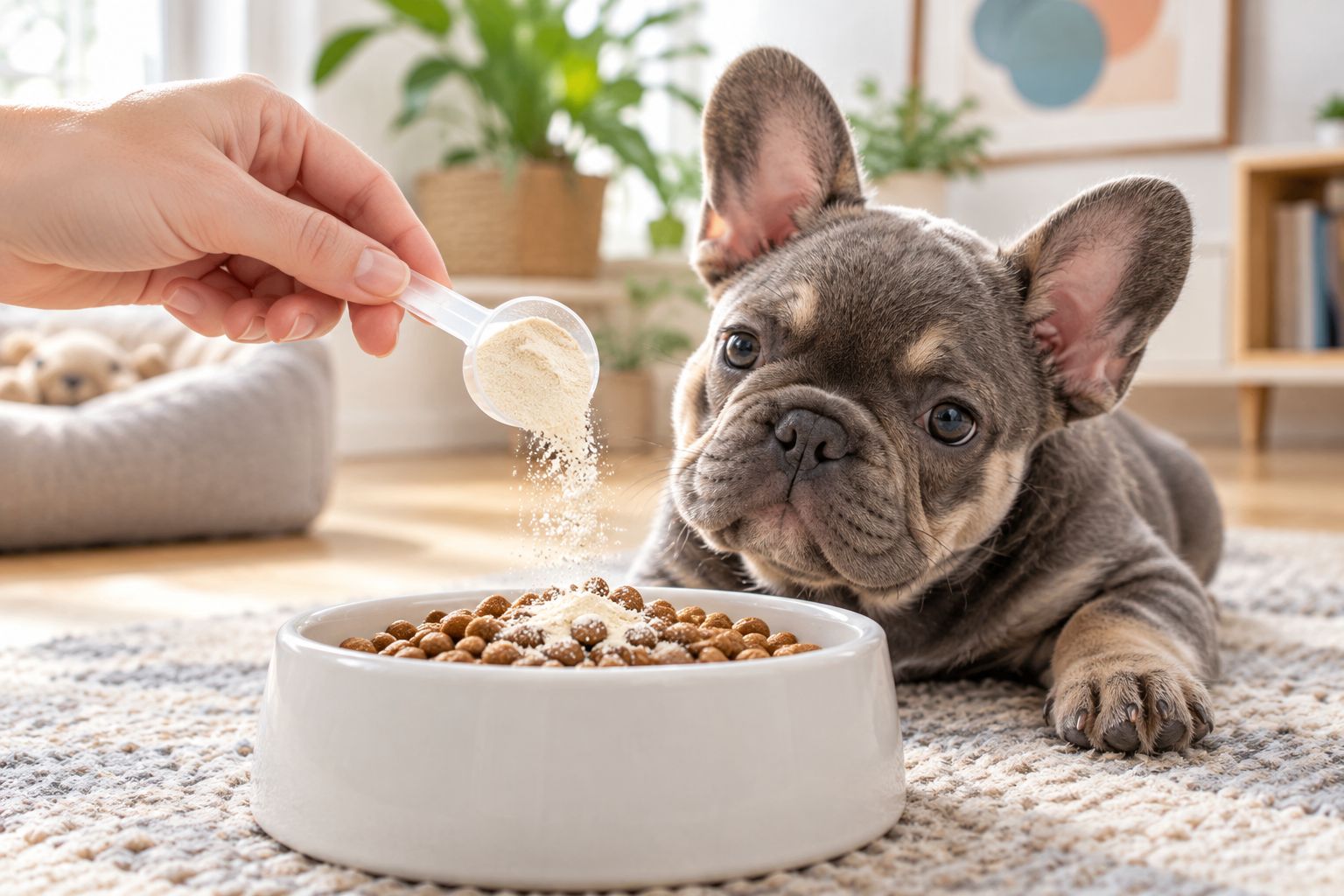
FortiFlora is a powder sachet built around Enterococcus faecium SF68, a single probiotic strain with a long track record in veterinary practice. You sprinkle the powder over your puppy's regular food once a day, which makes it one of the easier supplements to actually get into a French Bulldog puppy without a fight.
A sprinkle-on powder is the format most Bulldog puppies won’t fight you over.
FortiFlora pros:
Single strain with decades of veterinary use behind it
Sprinkle-on powder most Bulldogs eat without a fuss
Frequently the first probiotic a vet hands a new puppy owner
FortiFlora cons:
Narrower strain spectrum than multi-strain blends
Contains an animal digest flavoring some sensitive-stomach puppies react to
Not designed as a targeted fix for antibiotic-associated diarrhea
Best for: the first probiotic for a healthy new puppy settling into a home. Verdict: Buy.
2. Nutramax Proviable: best probiotic for gut recovery after antibiotics or illness
Proviable is the multi-strain blend most vets reach for after a puppy finishes a course of antibiotics, gets dewormed, or comes off a bout of diarrhea. The companion Proviable-DC capsule adds digestive enzymes on top of the probiotic strains, which is more firepower than a maintenance-only product carries.
Proviable pros:
Broader strain diversity than single-strain powders
DC capsules combine enzymes with probiotics for active GI issues
Common stock item in veterinary clinics for flare-ups
Proviable cons:
Capsule format is harder to disguise in food than a powder
More strains means more to track if a puppy reacts to one of them
Best used on a vet's timing around antibiotics, not grabbed off a shelf blind
Best for: recovery after antibiotics, deworming, or a diarrhea episode. Verdict: Buy, with a vet's guidance on timing.
3. VetriScience Vetri Mega Probiotic: best budget daily powder
Vetri Mega Probiotic is a multi-strain powder marketed for long-term daily maintenance rather than acute recovery. It costs less to run day to day than FortiFlora or Proviable, which matters if a probiotic is going into the daily routine for months, not weeks.
Vetri Mega Probiotic pros:
Multi-strain formula for broader daily coverage
Powder format most Bulldogs tolerate mixed into food
Positioned for ongoing use, not a short recovery course
Vetri Mega Probiotic cons:
Thinner clinical documentation than FortiFlora or Proviable
Powder can clump if stored somewhere humid
Not built to handle an acute GI flare the way Proviable is
Best for: owners who want daily maintenance without the cost of a vet-line product. Verdict: Buy for maintenance; skip it if your puppy is already having active diarrhea.
4. PetLab Co Probiotic Chews: best format for picky puppies
PetLab Co makes a chewable probiotic treat aimed at owners who don't want to mix powders or wrestle a capsule into a puppy's mouth. It works as a fallback when a Frenchie flat-out refuses every powder you've tried.
PetLab Co Chews pros:
Treat-style chew most puppies take willingly
No mixing, easy to bring on car rides or trips
Simple daily routine for owners who forget to measure powder
PetLab Co Chews cons:
Flavoring and fillers in a chew can bother a puppy already prone to food sensitivities
Harder to control exact strain dosing for a small breed's body weight
Less established in veterinary use than FortiFlora or Proviable
Best for: a puppy who refuses powders and capsules outright, or travel days when mixing isn't practical. Verdict: Hold — try it only after a powder format has already failed.
“A probiotic isn’t a fix for a poor diet — it’s backup for good food, not a replacement for it.”
How we ranked these
Each product was measured against the six criteria above: strain research, whether a French Bulldog puppy will actually eat it, ingredient simplicity, veterinary track record, and whether it's built for daily maintenance or acute recovery. FortiFlora and Proviable both carry the deepest veterinary history of the four, which is why they take the top two slots for different jobs — one for every day, one for flare-ups.
Which probiotic should you choose for your French Bulldog puppy?
Start a healthy new puppy on Purina Pro Plan FortiFlora the week it arrives — it's the safest default for a gut that's adjusting to a new home and a diet change. Switch to Nutramax Proviable if your Frenchie has just finished antibiotics, gotten dewormed, or had a rough stretch of diarrhea, and check with your vet on timing. If budget is the deciding factor for long-term daily use, VetriScience Vetri Mega Probiotic is the reasonable middle ground. Reach for PetLab Co Probiotic Chews only after a powder has already failed — it's a convenience trade, not an upgrade.
Bringing home a Frenchie puppy soon?
Reserve your spot before the litter arrives and plan the health routine early.
What’s the best probiotic for a French Bulldog puppy?
Purina Pro Plan FortiFlora is the best probiotics for French Bulldog puppies pick for daily gut support because it’s a single, well-studied strain most vets already stock. Nutramax Proviable is the better choice specifically after antibiotics, deworming, or a diarrhea flare.
Is FortiFlora good for French Bulldog puppies?
Yes, FortiFlora is commonly recommended by vets for puppies including Bulldogs because it’s a sprinkle-on powder most puppies eat without resistance. It works best for everyday maintenance rather than an active GI flare-up.
When should I start a puppy on probiotics after bringing it home?
Starting a probiotic the same week a puppy comes home helps offset the stress of a new environment and a diet transition. Pair it with a slow food transition rather than switching diets abruptly.
Can I give my Frenchie puppy human probiotics?
No — human probiotic products aren’t formulated with the strains or dosing tested for a dog’s digestive system. Stick to a product made specifically for dogs and sized for a puppy’s smaller body weight.
How long does it take a probiotic to fix diarrhea in a puppy?
Most puppies show firmer stool within several days on a probiotic if the cause is a simple diet or stress upset. If there’s no improvement within about a week, call your vet — that’s long enough to rule out a minor transition issue.
Do French Bulldog puppies need probiotics after deworming?
Deworming can disrupt gut bacteria, and a probiotic like Nutramax Proviable is commonly used afterward to support recovery. Check timing with your vet since deworming schedules and probiotic timing can overlap.
Is Proviable better than FortiFlora for a French Bulldog puppy?
Neither is universally better — Proviable’s multi-strain blend suits active GI recovery, while FortiFlora’s single strain suits daily maintenance. Most owners keep FortiFlora for everyday use and switch to Proviable only during a flare.
What signs mean a probiotic isn’t working and I should call the vet?
Diarrhea that persists past a week, blood in the stool, vomiting, or a puppy that stops eating are all reasons to call the vet regardless of what supplement you’re using. A probiotic supports digestion — it doesn’t treat infection or a blockage.
One last thing
Most owners reach for a probiotic only after diarrhea starts — but starting one the day you commit to a puppy, before the actual pickup date, gives the gut a head start on the stress of the move. If your puppy is also mid-transition off breeder food, pair the probiotic with a slow food changeover using the breeder-food-to-home-diet transition guide rather than switching everything on day one — stacking two gut stressors at once is the fastest way to end up back at the vet.
French Bulldog puppies stain fast because their eyes sit shallow and their nasal folds trap moisture right where tears drain — pick the wrong wipe and you're just feeding the yeast that causes the rust-brown streak in the first place.
TL;DR
Saline-based wipes are the best overall tear stain remover for French Bulldog puppies with healthy skin in 2026.
Colloidal silver wipes win for deep wrinkle folds where yeast and bacteria build up fastest.
Chamomile and aloe formulas are the safest pick for a Frenchie with allergy-prone or reactive skin.
Vet-formulated antibacterial wipes are for chronic, dark staining that hasn’t responded to anything gentler.
Why this matters
Tear staining in a French Bulldog puppy is almost always mechanical before it's cosmetic. Shallow eye sockets, a short muzzle, and deep facial wrinkles mean tears don't drain the way they would in a longer-nosed breed — they pool, sit against the fur, and oxidize into that reddish-brown streak owners hate. Add a warm, moist fold and you get the second problem: Malassezia yeast and staph bacteria, which is what actually darkens the stain past a light discoloration.
A wipe that only cleans the surface fur without addressing the fold underneath treats the symptom, not the cause. That's the gap the wrinkle balms and wipes guide for English Bulldogs covers from the balm side — this guide ranks the wipe formulations specifically for the tear-stain problem in French Bulldog puppies.
At Shrinkabulls, we see this question from nearly every new Frenchie family in their first few weeks home. The stain shows up fast on a puppy this young, usually within the first two months, and it's rarely a health emergency — but it's worth ranking your options properly instead of grabbing the first wipe on a store shelf.
What makes the best tear stain remover wipes for French Bulldog puppies
Tear-safe pH — anything close to the eye should be formulated not to sting if it drifts into the corner
Antimicrobial action without harsh dryness — the ingredient has to fight yeast and bacteria without cracking the skin in the fold
No dye, no fragrance — added color and scent are the two most common triggers for fold irritation in a brachycephalic breed
Texture that reaches into a deep fold — a flat cotton pad misses the crease; a textured or ribbed wipe gets into it
Fast dry time — a wipe that leaves the fold damp for hours undoes its own work
Puppy-appropriate strength — a formula built for an adult dog's tougher skin can be too aggressive for a 2026 litter still growing into its wrinkles
Tear stain remover wipes at a glance
Category
Best For
Standout Feature
Key Limitation
Saline-based wipes
Daily upkeep on healthy skin
Rinses debris without stinging the eye
Doesn't touch existing yeast staining
Chamomile & aloe wipes
Sensitive, allergy-prone skin
Calms redness around the fold
Weak against odor-causing bacteria
Colloidal silver wipes
Deep wrinkle folds
Antimicrobial action slows yeast growth
Can dry out skin with daily overuse
Coconut-oil enriched wipes
Dry, flaky stained fur
Moisturizes while lifting the stain
Greasy residue attracts dust and lint
Vet-formulated antibacterial wipes
Chronic or severe staining
Highest active-ingredient concentration
Needs a vet check before regular use
1. Saline-based wipes: best overall tear stain remover for daily upkeep
Saline wipes are close to what a vet uses to flush an eye during an exam — mild, sterile, and built to rinse away the debris and dried tear residue before it has a chance to set into fur. For a French Bulldog puppy with otherwise healthy skin and only light staining, this is the daily habit that keeps things from getting worse.
Saline wipe pros:
Gentle enough for daily use without drying the fold
Safe if a drop drifts into the eye itself
Low cost per wipe compared to medicated formulas
Saline wipe cons:
Does nothing for stains that have already darkened
No antimicrobial action, so it won't slow active yeast growth
Best for: puppies with mild, fresh staining and no sign of fold odor or redness.
Verdict: Buy — this is the wipe every French Bulldog household should have on hand in 2026, staining or not.
2. Chamomile & aloe wipes: best for sensitive, allergy-prone skin
Some French Bulldog puppies react to almost anything applied near the face — redness, a little swelling, scratching at the eye after a wipe-down. Chamomile and aloe formulas are built around calming, low-irritant plant ingredients rather than active antimicrobials, which makes them the safer starting point for a puppy that's already shown sensitivity.
Chamomile & aloe wipe pros:
Lowest irritation rate of any wipe category on this list
Doubles as a soothing wipe for general facial fold care, not just tear stains
Usually fragrance-light, which matters for a wrinkled breed
Chamomile & aloe wipe cons:
Too mild to make a dent in bacterial or yeast-driven staining
Slower results than an antimicrobial formula on already-dark stains
Best for: a puppy that's reacted poorly to a stronger wipe in the past.
3. Colloidal silver wipes: best for deep wrinkle folds
Colloidal silver has broad antimicrobial properties and shows up in a lot of veterinary skin products for exactly that reason. For a French Bulldog puppy whose nasal fold or under-eye crease stays damp most of the day, this is the category built to interrupt the yeast and bacteria actually causing the discoloration, not just clean the surface.
Colloidal silver wipe pros:
Targets the yeast and bacterial buildup that darkens a stain
Works well as a spot treatment in the deepest folds, not just around the eye
Noticeable improvement on odor within the fold, not just the stain color
Colloidal silver wipe cons:
Overuse can dry and crack skin that's already delicate on a young puppy
Some puppies show mild sensitivity on first use
Best for: a French Bulldog puppy with a deep nasal fold that stays warm and moist regardless of wiping schedule.
Verdict: Buy — with a two-to-three-times-a-week schedule rather than daily.
The fold under the eye needs the wipe to reach in, not just pass over the fur.
4. Coconut-oil enriched wipes: best for dry, flaky stained fur
When a tear stain sits long enough, the fur underneath it can turn dry, brittle, and flaky rather than just discolored. Coconut-oil enriched wipes lift the stain while replacing some of the moisture the skin lost, which makes this category the right pick for a Frenchie whose stained patch looks crusty rather than just dark.
Coconut-oil wipe pros:
Moisturizes as it cleans, useful for flaky or crusted stains
Softens fur texture around the eye, which some puppies tolerate better
Mild enough for frequent use
Coconut-oil wipe cons:
Oil residue can attract dust and lint in a fold that already traps debris
Weaker antimicrobial effect than a silver or vet-strength formula
Best for: a puppy with dry, flaky skin under the stain rather than active odor or redness.
Verdict: Hold — good as a secondary wipe, not the only one in rotation.
5. Vet-formulated antibacterial wipes: best for chronic or severe staining
When staining has been present for weeks despite consistent wiping, or when the fold shows redness, odor, or thickened skin, a vet-formulated antibacterial wipe with a higher active-ingredient concentration is the category built for that stage. These are meant to be used under guidance rather than as a default daily product for every puppy.
Vet-formula wipe pros:
Strongest active-ingredient concentration of any category here
Built to address a fold that's crossed into infection territory, not just cosmetic staining
Often paired with a vet's broader treatment plan
Vet-formula wipe cons:
Not meant for daily use on a puppy without an active problem
Overuse risks irritating skin that didn't need that level of intervention
Best for: a French Bulldog puppy with staining that hasn't improved after several weeks of gentler wipes, or visible redness in the fold.
Verdict: Buy — but only after a vet confirms there's no entropion in the French Bulldog puppy or another structural cause making the eye water constantly in the first place.
“If the fold under the eye stays damp for more than a few hours after wiping, the stain is already setting in again.”
How we ranked these
Each category was measured against the six criteria above: tear-safe pH, antimicrobial strength, dye and fragrance content, fold-reaching texture, dry time, and appropriateness for puppy-stage skin. No category swept every criterion — which is exactly why this reads as a decision tree by use case rather than a single overall winner.
Which tear stain remover should you choose?
For most French Bulldog puppies in 2026 with light, fresh staining and no redness, saline-based wipes used daily are the right default — cheap, gentle, and enough to stop new staining from setting. If the fold stays damp and smells slightly off, move to colloidal silver two to three times a week. Reserve vet-formulated antibacterial wipes for staining that hasn't budged after a few weeks of the gentler approach, and always rule out a structural eye issue before assuming it's just a grooming problem.
Stock a full wrinkle care kit
See the starter supplies most new French Bulldog owners pick up in the first week.
What is the best tear stain remover for French Bulldog puppies?
Saline-based wipes are the best overall tear stain remover for French Bulldog puppies with healthy, unirritated skin in 2026. For deep wrinkle folds that stay damp, colloidal silver wipes work better because they target the yeast and bacteria that darken the stain.
Why do French Bulldog puppies get tear stains so young?
Their shallow eye sockets and short muzzles cause tears to pool against the fur instead of draining normally, and this can start showing within the first two months of life. The deep facial folds trap that moisture, which lets yeast and bacteria build up and darken the stain.
Are tear stain wipes safe if they touch the eye?
Saline and chamomile-based wipes are formulated to be tear-safe and shouldn’t sting if a drop reaches the eye. Colloidal silver and vet-strength antibacterial wipes are made for the fold and fur, not the eye itself, so keep those away from direct contact.
How often should I wipe a French Bulldog puppy’s tear stains?
Daily is appropriate for a mild saline wipe, but stronger antimicrobial formulas like colloidal silver work better at two to three times a week to avoid drying the skin. Vet-formulated wipes should follow whatever schedule a vet recommends rather than a default routine.
Can tear stain wipes fix staining on their own?
Wipes manage the surface problem but won’t fix a structural cause like entropion or a blocked tear duct if one is present. If staining doesn’t improve after a few weeks of consistent wiping, a vet check is the next step before switching wipes again.
Is colloidal silver safe for a French Bulldog puppy’s face?
Colloidal silver wipes are generally well tolerated and are one of the more effective categories against fold-related yeast and bacteria, but overuse can dry a puppy’s still-developing skin. Two to three uses a week is a safer starting point than daily use.
What causes dark, rust-colored tear stains in French Bulldogs?
The reddish-brown color comes from oxidized tear proteins mixing with yeast and bacterial buildup in a fold that stays consistently moist. Left alone, this darkens over weeks rather than appearing all at once.
Should I wipe a French Bulldog puppy’s wrinkles even without visible staining?
Yes — a daily saline wipe as prevention is cheaper and easier than treating staining once it sets in. Puppies with deep nasal folds especially benefit from a wipe-down as a standing habit, not just a reaction to a visible stain.
One last thing
The fold that causes the most trouble in a French Bulldog puppy usually isn't the one under the eye — it's the nasal fold, because it sits closer to the nose and stays warmer and wetter than anywhere else on the face. Most owners focus their wipe routine entirely on the eye corner and miss the spot doing the real damage. Shrinkabulls tells every new French Bulldog family the same thing during pickup week: wipe the nose fold as carefully as the eye, or the tear stain remover you picked won't be doing its full job in 2026.
Plan a bulldog stud match consultation by gathering your female’s health records, requesting the stud’s records, defining the breeding goal, comparing pedigrees and documenting every agreed term. The consultation should end with a clear proceed, pause or decline decision and a breeding plan reviewed by your veterinarian.
TL;DR
A bulldog stud match consultation in 2026 should review health, pedigree, structure, temperament, genetics and breeding logistics.
Request matching records from both dogs; a strong pedigree cannot compensate for missing health information.
Shrinkabulls bulldog stud services are best for breeders seeking an English Bulldog or French Bulldog match discussion.
Confirm registration status, breeding rights and written contract terms before scheduling the breeding.
Why this matters
A stud contributes half of every puppy’s genetic material, so the consultation must look beyond color, photographs and pedigree names. Use the meeting to identify health concerns, incompatible genetic combinations and structural weaknesses before making a commitment.
Start with a repeatable process for choosing a bulldog stud for your breeding program. In 2026, a useful match review combines documents with veterinary guidance; neither appearance nor registration alone establishes that two dogs belong in the same breeding plan.
Shrinkabulls is a bulldog breeding business offering stud services alongside AKC-registered English and French Bulldog puppies. That breed focus makes the consultation relevant to Bulldog owners, but you still need independent veterinary review of your female and the proposed pairing.
How do you plan a stud-match consultation for your English Bulldog?
Plan the consultation in nine steps. Send the core documents at least 7 calendar days beforehand so both sides can review the information rather than trying to interpret every record during the call.
Write down the purpose of the litter. State whether you are breeding for companions, conformation, a particular family line or a carefully managed color program. A vague goal produces a vague recommendation.
Build your female’s health file. Include her veterinary history, orthopedic evaluations, cardiac information, genetic test results and any reproductive records. If a test has not been completed, mark it as pending rather than treating silence as a clear result.
Request the equivalent stud file. Compare like with like. A stud’s social media presence, registration certificate or rare color does not replace documented health information.
Verify identity and registration. Match the registered name and registration number across the pedigree, test reports and contract. Also confirm whether the registration carries breeding rights appropriate to the planned litter.
Compare pedigrees. Review shared ancestors, repeated dogs and known traits from both families. The goal is not simply to find famous names; it is to understand what the pairing may concentrate.
Compare genetic test results. Review each result by gene and variant instead of relying on a broad clear label. Color testing and health testing answer different questions, so keep them in separate parts of the consultation.
Discuss structure and temperament. Identify the female’s strengths and weaknesses, then ask how the stud complements them. Do not choose two dogs with the same significant weakness and expect the puppies to correct it.
Select the breeding method and logistics. Discuss whether the plan involves the dogs being in the same location or semen collection and veterinary reproductive support. Assign responsibility for appointments, records and communication.
Record the decision and next actions. End with a written summary covering missing documents, veterinary questions, contract items and the point at which the match becomes final. A verbal yes is not a finished consultation.
Prepare one review file before the call
A well-organized file keeps the 2026 stud consultation focused on the match rather than paperwork searches. Use separate folders for the female and stud, and label every report with the dog’s registered name and test date.
Bring or request these items:
Registration certificate and registered name
Pedigree showing the available generations
Orthopedic evaluation records
Cardiac and patella evaluation records
Relevant DNA health-test reports
Separate coat-color and pattern results
Reproductive history, when one exists
Current veterinary summary for the female
Photographs showing the front, side and rear structure
Proposed contract and responsibilities
Use the bulldog breeder health-testing panel guide to organize questions, but let your veterinarian determine which examinations and tests fit the individual dogs. For OFA final hip and elbow classifications, the dog must be at least 24 months old when evaluated; younger dogs can receive preliminary evaluations instead.
Registration also needs its own check. Review full versus limited AKC registration before assuming a certificate automatically includes breeding rights.
Review health before color or pedigree prestige
Health information belongs at the beginning of a Bulldog stud consultation. Ask what was tested, when it was tested, who evaluated it and whether the report clearly identifies the dog under discussion.
A normal result in one category does not clear every other category. Orthopedic, cardiac, eye, respiratory and genetic information address different risks, and a DNA panel cannot replace a physical examination. Your veterinarian should interpret findings that affect the female’s safety or the proposed litter.
The 2026 rule is simple: missing evidence is an unanswered question, not a passing result. Pause the match when an important report is absent, belongs to another dog or cannot be connected to the registered identity.
Compare pedigrees as family histories
A pedigree tells you how the dogs are related and which ancestors repeat; it does not guarantee health, temperament or quality by itself. Mark every shared ancestor, then ask what is documented about that dog and its close relatives.
Look for patterns rather than one celebrated name. Repetition can concentrate desired traits, but it can also concentrate unwanted traits. If the consultation identifies close or repeated ancestry, ask a qualified genetics professional to explain the implications for this specific pairing.
The best pedigree discussion connects names to evidence: health records, structure, temperament and prior offspring when documented. A long pedigree without supporting information is still incomplete.
Separate color genetics from health genetics
Rare-color planning requires precise language. Merle, lilac and blue describe color or pattern genetics; they do not establish orthopedic, cardiac or respiratory health.
Confirm each dog’s genotype from an identifiable laboratory report. Two copies of a merle-associated variant can increase the risk of hearing and eye abnormalities, so a suspected merle pairing needs professional genetic interpretation before breeding. Visual appearance alone can miss a cryptic or minimally expressed pattern.
The AKC Bulldog breed standard lists merle as a conformation disqualification. That standard question is separate from registration, health testing and the mechanics of breeding, so establish whether your 2026 goal is companionship, a color program or AKC conformation before selecting the stud.
Compare the breeding methods
A bulldog stud match consultation should identify the proposed method without pretending every method fits every dog. The female’s veterinarian or reproductive specialist makes the medical recommendation.
Method
Best for
Main advantage
Main limitation
Dogs in the same location
A pairing where travel and veterinary guidance allow it
Direct coordination between both owners
Requires safe travel, timing and handling plans
Fresh semen with veterinary support
Local or closely coordinated breeding plans
Collection and insemination can follow the same reproductive plan
Timing depends on access to both dogs and veterinary services
Chilled shipped semen
Dogs in different locations
Avoids transporting one of the dogs for the pairing
Shipping, collection and insemination must be coordinated
Frozen semen
Preserved genetics or long-distance planning
Allows stored semen to be used in a later cycle
Requires specialized storage, handling and reproductive expertise
Ask who schedules progesterone testing, collection, shipment and insemination. Canine pregnancy averages about 63 days from ovulation, but breeding dates alone do not identify ovulation precisely. Veterinary timing matters from the beginning, not only after pregnancy is confirmed.
Discuss your stud match
Review English Bulldog stud-service options and prepare your consultation questions.
The same checklist applies to every consultation, but the depth of review changes with the dogs and breeding goal.
Available health records: Missing or outdated information creates additional questions and veterinary work.
Pedigree overlap: Shared ancestors require closer review than an unrelated pairing with fully documented families.
Color genetics: Merle and dilute-color plans need genotype-level review rather than guesses based on appearance.
Registration goal: Companion litters, breeding programs and AKC conformation goals do not use identical selection criteria.
Reproductive history: A first breeding offers less reproductive history than a pairing involving documented prior litters.
Distance and breeding method: Shipping and reproductive services add more coordination than a local consultation.
Do not shorten the review because the female enters her cycle sooner than expected. A rushed timeline does not make missing evidence less important.
Decide whether to proceed, pause or decline
A useful consultation ends with one of three decisions. Proceed when the required records are verified, the goals align and the veterinarian has no unresolved concern. Pause when a report, interpretation or contract term still needs attention.
Decline when the pairing conflicts with the breeding goal, carries an unacceptable genetic concern or depends on claims that cannot be documented. Saying no to one match protects the option to consider a better match later.
Shrinkabulls is best for prospective English Bulldog breeders who want to discuss stud services with a Bulldog-focused breeding business. The benefits are direct breed relevance and experience with English Bulldogs, French Bulldogs and rare-color varieties. The limitation is equally important: no stud provider replaces your veterinarian, reproductive specialist or independent interpretation of the two dogs’ records.
When contacting Shrinkabulls about bulldog stud services in 2026, send your female’s organized file and breeding goal first. That creates a specific conversation instead of a general request for an available male.
How far ahead should I schedule the consultation?
Send the records at least 7 calendar days before the consultation, then complete the consultation before the planned breeding cycle requires time-sensitive appointments. This is a planning recommendation, not a substitute for reproductive timing from your veterinarian.
Leave enough time to obtain missing reports and review the contract without pressure. If a critical health or genetic question remains unresolved when timing becomes tight, pause rather than approving the match by default.
Can the stud consultation happen over video?
Yes. A video consultation can cover pedigrees, laboratory reports, structural photographs, breeding goals and contract responsibilities when the documents are shared in advance.
Video does not replace veterinary examination or every form of physical evaluation. Ask for clear, current movement and conformation footage, then arrange any necessary in-person or veterinary assessment before final approval.
What should the written consultation summary include?
The summary should identify both dogs, the breeding goal, records reviewed, missing information, proposed method, assigned responsibilities and the final decision. Send corrections within 48 hours so both sides work from the same version.
The breeding contract remains a separate document. The summary explains why the pairing was approved or paused; the contract governs the agreed stud-service terms.
FAQ
What should I bring to a bulldog stud match consultation?
Bring your female’s registration, pedigree, veterinary summary, orthopedic and cardiac records, DNA reports, reproductive history and breeding goal. Label every document with her registered name and the test date.
How old must a Bulldog be for final OFA hip and elbow results?
A dog must be at least 24 months old for final OFA hip and elbow classification. Evaluations completed earlier are preliminary rather than final.
Is a DNA panel enough to approve a Bulldog breeding match?
No, a DNA panel does not replace physical, orthopedic, cardiac or reproductive evaluation. It answers only the questions covered by the variants included in that panel.
Can two merle Bulldogs be matched?
Do not approve a suspected merle-to-merle pairing without qualified genetic review. Inheriting two merle-associated copies can increase the risk of hearing and eye abnormalities.
Does AKC registration mean a Bulldog meets the breed standard?
No, AKC registration and compliance with the Bulldog breed standard are different questions. The AKC Bulldog standard lists merle as a conformation disqualification.
Can I complete a stud consultation remotely in 2026?
Yes, records, pedigrees, genetics and contract responsibilities can be reviewed remotely in 2026. Veterinary examinations and some structural assessments still require qualified in-person evaluation.
When should my veterinarian join the stud-match process?
Involve your veterinarian before the pairing is approved and before reproductive timing begins. The veterinarian should address the female’s health, breeding suitability and method-specific care.
How long is an English Bulldog pregnancy?
Canine pregnancy averages about 63 days from ovulation. Breeding dates do not identify ovulation precisely, so use veterinary reproductive timing for the individual female.
One last thing
An AKC registration certificate, a rare color and an impressive pedigree answer three different questions—and none alone confirms a responsible match. In 2026, the strongest consultation links every claim to the correct dog and document.
Shrinkabulls bulldog stud services belong in the discussion only after your female’s health, pedigree and breeding goal are organized. That preparation makes it easier to spot a genuine match and easier to walk away when the evidence does not support one.



 REVIEWS