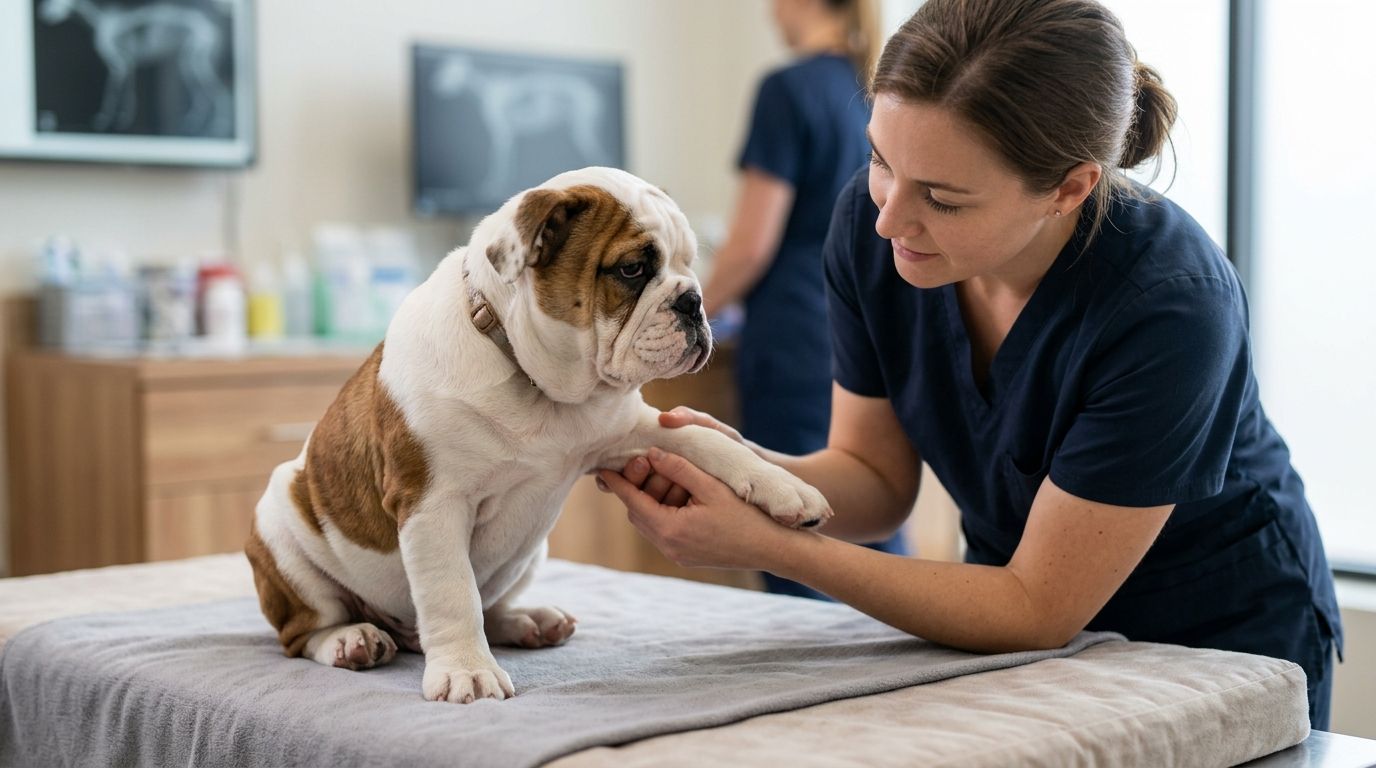
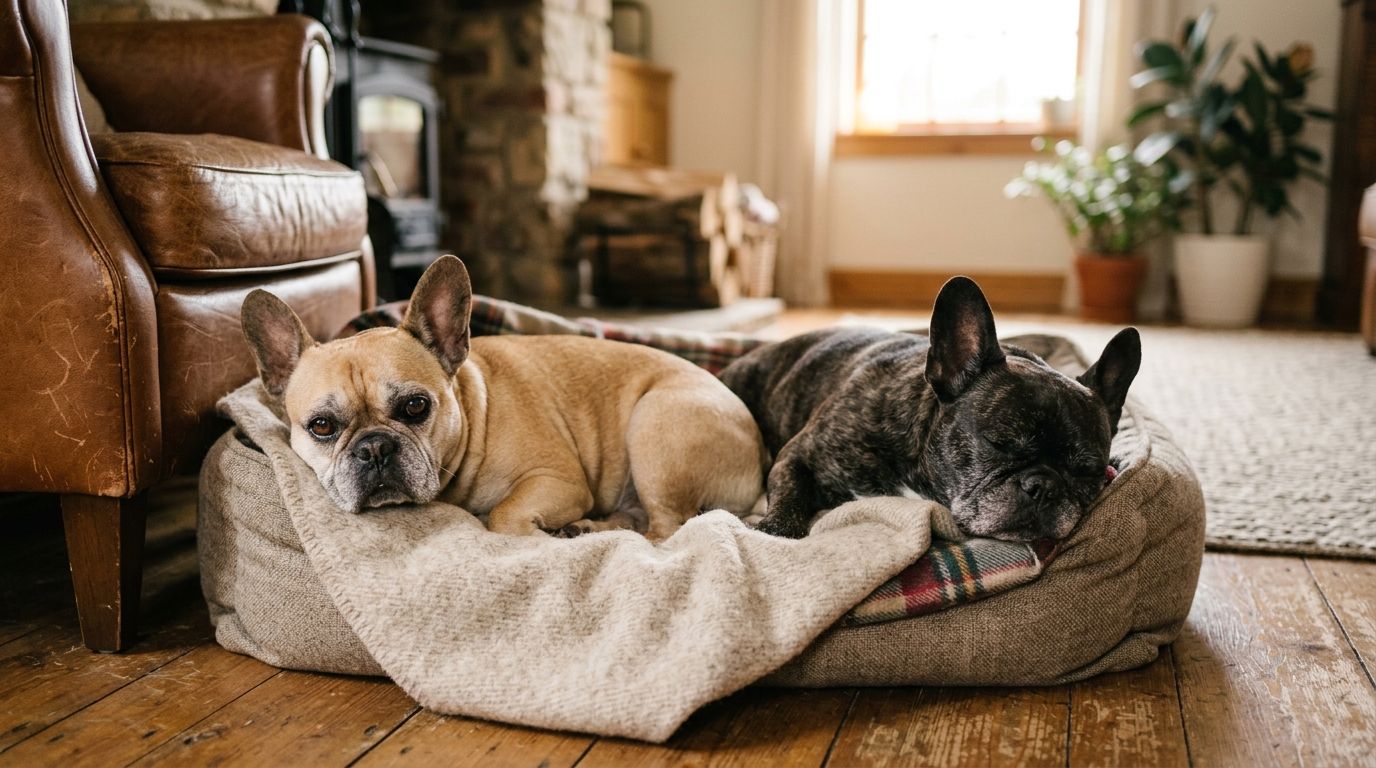
Elbow dysplasia in an English Bulldog puppy shows up as front-leg lameness that worsens after play, a short choppy "bunny hop" stride, and stiffness after naps that loosens up then returns within the hour. Symptoms most often appear between 4 and 8 months of age, while the growth plates in the elbow are still open and the joint is most vulnerable to abnormal bone growth. The hidden catch: a puppy can carry elbow dysplasia for months with almost no visible limp, because Bulldogs mask pain well and often shift weight onto the hindquarters instead of favoring one leg outright.
TL;DR
Front-leg lameness that worsens after exercise and eases with rest is the clearest early sign of elbow dysplasia in an English Bulldog puppy.
Symptoms usually surface between 4 and 8 months of age, while growth plates are still open.
OFA elbow grading runs from Normal through Grade III; only X-rays confirm the grade, never a visual check alone.
Weight control and low-impact exercise slow progression more reliably than any joint supplement on its own.
Requesting a breeder’s elbow X-ray results before buying is the single strongest prevention step available to a puppy buyer in 2026.
Key numbers on elbow dysplasia
4 to 8 months
Typical age symptoms start
Normal to Grade III
OFA elbow grading scale
Confirmed by X-ray only
Why this matters
Elbow dysplasia is a developmental fit problem between the three bones that form the elbow joint (the humerus, radius, and ulna), and it's common in breeds with a heavy, short-legged build like the English Bulldog. Left unmanaged, uneven pressure on the joint wears down cartilage early, and a puppy that seemed fine at 10 weeks can be limping consistently by 6 months.
Bulldog owners often confuse this with hip dysplasia signs, which affect the rear legs and show up as a rolling, swaying gait instead of front-leg stiffness. Both conditions can occur in the same puppy, and both get diagnosed with X-rays, not by watching a dog walk across a room. Shrinkabulls breeding stock gets screened specifically because elbow and hip problems can travel through a pedigree together.
How to spot elbow dysplasia in an English Bulldog puppy
Run through this checklist any time a puppy seems "off" after playtime or a walk:
Front-leg lameness that comes and goes — worse after exercise, better after a nap, then worse again after the next play session.
A short, choppy stride or "bunny hop" in the front legs instead of a smooth, even gait.
Elbows turned outward, paws turned inward — a visible pigeon-toed stance when the puppy stands still.
Reluctance to fully extend the front leg, or a yelp when you gently flex the elbow joint.
Muscle loss in one shoulder from consistently favoring the opposite leg over a period of weeks.
Stiffness getting up from rest that eases within a few minutes of walking, then reappears after exertion.
One or two of these on their own aren't proof of elbow dysplasia — puppies get sore from rough play all the time. Three or more of these signs together, repeating over more than a week, is the point where an X-ray stops being optional.
Grade 0: normal elbows
A Grade 0 (Normal) rating on an OFA elbow X-ray means the joint surfaces line up cleanly with no bone spurring or incongruity. Puppies at this grade show none of the checklist signs above and need no restriction beyond normal puppy exercise limits. Verdict: monitor at annual checkups, no action needed.
Grade I: mild elbow dysplasia
Grade I shows minor bone changes on X-ray — usually small osteophytes (bone spurs) under 3mm — often with subtle or no visible lameness at all. Many Grade I dogs live full, active lives with weight management and joint support alone. Verdict: manage conservatively, recheck X-rays in 12 months.
Grade II: moderate elbow dysplasia
Grade II involves more pronounced spurring and joint surface irregularity, and this is usually where the checklist symptoms above become obvious and consistent rather than occasional. A veterinary orthopedic exam typically follows to weigh medical management against surgical options. Verdict: veterinary orthopedic consult recommended.
Grade III: severe elbow dysplasia
Grade III is the most advanced stage, with significant bone remodeling and often secondary arthritis already forming by the time a puppy is diagnosed. Dogs at this grade usually show daily, visible lameness and benefit most from a full orthopedic workup rather than supplements alone. Verdict: surgical evaluation, not a wait-and-see case.
Why elbow dysplasia severity varies from puppy to puppy
Genetics and conformation — Bulldogs carry a heavy front end on short legs, which puts more load on the elbow joint than a leaner breed's frame.
Growth rate as a young puppy — fast weight gain in the first 6 months outpaces bone development and stresses the joint.
Exercise on hard surfaces — repeated jumping off furniture or running on pavement adds impact stress during the growth window.
Excess body weight — every extra pound is extra load on a joint that's already working against a compact frame.
Uneven growth between the radius and ulna — the two forearm bones need to grow at matching rates; a mismatch pulls the elbow joint out of alignment.
Lack of screening in breeding stock — parents that were never X-rayed pass along undetected joint conformation issues. Requesting a breeder's health testing panels before buying is the one step that actually reduces risk before a puppy comes home.
“If your bulldog puppy holds one front leg out or refuses to put full weight on it for more than a day, treat it as an orthopedic emergency, not a phase.”
Managing early elbow dysplasia signs in a bulldog puppy
Once a vet confirms elbow dysplasia on X-ray, day-to-day management focuses on reducing joint load rather than curing the joint itself:
Keep body weight lean. Extra weight on an already compromised elbow accelerates cartilage wear.
Swap hard-surface exercise for controlled walks. Skip repeated stair-climbing and jumping off couches during flare-ups.
Add vet-approved joint support.Joint and mobility supplements help some dogs, though they support comfort rather than reverse existing bone changes.
Is elbow dysplasia the same as hip dysplasia in Bulldogs?
No — elbow dysplasia affects the front legs while hip dysplasia affects the rear legs, and a puppy can have one, both, or neither. A rolling, swaying rear gait points toward the hips; a choppy front stride or turned-out elbow points toward the elbow joint, and each is confirmed with its own set of X-rays.
What age do elbow dysplasia symptoms start in an English Bulldog puppy?
Symptoms typically start between 4 and 8 months of age, while the puppy's growth plates are still open and the joint is developing fastest. Some mild (Grade I) cases show no visible symptoms at all until later in adulthood, which is why X-rays catch cases a visual check misses.
Can elbow dysplasia be prevented in English Bulldog puppies?
Elbow dysplasia can't be fully prevented once the genetics are in play, but Grade 0 elbow screening on both parents before breeding lowers the odds substantially. Keeping a puppy lean and limiting hard-surface jumping during the 4-to-8-month growth window also reduces how severe symptoms become if the tendency is already there.
FAQ
What does elbow dysplasia look like in an English Bulldog puppy?
It looks like front-leg lameness that worsens after play, a short choppy stride, and elbows that turn outward while the paws turn inward. Stiffness after rest that loosens with light movement is another common early sign.
Is elbow dysplasia hereditary in English Bulldogs?
Yes, elbow dysplasia has a genetic component and runs in bloodlines with poor joint conformation history. Breeding stock with Normal (Grade 0) OFA elbow scores on both sides significantly lowers the odds of passing it to puppies.
Can an English Bulldog puppy outgrow elbow dysplasia?
Mild Grade I cases can stabilize with weight management and stay symptom-free for years, but the underlying bone changes don’t reverse on their own. Moderate to severe cases (Grade II and III) typically need ongoing management or surgery rather than time alone.
What’s the difference between elbow dysplasia and hip dysplasia?
Elbow dysplasia affects the front legs and shows up as a choppy front-end stride, while hip dysplasia affects the rear legs and shows up as a rolling, swaying gait. Both are confirmed with separate X-rays and both can occur in the same dog.
How is elbow dysplasia diagnosed in a bulldog puppy?
A veterinarian confirms elbow dysplasia through X-rays graded on the OFA scale from Normal through Grade III. A physical exam and gait observation raise suspicion, but only imaging confirms the grade.
Do all English Bulldog breeders screen for elbow dysplasia?
No, not all breeders screen for elbow dysplasia, which is why asking directly for OFA elbow results on both parents matters before buying. Reputable breeders should be able to produce these results without hesitation.
Should I still buy an English Bulldog puppy if the parents weren’t elbow-tested?
Untested parents don’t guarantee a problem, but they remove your ability to gauge the risk before bringing a puppy home. Ask the breeder directly why testing wasn’t done and weigh that answer alongside the rest of the litter’s health history.
One last thing
Most bulldog buyers ask about hip screening and never think to ask about elbows, even though OFA maintains a completely separate elbow registry with its own Normal-to-Grade-III scale. Ask a breeder for both hip and elbow results, not just one — a puppy with a clean hip score can still carry an unscreened elbow risk from the other side of the pedigree. Shrinkabulls treats elbow and hip screening as a matched pair for exactly this reason, not an either-or checkbox.
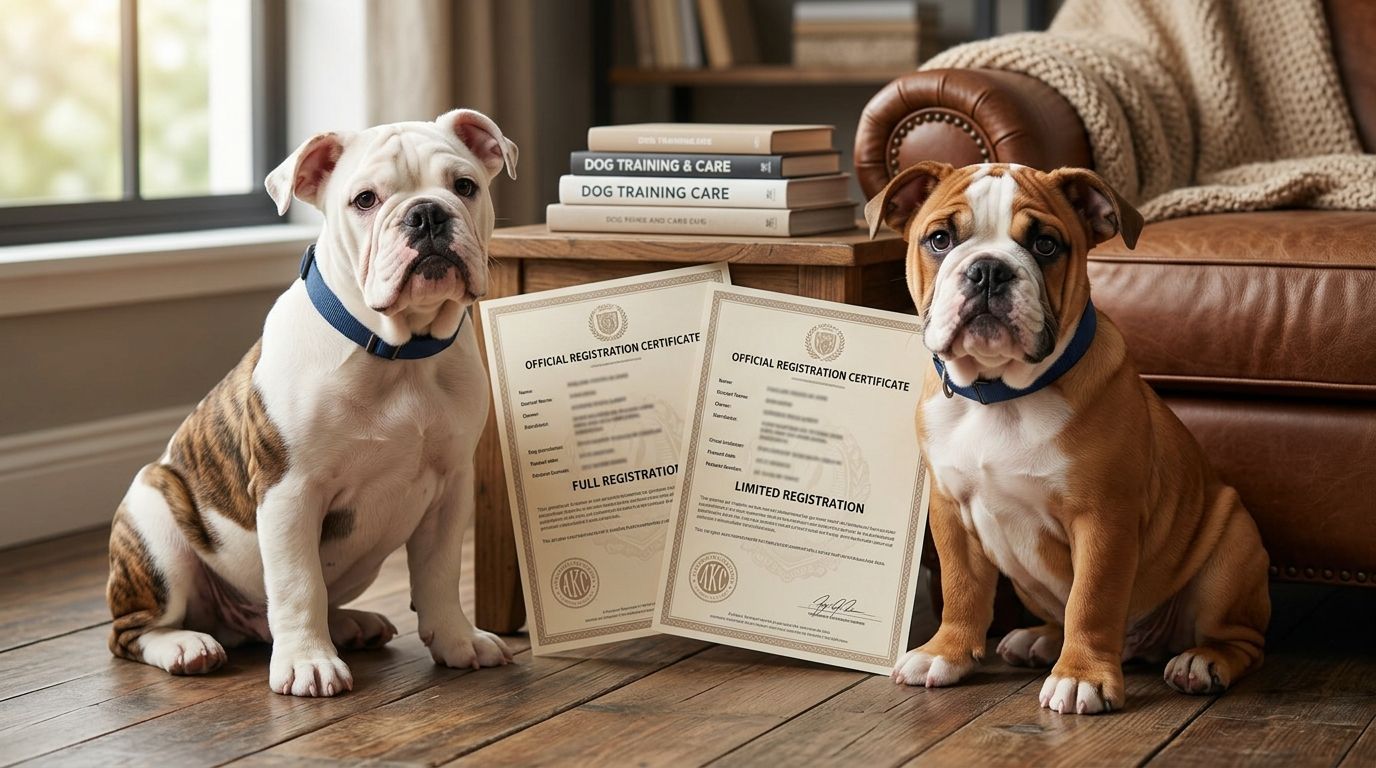
Full AKC registration lets a bulldog compete in conformation shows and lets its puppies be individually registered with the American Kennel Club; limited registration blocks both of those but still allows agility, obedience, rally, and other companion events. Most reputable breeders in 2026, including Shrinkabulls, sell pet-home puppies on limited registration and reserve full papers for buyers who've been approved for a breeding or show program.
TL;DR
Full vs limited AKC registration bulldog comes down to breeding rights and conformation-show eligibility, not the dog’s health or pedigree quality.
Limited-registration bulldogs still compete in agility, obedience, and rally under full AKC rules in 2026.
AKC lets a breeder convert a dog from limited to full registration later by signing an official change-of-status form.
Shrinkabulls sells most English and French Bulldog puppies on limited registration and reserves full papers for approved breeding-program buyers.
A litter born to a limited-registration parent cannot be individually registered with the AKC, no exceptions.
Why this matters
AKC papers get treated like a health certificate. They aren't. Full or limited registration status says nothing about hip scores, heart clearances, or how a puppy's face is built — it only controls whether the dog can be shown and whether its offspring get registered.
Breeders use registration status as a gate. It's how a program keeps rare colors, structure, and temperament out of the hands of anyone who'd breed two bulldogs together without health testing or a plan. Before you verify AKC registration papers on a puppy you're considering, know which type you're actually looking at — the paperwork looks nearly identical either way.
Full vs limited AKC registration bulldog: what actually changes
Feature
Full Registration
Limited Registration
Conformation shows
Eligible
Not eligible
Litter registration
Puppies can be registered
Puppies cannot be registered
Agility, obedience, rally
Eligible
Eligible
Ownership transfer
Unaffected
Unaffected
Microchip/ID records
Unaffected
Unaffected
Can be converted later
N/A
Yes, with breeder's signature
The table is the whole answer in one place. Everything below explains why breeders split it this way.
Full registration: what it unlocks
A bulldog with full AKC registration can enter conformation shows, and if it's bred to another fully-registered AKC dog, the resulting litter can be individually registered. This is the paperwork tier breeders extend to buyers taking on a show dog or a planned breeding program, including breeding-rights French Bulldog puppies sold specifically for that purpose. Full papers come with an expectation: the dog meets the breeder's health and structure standards well enough to pass those traits on.
Limited registration: what it restricts
A bulldog with limited registration cannot be shown in conformation, and any litter it produces cannot be registered with the AKC — even if both parents are individually AKC-registered. Performance and companion events stay open: agility, obedience, rally, tracking, and scent work all accept limited-registration dogs under AKC rules in 2026. This is the default tier for the vast majority of pet-home English and French Bulldog puppies, and it doesn't affect ownership, microchip records, or how the dog is loved at home.
“If a puppy’s papers say Limited, breeding it and registering the litter is impossible until the breeder signs a conversion form — no workaround exists.”
Why breeders choose full vs limited registration
Protecting rare-color programs. Merle, lilac, and blue bloodlines take generations to plan correctly, and an unapproved breeding can undo years of selective pairing.
Health testing standards. Breeding rights typically go to dogs that clear the health screenings a breeder requires before a puppy joins a program.
Preventing unplanned litters. Limited registration is a practical brake on backyard breeding of dogs that were never meant to reproduce.
Contract and stud terms. Registration status is usually written directly into the sales contract, alongside spay/neuter timelines and any stud fee and breeding contract terms.
Buyer intent. A buyer planning to show or breed asks for full registration up front; a buyer wanting a companion dog rarely needs it.
AKC's own rule. The AKC has offered this two-tier system since 1990, and it applies the same way across all AKC-recognized breeds, not just bulldogs.
Ask about registration status before you buy
See which puppies are offered on full vs limited papers.
Can limited registration be changed to full registration?
Yes — the breeder who sold the dog is the only one who can convert limited registration to full, by signing and submitting an AKC change-of-registration form. It's common for a breeder to agree to this after a dog clears health testing or matures into breeding condition, but the buyer can't force the change unilaterally.
Can a limited-registration bulldog still compete in AKC events?
A limited-registration bulldog cannot enter conformation shows, but it's fully eligible for agility, obedience, rally, and other AKC companion events in 2026. The restriction is narrow: it blocks the show ring and litter registration, nothing else.
Does full registration mean a healthier puppy?
No — full vs limited AKC registration bulldog status reflects a breeder's decision about breeding rights, not a health guarantee on its own. A puppy's actual health depends on its pedigree chart and the parents' test results, which is worth reviewing regardless of which registration tier the puppy is sold on.
FAQ
What’s the difference between full and limited AKC registration for a bulldog?
Full registration allows conformation showing and litter registration; limited registration allows companion events like agility and obedience but blocks both showing and registering any offspring.
Can you breed a dog with limited AKC registration?
You can breed a limited-registration bulldog, but the resulting puppies cannot be individually registered with the AKC under any circumstance until the parent’s status is converted to full.
Is limited registration a bad sign when buying a bulldog puppy?
No, limited registration is the standard, responsible choice most breeders use for pet-home puppies in 2026 to keep breeding decisions with the program that raised the dog.
How do you change limited AKC registration to full?
The original breeder submits a signed AKC change-of-registration form; the buyer cannot make this change without the breeder’s cooperation.
Can a limited-registration bulldog still compete in agility or obedience?
Yes, limited-registration bulldogs are fully eligible for agility, obedience, rally, and other AKC companion events; only conformation shows and litter registration are restricted.
Does full registration mean a puppy is healthier?
No, registration status reflects breeding rights, not health status; health depends on the parents’ testing and the individual puppy’s structure, regardless of full or limited papers.
What happens if a litter comes from a limited-registration parent?
That litter cannot be registered with the AKC at all, even if the other parent carries full registration, which is why breeding contracts spell out registration status clearly.
Do all bulldog breeds use the same AKC registration system?
Yes, the AKC has applied the same full vs limited registration system across all its recognized breeds, more than 200 in total, since introducing it in 1990.
One last thing
The conversion form is the detail most buyers miss: only the breeder who originally registered the litter can sign it, which means a limited-registration bulldog stays limited forever if that breeder is unreachable or unwilling. Get the registration status confirmed in writing before you commit to a puppy, not after, and ask directly whether the breeder has ever converted a dog's status before — Shrinkabulls puts registration terms in the sales contract for every English and French Bulldog puppy, full or limited, before a deposit changes hands.
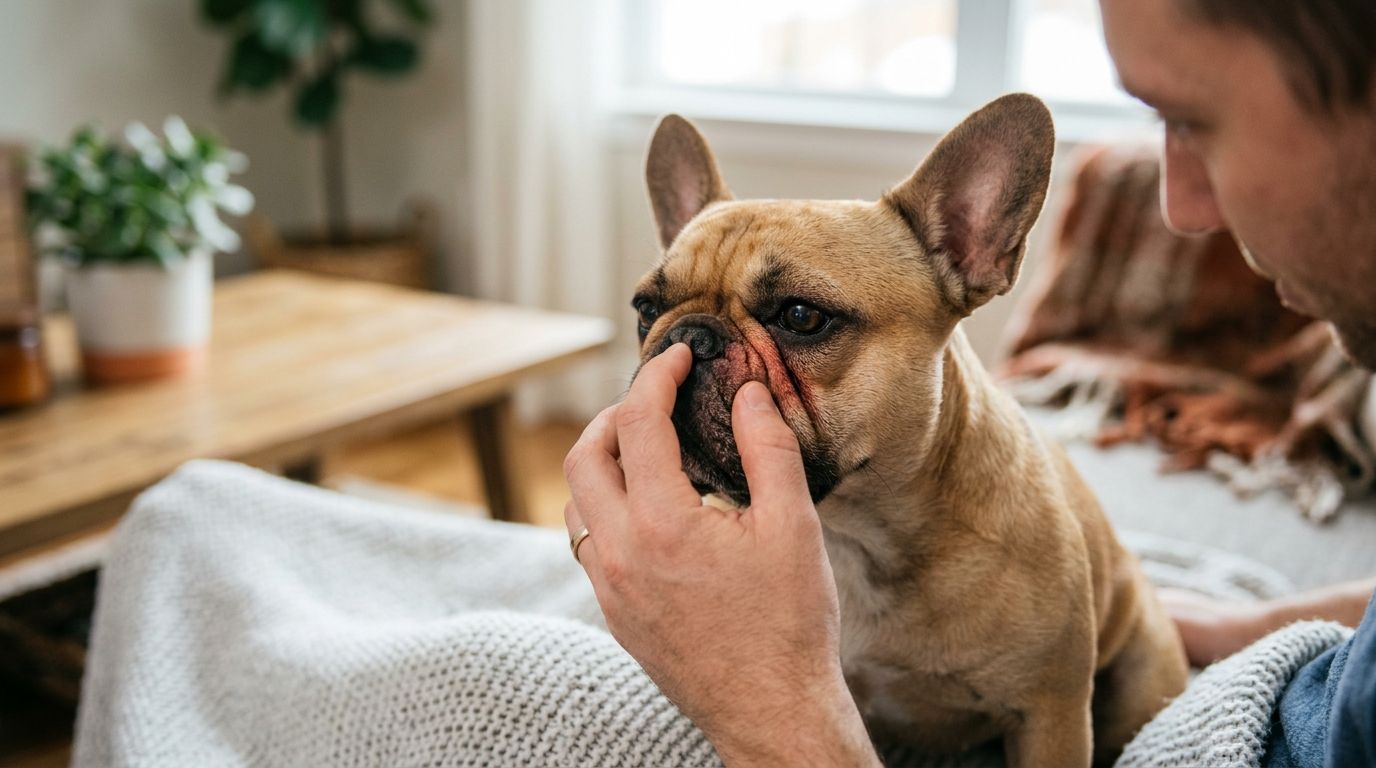
A yeast infection in a French Bulldog's skin folds shows up as reddish-brown or greasy skin, a musty "corn chip" smell, and sometimes a crusty discharge in the nose roll, cheek folds, or tail pocket. Most mild cases clear up in 10 to 14 days with a strict wipe-and-dry routine and a vet-approved antifungal product, but left alone the yeast (usually Malassezia) spreads to raw, itchy skin that a Frenchie will lick and chew until a secondary bacterial infection sets in.
TL;DR
A yeast infection french bulldog skin folds case smells like corn chips and looks reddish-brown before it ever looks ‘infected.’
Mild cases clear in 10-14 days with daily chlorhexidine or antifungal wipes and thorough drying.
Moderate to severe cases need a vet-prescribed antifungal cream or oral medication, not just better wiping.
Untreated fold yeast turns into raw skin, chewing, and secondary bacterial infections that take longer and cost more to fix.
French Bulldogs need fold checks year-round in 2026, not just during humid months.
Why This Matters
French Bulldog anatomy is the whole problem. Deep facial wrinkles, a tight nose roll, and a tail pocket trap moisture, oil, and dead skin cells against warm skin, which is exactly the environment Malassezia yeast needs to multiply. A Frenchie that gets a bath, a swim, or even a slobbery play session and doesn't get dried properly can develop a fold infection within days.
Here at Shrinkabulls, we build a daily wrinkle-fold grooming routine into every French Bulldog puppy's care plan before it ever goes home, because catching yeast early is the difference between a five-minute wipe-down and a two-week vet-supervised treatment. Ignoring the smell or the discoloration doesn't make it go away in 2026 any more than it did a decade ago — Malassezia keeps feeding as long as the fold stays warm and damp.
How to Manage a Yeast Infection in a French Bulldog's Skin Folds
Treatment follows the same sequence whether the fold is the nose roll, the cheek, or the tail pocket.
Identify every affected fold. Separate the skin gently and check the nose roll, cheek folds, neck rolls, and tail pocket — yeast rarely stays in just one spot on a Frenchie.
Clean with a diluted antiseptic or antifungal wipe. A chlorhexidine-based wipe or solution is standard for canine fold dermatitis; work it into the fold, not just across the surface.
Dry completely. Use a soft cloth or a cool hairdryer setting — trapped moisture is what restarts the yeast cycle, so this step matters as much as the cleaning step.
Apply a vet-approved antifungal balm or powder.Wrinkle balms and wipes formulated for bulldog folds help keep the area dry between cleanings, not just clean.
Repeat once or twice daily until the smell, redness, and discharge are gone — usually 10 to 14 days for mild cases.
Recheck at day 5 to 7. No improvement by then means the case has moved past a home-care routine.
Mild Fold Yeast: Daily Wipe-Down Routine
Mild fold yeast looks like slight discoloration and a faint odor with no open skin or bleeding. A daily wipe-and-dry routine with an antifungal wipe, followed by a thin layer of medicated balm, resolves most mild cases in 2026 without a vet visit. Verdict: manageable at home if you catch it early.
Moderate to Severe Fold Yeast: Vet-Prescribed Treatment
Moderate to severe fold yeast comes with visible redness, thickened or crusty skin, an intense smell, and a dog that scratches or chews at the fold constantly. This tier needs a vet-prescribed antifungal cream, an oral antifungal, or both, plus a recheck to confirm the infection has actually cleared and hasn't become bacterial. Verdict: skip the home-remedy approach and book a vet experienced with brachycephalic breeds instead.
Severity
Signs
Treatment
Typical Timeline
Mild
Faint smell, slight discoloration, no broken skin
Daily antifungal wipe + balm
10-14 days
Moderate to severe
Strong odor, thickened/crusty skin, constant licking or chewing
Vet-prescribed antifungal cream or oral medication
2-4 weeks, with recheck
Why Yeast Infections Keep Coming Back in French Bulldog Folds
Deep or tight folds trap more moisture than shallow folds and never fully air-dry on their own.
Hot, humid climates speed up yeast growth even between baths, which is why fold checks matter year-round in 2026, not just summer.
Underlying allergies (food or environmental) keep the skin inflamed and more hospitable to yeast overgrowth.
Incomplete drying after baths or swims is the single most preventable cause of recurring fold yeast.
Tail pocket structure on some French Bulldogs holds moisture even better than facial folds and gets missed during routine grooming.
Skipping maintenance between flare-ups lets yeast populations rebuild before the next visible infection.
“If the folds smell like corn chips before they look red, the yeast is already established.”
What Does a Yeast Infection Look Like in a French Bulldog's Folds?
A yeast infection in a French Bulldog's folds looks reddish-brown to dark, feels greasy or slightly crusty, and carries a distinct musty or "corn chip" odor before the skin ever looks visibly damaged. The nose roll, cheek folds, and tail pocket are the most common spots because they trap the most moisture on a Frenchie's body.
Can I Treat a French Bulldog's Fold Yeast Infection at Home?
Yes, mild fold yeast infections respond to a home routine of daily antifungal wipes, thorough drying, and a medicated balm in most cases within 10 to 14 days. Cases with broken skin, bleeding, thickened tissue, or no improvement after a week need veterinary treatment instead of continued home care.
How Long Does It Take to Clear a Yeast Infection in the Folds?
Mild fold yeast typically clears in 10 to 14 days with consistent daily care, while moderate to severe cases treated with vet-prescribed antifungals can take 2 to 4 weeks including a follow-up recheck. Stopping treatment early, even when the smell fades, is the most common reason yeast comes right back within a month.
If you're bringing home a French Bulldog puppy in 2026, ask your breeder how folds were checked and cared for before the puppy left — Shrinkabulls builds fold checks into every puppy's routine so new owners start with clean, dry skin instead of a hidden problem.
Reserve a French Bulldog puppy
Ask about fold care and health screening before you put down a deposit.
What causes a yeast infection in a French Bulldog’s skin folds?
Trapped moisture, oil, and warmth in deep facial folds and the tail pocket let Malassezia yeast overgrow. Allergies, humid climates, and incomplete drying after baths make it worse.
Is a yeast infection in the folds contagious to other dogs?
No, Malassezia fold dermatitis is not typically contagious between dogs since it develops from the dog’s own skin environment rather than spreading through contact.
How often should I clean a French Bulldog’s folds to prevent yeast?
Wipe and dry the folds once daily as a baseline, and check them again after any bath, swim, or heavy play session in warm weather.
Can diet affect yeast infections in the folds?
Yes, food allergies and sensitivities can keep skin inflamed and more prone to yeast overgrowth, so a vet may recommend a diet change alongside topical treatment.
What’s the difference between fold yeast and fold dermatitis?
Fold dermatitis is the general inflammation of skin folds, while yeast infection is one specific cause of it identified by the corn-chip smell and greasy texture; a vet confirms the cause with a skin swab.
Do French Bulldogs get yeast infections more than other bulldogs?
French Bulldogs’ tighter facial folds and prominent tail pocket trap more moisture than many other breeds, making fold yeast a more frequent issue for the breed overall.
When should I take my French Bulldog to the vet for fold yeast?
See a vet if there’s no improvement after 5 to 7 days of home care, if the skin is broken or bleeding, or if the odor and discharge get worse instead of better.
Can untreated fold yeast lead to bigger health problems?
Yes, untreated yeast infections cause raw, painful skin that a dog licks and chews, which frequently develops into a secondary bacterial infection needing antibiotics.
One Last Thing
The tail pocket gets missed more often than any facial fold because owners forget it's there until the smell shows up. A quick daily check of that spot, not just the nose roll and cheeks, catches most fold yeast before it needs a vet visit — and it's the one fold Shrinkabulls tells every new French Bulldog owner to check first in 2026.
French Bulldog puppies with a food allergy show up with itchy paws, red ears, loose stool, or a rash around the muzzle within a few hours to a few days of eating the trigger ingredient — chicken and beef top the list of common culprits in the breed. The tricky part is that these symptoms overlap almost exactly with environmental allergies and normal brachycephalic skin fold issues, so an elimination diet run over 8 to 12 weeks is the only reliable way to confirm it's food and not something else.
TL;DR
Food allergies in a French Bulldog puppy show as itchy skin, ear infections, and loose stool, not sneezing or watery eyes.
Chicken, beef, dairy, and wheat cause most confirmed reactions in Frenchies as of 2026.
An 8-12 week elimination diet with a novel or hydrolyzed protein is the only real diagnostic tool — blood panels are unreliable.
Symptoms that start within hours of a meal point to food; symptoms tied to season point to environment.
Shrinkabulls feeds a consistent puppy diet before pickup specifically to reduce false alarms during a new home transition.
Why this matters
French Bulldogs already carry more skin fold and gut sensitivity than most breeds, so an owner who misreads a food allergy as "just a Frenchie thing" can let a treatable problem run for months. Left alone, chronic itching turns into hot spots and secondary skin infections, and chronic GI upset can slow growth in a puppy that's already working with a compressed airway and a sensitive stomach. Catching the pattern early means a diet swap; missing it means a vet bill and a puppy that's miserable in the meantime.
We've fielded this question from a lot of new Shrinkabulls families in 2026, usually in the first two to four weeks after a puppy comes home — which happens to be exactly when a diet transition can mask or mimic a real allergy.
How to identify food allergies in a French Bulldog puppy
The process is diagnostic, not guesswork. Work through it in order rather than jumping straight to a special diet.
Log every symptom with a date and time. Note whether it's skin (itching, redness, hair loss around the ears, paws, or belly) or digestive (soft stool, gas, vomiting).
Check the timing against meals. A reaction that shows up within a few hours of eating and repeats with the same food is a strong food signal. A reaction tied to spring, humidity, or a new detergent points to environment instead.
Rule out parasites and infection first. A vet exam and stool check clears out giardia, mites, or yeast, which mimic allergy symptoms almost perfectly in bulldogs.
Start an elimination diet. Feed a single novel protein (rabbit, kangaroo, venison) or a hydrolyzed prescription diet, and nothing else — no treats, no table scraps — for 8 to 12 weeks.
Reintroduce ingredients one at a time. Add back the old protein source for a week and watch for the symptoms to return. That's your confirmation.
Food allergy vs. environmental allergy vs. normal puppy behavior
Sign
Food Allergy
Environmental Allergy
Normal Puppy Behavior
Itchy ears/paws
Yes, often year-round
Yes, seasonal
Occasional scratching, not chronic
Loose stool
Common, tied to meals
Rare
Occasional, tied to diet change
Onset
Hours to 2 days after eating
Seasonal or after outdoor exposure
Not applicable
Response to diet change
Improves in 8-12 weeks
No change
Not applicable
Skin redness
Muzzle, ears, belly, paws
Face, paws, armpits
None chronic
A French Bulldog puppy scratching year-round with loose stool almost always has a food trigger — one that only flares in spring almost never does.
Why French Bulldog food allergies vary from puppy to puppy
Not every Frenchie reacts to the same ingredient, and severity swings widely even within one litter. A few things drive that:
Protein exposure history — a puppy fed chicken from birth builds sensitivity faster than one on a rotated protein diet.
Genetics and littermate patterns — allergy tendency runs in bloodlines, similar to skin fold sensitivity.
Gut maturity — a puppy's digestive lining is still developing through 2026's first year of life, so reactions can look worse at 10 weeks than at 6 months.
Ingredient quality and fillers — cheap kibble with multiple protein sources makes it harder to isolate the actual trigger.
Stress from a home transition — a new environment alone can cause loose stool that looks like an allergy but resolves on its own within a week.
Concurrent skin issues — bulldogs prone to fold infections or yeast overgrowth often get misdiagnosed with a food allergy when the real driver is topical.
Related questions
How long does it take to identify a food allergy in a French Bulldog puppy?
8 to 12 weeks is the standard elimination diet window vets use to confirm a food allergy in a French Bulldog puppy. Shorter trials often produce false negatives because gut inflammation takes weeks to fully settle.
Can a French Bulldog puppy outgrow a food allergy?
Some puppies do improve as the gut matures, but a confirmed reaction to a specific protein like chicken or beef typically persists into adulthood. Most owners manage it long-term with a consistent limited-ingredient diet rather than waiting for it to resolve.
What's the most common food allergy trigger for French Bulldogs?
Chicken and beef are the two most frequently confirmed triggers in French Bulldogs, followed by dairy and wheat-based fillers. Novel proteins like duck, rabbit, or venison are the usual starting point for an elimination trial.
If your Frenchie is still on breeder food and headed toward a diet switch, transitioning from breeder food to a home diet slowly over 7-10 days reduces the odds of a false allergy flag from the switch itself. And because French Bulldog symptoms overlap so heavily with skin fold and breathing issues unique to the breed, working with a vet experienced with brachycephalic breeds from day one saves you from chasing the wrong diagnosis.
Looking for a French Bulldog puppy in 2026?
See available litters raised on a consistent, gut-friendly diet before pickup.
Every Shrinkabulls puppy leaves on the same diet they've been raised on so new owners have a stable baseline before any allergy testing starts. If a symptom shows up in week one, that consistency is what lets you separate a real food reaction from a stress reaction to the move.
FAQ
What are the first signs of a food allergy in a French Bulldog puppy?
The first signs are usually itchy paws or ears, redness around the muzzle, and loose stool that shows up within hours of a meal. Chronic ear infections that don’t clear with treatment are another early red flag in French Bulldogs specifically.
How much does it cost to test a French Bulldog puppy for food allergies?
Blood and saliva allergy panels are widely available but considered unreliable by most veterinary dermatologists for food allergies specifically. An elimination diet trial, which relies on a prescription or novel-protein food over 8-12 weeks, is the diagnostic method vets actually trust.
Is it food allergies or a skin fold infection?
A skin fold infection stays localized to the folds around the face, tail, or vulva and often has an odor, while a food allergy causes broader itching across the ears, paws, and belly. Both can occur at once, which is why a vet exam should come before starting an elimination diet.
Can French Bulldog puppies be allergic to chicken?
Yes, chicken is one of the two most common confirmed food allergy triggers in French Bulldogs, alongside beef. A novel protein like duck, rabbit, or venison is the standard substitute during an elimination trial.
What should I feed a French Bulldog puppy with food allergies?
A single novel protein or a hydrolyzed prescription diet, fed with zero treats or table scraps, is the standard approach during the 8-12 week diagnostic window. Once the trigger is confirmed, most owners stay on a limited-ingredient diet built around that safe protein long-term.
How is a food allergy different from a puppy just adjusting to a new home?
A stress reaction from a new home typically resolves within a week and doesn’t repeat with every meal, while a true food allergy is consistent and tied directly to what’s being eaten. If loose stool or itching persists past 10-14 days after settling in, it’s worth starting the elimination process rather than waiting it out.
Do French Bulldogs get more food allergies than other breeds?
French Bulldogs are considered one of the more allergy-prone breeds due to their already sensitive skin and gut, though exact prevalence data varies by source. Their skin folds also make allergy symptoms easier to notice early compared to smoother-coated breeds.
One last thing
The detail most owners miss: a food allergy in a French Bulldog puppy almost never shows up as sneezing or watery eyes the way it might in a person — it shows up on the skin and in the gut, full stop. If your puppy's symptoms are respiratory, look at brachycephalic breathing issues instead of chasing a diet change that won't fix it.
Merle bulldogs carry a diluted pigment gene that leaves the nose leather, eye rims, and often patches of skin lighter than a standard-colored pup — which means more UV gets through where it shouldn't. Sun protection for merle bulldog puppies isn't a nice-to-have accessory; it's a health decision, and getting it wrong shows up as sunburn, cracked noses, and long-term skin damage. This guide ranks five sun-protection categories that hold up for merle, lilac, and blue bulldogs in 2026, and tells you exactly where each one falls short.
TL;DR
Dog-safe mineral sunscreen stick wins overall for merle bulldog puppies with pink noses or light skin patches.
UPF 50+ sun shirts are best for merle bulldogs spending hours outdoors in hot, sunny climates.
Zinc oxide sunscreen is off the list entirely — it’s toxic if a bulldog licks it off its own nose.
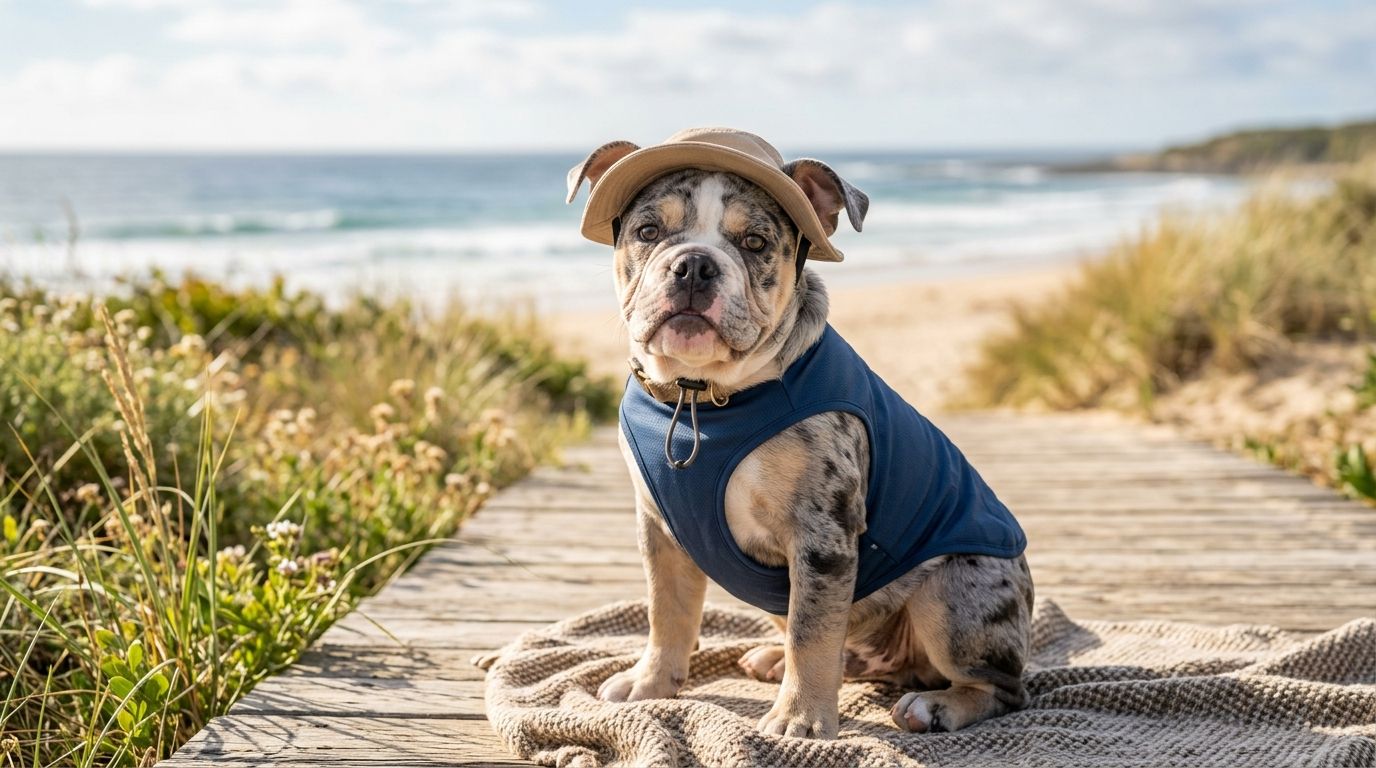
A wide-brim dog sun hat is the right call for the light, sensitive eyes common in merle bulldogs.
Sun exposure numbers to know
UPF 50+
Fabric UV block rating
blocks roughly 98% of UV rays
10 a.m.-4 p.m.
Peak UV hours to avoid
2 hours
Typical sunscreen reapplication window
Why this matters for merle bulldogs specifically
Standard fawn or brindle bulldogs already deal with short, thin coats and exposed skin at the muzzle. Merle bulldogs stack a second risk factor on top: the same gene that produces the mottled, marbled coat pattern also dilutes pigment in the nose, lips, and sometimes the eye rims. Less pigment means less natural UV defense.
Families raising a merle bulldog puppy in a hot, sunny climate see this play out fastest — a pink-nosed pup left in direct sun for an unsupervised afternoon can burn in a single outing. Over months and years, repeated sun exposure on unprotected pink skin raises the risk of solar dermatitis and, eventually, skin cancer in light-pigmented dogs. That is standard veterinary guidance for any dog with reduced pigment, but bulldogs' flat faces and short coats make the exposed areas harder to shield with a bandana alone.
At Shrinkabulls, we get asked about merle sun protection constantly by families picking up a rare-color puppy, because the coat pattern that makes these dogs so striking is the exact trait that puts their skin at risk.
What makes the best sun protection for merle bulldog puppies
Zinc-free formulation. Zinc oxide is a common human sunscreen active and it is toxic to dogs if ingested — bulldogs lick everything, so this is a hard disqualifier.
Coverage of the right zones. Nose leather, ear tips, belly skin, and eye rims are the areas merle bulldogs actually need shielded.
UPF rating on fabric options. A garment rated UPF 50+ blocks about 98% of UV radiation and never needs reapplication.
Wearability on a brachycephalic body. Anything that restricts airflow around the muzzle or chest works against a breed that already struggles to regulate heat.
Reapplication practicality. Topical products only help if you'll actually reapply them every couple of hours on a hot day.
Made for dogs, not repurposed. Products formulated specifically for dogs beat human sunscreen every time.
At a glance: sun protection options for merle bulldog puppies
Option
Best for
Standout feature
Key limitation
Dog-safe mineral sunscreen stick
Pink noses and exposed belly skin
Zinc-free formula, safe if licked
Reapply roughly every 2 hours
UPF 50+ sun shirt
Long outdoor time in hot climates
Blocks ~98% of UV with nothing on the skin
Leaves nose and ears uncovered
UV-blocking cooling vest
Combined heat and sun exposure
Doubles as a cooling layer for breathing relief
Covers torso only, not the face
Wide-brim dog sun hat
Light, photosensitive eyes
Shades eyes and cuts glare
Many bulldogs paw it off
UV window film or car shades
Car rides and travel days
Passive protection, nothing worn
Useless once the dog is outside the car
1. Dog-safe mineral sunscreen stick: best sun protection for merle bulldog puppies with pink noses
A zinc-free mineral stick applied to the nose, ear tips, and any bare belly skin is the most direct fix for the pigment gap merle bulldogs carry. It goes exactly where the sun hits hardest and doesn't restrict movement or airflow.
Mineral sunscreen stick pros:
Targets the exact exposed areas merle bulldogs lack pigment on
Safe if the puppy licks it, unlike zinc oxide human products
Applies in under a minute before a walk
Mineral sunscreen stick cons:
Needs reapplication roughly every 2 hours outdoors, easy to forget
Some puppies rub their face and remove it within minutes
Does nothing for eye glare or heat buildup
Best for: merle bulldog puppies with visibly pink or light-pigmented noses. Verdict: Buy.
2. UPF 50+ sun shirt: best sun protection for merle bulldog puppies in hot climates
A lightweight UPF 50+ shirt covers the back, sides, and chest with no topical product involved. That matters for owners who can't realistically reapply sunscreen every two hours during a full day outside in the summer of 2026.
UPF sun shirt pros:
Passive protection that never wears off
Blocks roughly 98% of UV across the torso
Breathable fabric options exist that don't trap heat against the skin
UPF sun shirt cons:
Leaves the nose, ears, and face completely exposed
A poorly fitted shirt rubs the skin folds bulldogs already struggle with
Adds a layer on a breed that overheats fast
Best for: merle bulldogs spending extended time outdoors in high-UV regions. Verdict: Buy.
3. UV-blocking cooling vest: best sun protection for merle bulldog puppies facing heat and sun together
This is the two-problems-one-product pick. A cooling vest built for bulldogs in hot weather that also carries a UV-block rating handles sunburn risk and overheating risk at the same time — and overheating is the faster killer in a brachycephalic breed.
Cooling vest pros:
Addresses heat regulation and sun exposure in one garment
Useful most of the year in warm climates, not just July
Sits over the torso without pressing on the airway
Cooling vest cons:
Covers nothing above the shoulders
Has to be wetted or activated correctly to cool at all
Some bulldogs need a break-in period before they tolerate it
Best for: merle bulldogs in climates where heat and peak UV arrive together. Verdict: Buy.
4. Wide-brim dog sun hat: best sun protection for merle bulldog puppies with light eyes
Merle bulldogs frequently carry lighter eye pigment, which makes them more sensitive to glare than a dark-eyed pup. A wide-brim, adjustable hat shades the eyes and the top of the skull in a way no cream can.
Sun hat pros:
Shields pale, glare-sensitive eyes directly
Covers the top of the head and the ear base
Reusable, nothing to reapply
Sun hat cons:
Plenty of bulldogs refuse headgear and paw it straight off
Protects neither the nose nor the belly
Fit is fussy on a broad bulldog skull, so sizing matters
Best for: merle bulldog puppies with pale eyes who squint in bright sun. Verdict: Hold — worth trying, but budget a training period.
5. UV window film or car shades: best sun protection for merle bulldog puppies on travel days
Every merle bulldog puppy ends up in a car — vet visits, road trips, pickup day. Window film or clip-on shades cut direct sun through the glass with nothing worn on the dog.
Car UV shade pros:
Zero tolerance issues since nothing touches the dog
Protects on long drives when a puppy can't move out of a sunbeam
One-time install for film, reusable for clip-ons
Car UV shade cons:
Does nothing the moment the dog steps outside
Cheap film peels and bubbles
Doesn't address the outdoor exposure that causes most burns
Best for: families doing regular or long-distance car trips with a merle bulldog puppy. Verdict: Buy as a supplement, never as the whole plan.
How we ranked these
Every pick was scored against the criteria above: pigment-gap coverage, zinc-free safety, UPF rating where relevant, and real wearability on a flat-faced body. Options that solve only one piece — heat, glare, or nose exposure — were ranked by which single problem they solve best, not penalized for failing to be an all-in-one.
“A merle bulldog’s nose has less pigment to begin with, so sun protection is compensating for a gap, not just adding a layer.”
Which sun protection should you choose for a merle bulldog puppy?
For most families: start with a zinc-free mineral sunscreen stick on the nose and belly, then add a UPF 50+ shirt for long outdoor days. That pair covers both the pigment gap and the broader UV load a merle bulldog picks up outside in 2026. Hot climate? Layer in the cooling vest. Pale eyes and constant squinting? The hat earns its place once the puppy tolerates wearing it.
Bringing home a merle bulldog puppy?
Reserve early and set up your sun-care routine before pickup day.
What is the best sun protection for merle bulldog puppies?
A zinc-free mineral sunscreen stick on the nose and belly, paired with a UPF 50+ shirt for long outdoor sessions, covers the most ground for a merle bulldog puppy in 2026.
Is human sunscreen safe for a bulldog?
No. Most human sunscreen contains zinc oxide, which is toxic to dogs if licked off the skin. Use a formula made specifically for dogs.
Do merle bulldogs sunburn more easily than standard-colored bulldogs?
Yes. The merle gene dilutes pigment in the nose, skin, and sometimes the eyes, leaving less natural UV defense than a solidly pigmented bulldog.
What time of day is UV worst for a bulldog puppy?
UV peaks between 10 a.m. and 4 p.m. That window is when a merle bulldog puppy most needs shade or applied protection.
Do lilac and blue bulldogs need sun protection too?
Yes. Lilac, blue, and merle bulldogs all carry diluted pigment, so the same sun-protection rules apply across all three.
How do I protect a bulldog puppy’s eyes from glare?
A wide-brim, adjustable dog sun hat shades the eyes directly. This matters more for merle bulldogs with pale eye pigment than for dark-eyed dogs.
How often should sunscreen be reapplied on a bulldog?
Roughly every 2 hours during active outdoor time, and immediately after swimming or heavy panting wipes the product off.
How much does sun protection for a bulldog puppy cost?
Costs vary widely by brand and coverage type. Check current retail pricing before buying rather than relying on a fixed figure.
One last thing
The detail most new merle owners miss: sun damage on a pink nose rarely looks like a burn first. It shows up as dry, flaky, or cracked nose leather days before any redness appears. Check the nose daily through summer 2026, not just after long walks, and treat dryness as the early warning it is.
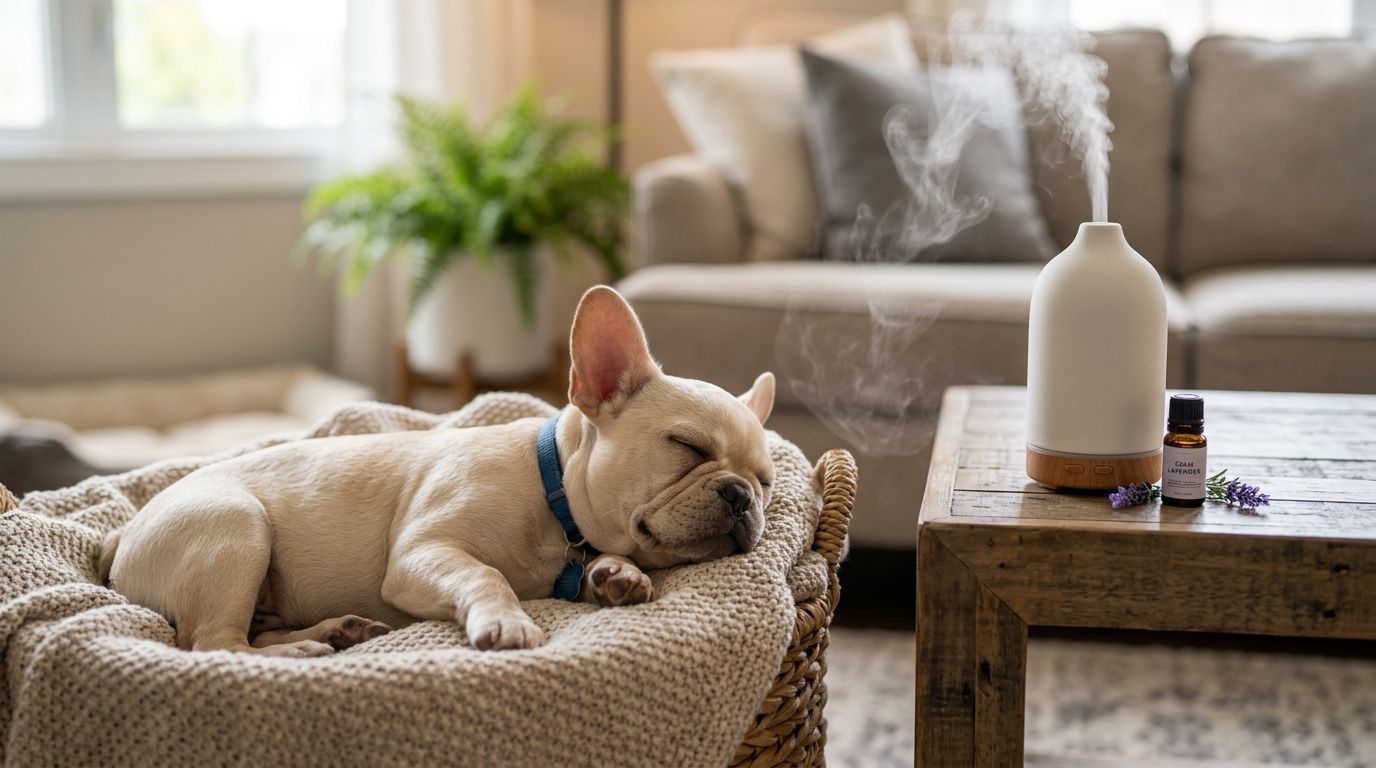
The best calming diffuser for French Bulldog puppies in 2026 is the ThunderEase Calming Diffuser Kit for Dogs — it runs on dog-appeasing pheromone (DAP) instead of a scented oil blend, which matters for a brachycephalic breed with a narrower airway than most. Pet Remedy Plug-In Diffuser wins for multi-dog households, Adaptil On-The-Go is the pick for car rides and travel anxiety, and Comfort Zone Calming Diffuser is the budget-friendly entry point for first-time owners testing the category.
TL;DR
ThunderEase Calming Diffuser Kit is the best calming diffuser for French Bulldog puppies overall in 2026.
Pet Remedy Plug-In Diffuser suits multi-dog homes; Adaptil On-The-Go handles car rides and travel anxiety.
Skip pure essential-oil diffusers — strong scents can irritate a Frenchie’s already narrow airway.
Comfort Zone Calming Diffuser is the budget pick for first-time owners testing calming aids.
A diffuser works best paired with crate training, not as a standalone fix for separation anxiety.
Key numbers
30 days
Typical pheromone diffuser refill life
8-16 weeks
Peak puppy socialization window
Why this matters
French Bulldog puppies pant, pace, and vocalize when they're anxious, and because they're brachycephalic, that stress response taxes their breathing more than it would in a longer-nosed breed. A calming diffuser doesn't fix separation anxiety on its own — it takes the edge off while you do the actual training work, which is why managing separation anxiety in a French Bulldog puppy still matters more than the plug-in itself.
We get asked about calming diffusers constantly by families picking up a Shrinkabulls puppy, especially first-time Frenchie owners nervous about the first few nights home. The honest answer: the right diffuser helps, the wrong one (usually a strong essential-oil blend) can actually irritate a short-faced dog's airway. That distinction is the whole ranking below.
What makes the best calming diffuser for French Bulldog puppies
Pheromone or valerian-based formula, not a synthetic "calming" essential oil blend marketed for humans
No heat element or strong airborne scent that could bother a brachycephalic breed's sensitive breathing
A predictable refill cycle so coverage doesn't lapse mid-adjustment period
Single-room coverage that's honest about its limits rather than vague "whole house" marketing claims
A portable or travel version for crate and car use, not just a wall unit
A track record with dogs specifically, not a repurposed aromatherapy product
Calming diffusers for French Bulldog puppies at a glance
Diffuser
Best for
Standout feature
Key limitation
ThunderEase Calming Diffuser Kit
General home anxiety
DAP pheromone mimics nursing-mother signals
Only treats the room it's plugged into
Pet Remedy Plug-In Diffuser
Multi-dog or multi-pet homes
Valerian-based blend works across species
Herbal scent is more noticeable to people
Adaptil On-The-Go
Car rides and travel
Portable, clips to a crate or car seat cover
Needs reapplication every few hours
Comfort Zone Calming Diffuser
First-time owners on a budget
Simple plug-in, widely stocked at pet retailers
Fewer clinical citations than Adaptil-line products
1. ThunderEase Calming Diffuser Kit for Dogs: best calming diffuser for French Bulldog puppies overall
ThunderEase plugs directly into a wall outlet and releases a synthetic version of the dog-appeasing pheromone (DAP) a mother dog produces while nursing. It runs passively in the background of a bedroom, living room, or crate area without any scent strong enough to bother a puppy's airway.
ThunderEase pros:
No essential oils, so it's gentler on a brachycephalic dog's breathing
Passive — no app, no timer, no daily maintenance
Refill cartridges typically run about 30 days before replacement
ThunderEase cons:
Coverage stops at the room it's plugged into; it doesn't travel with the puppy
Some puppies take a week or two to show a visible shift in behavior
ThunderEase verdict: Buy. It's the safest default for a French Bulldog puppy still adjusting to a new home.
2. Pet Remedy Plug-In Diffuser: best for multi-dog households
Pet Remedy uses a valerian-based botanical blend rather than a single-species pheromone, which is why it's marketed to work across dogs, cats, and other household pets at the same time. That's the deciding factor if your new Frenchie is joining a house that already has other animals.
Pet Remedy pros:
One diffuser calms multiple species in the same room
Plug-in simplicity, no reapplication needed
Botanical formula rather than a synthetic hormone
Pet Remedy cons:
The herbal scent is more noticeable to humans than DAP-based products
Less brachycephalic-specific evidence behind it than the Adaptil/ThunderEase family
Pet Remedy verdict: Buy for multi-pet homes. Hold if you only have one dog — ThunderEase edges it out for single-puppy anxiety.
3. Adaptil On-The-Go: best for car rides and travel
Adaptil On-The-Go is a portable spray or clip-style version of the same DAP pheromone family used in plug-in diffusers, meant for a crate liner, bandana, or car seat cover. If your Frenchie panics before the car even leaves the driveway, this is the format that actually goes with the dog, and it pairs directly with the steps in calming a French Bulldog puppy during car rides.
Adaptil On-The-Go pros:
Fits inside a crate or attaches to a car seat cover
Same pheromone family as the trusted plug-in line
Reusable across multiple trips
Adaptil On-The-Go cons:
Needs reapplication every few hours, unlike a continuous plug-in
Not built for whole-day, whole-house coverage
Adaptil On-The-Go verdict: Buy for travel-heavy households. Skip if your puppy's anxiety is strictly a home-alone issue.
4. Comfort Zone Calming Diffuser: best budget option for first-time owners
Comfort Zone is a plug-in synthetic pheromone diffuser positioned as an entry-level option and stocked widely at big-box pet retailers. It's a reasonable way to test whether the category works for your puppy before committing to a specific brand long-term.
Comfort Zone pros:
Easy to find at most pet supply stores
Simple plug-in setup, no learning curve
Solid starting point if you've never tried a calming diffuser before
Comfort Zone cons:
Fewer clinical citations behind it compared to Adaptil-brand products
Same single-room coverage limit as every other plug-in on this list
Comfort Zone verdict: Hold if you want the most-cited option. Buy if you just want to try the category without overcommitting.
“A diffuser calms the room. It doesn’t replace crate training or a predictable routine for a French Bulldog puppy.”
How we ranked these
The ranking weighted five things: pheromone or valerian formula over essential oil, brachycephalic-safe scent strength, availability of a travel format, refill practicality, and how well each product matched a specific household situation instead of trying to be everything to everyone. ThunderEase wins overall because it clears every criterion without asking the owner to do anything extra.
Which calming diffuser should you choose?
If you're not sure where to start, plug in the ThunderEase Calming Diffuser Kit the day your French Bulldog puppy comes home in 2026 and give it two to three weeks before judging results. Add Adaptil On-The-Go the first time you plan a car trip, and switch to Pet Remedy if there's already another pet in the house. Skip essential-oil diffusers entirely — a Frenchie's short muzzle and narrow airway don't need an extra scent load on top of normal breathing effort.
If you're still weighing which puppy to bring home before any of this becomes relevant, our breakdown of what rare-color bulldog pricing actually looks like is worth reading before you budget for calming gear at all.
Want a puppy raised in a calm environment?
Reserve a Shrinkabulls French Bulldog puppy before birth.
What is the best calming diffuser for French Bulldog puppies?
The ThunderEase Calming Diffuser Kit is the best calming diffuser for French Bulldog puppies overall in 2026 because it uses dog-appeasing pheromone instead of scented oils, which is easier on a brachycephalic dog’s airway.
Are essential oil diffusers safe for French Bulldogs?
Pure essential-oil diffusers are not the safest choice for French Bulldogs. Their short muzzle and narrow airway make strong airborne scents more likely to cause irritation than in longer-nosed breeds.
How long does a pheromone diffuser refill last?
A standard pheromone diffuser refill cartridge typically lasts about 30 days before it needs replacing, whether it’s ThunderEase, Adaptil, or Comfort Zone.
Can I use a calming diffuser in the car?
A plug-in diffuser only works on household power, so for car rides use a portable format like Adaptil On-The-Go, which clips to a crate liner or car seat cover instead.
Do calming diffusers actually work for puppy anxiety?
Pheromone and valerian-based diffusers reduce anxiety signs for many puppies, but they work best combined with crate training and a consistent routine, not as a standalone fix.
Is Adaptil the same as ThunderEase?
Adaptil and ThunderEase both use dog-appeasing pheromone (DAP) technology, but they are sold under different brand names and product lines, with Adaptil offering the travel-format On-The-Go version.
How soon will I see results from a calming diffuser?
Most owners report a visible shift in a puppy’s stress signals within one to two weeks of continuous use, though individual puppies vary.
Should I combine a diffuser with training?
Yes. A diffuser reduces baseline anxiety, but crate training and a predictable schedule address the root cause of separation anxiety in a French Bulldog puppy.
One last thing
Panting and restlessness in a French Bulldog puppy don't always mean anxiety — sometimes they mean the airway is working harder than it should be, which looks similar from the outside. If a diffuser and a calmer routine don't settle things down within a few weeks in 2026, that's worth ruling out before assuming it's purely behavioral.
An English Bulldog mixed with a Pitbull, sometimes marketed as a "Bully mix" or "Pitbull Bulldog cross," is not a purebred and will not carry AKC papers no matter what a seller promises. The fastest tell is structure: a purebred English Bulldog stays 14 to 15 inches at the shoulder with a low, wide, rolling gait, while a Bulldog-Pitbull mix typically stands taller and leggier with a leaner rib cage and a longer muzzle. The catch is that modern "Bully-style" purebred lines already push toward longer legs and less wrinkle, so structure alone isn't proof — you need AKC registration papers, a pedigree, or a DNA panel to close the case.
TL;DR
An English Bulldog mixed with a Pitbull lacks AKC papers and shows taller legs, leaner ribs, and erect ears versus a purebred.
A purebred English Bulldog stands 14-15 inches tall per the AKC breed standard; Pitbull-type dogs typically run 17-21 inches.
DNA panel tests confirm mixed ancestry more reliably than judging coat color or head shape by eye alone.
Shrinkabulls sells only AKC-registered English and French Bulldog puppies with a verifiable four-generation pedigree.
Sellers who mislabel a mix as a rare purebred color are the most common form of bulldog puppy scam in 2026.
Why this matters
Buyers pay purebred prices for mixed-breed dogs every year because a Bulldog-Pitbull cross can look convincing in a photo, especially at 8 weeks old before adult proportions set in. Some municipalities and insurers still apply breed-specific rules to Pitbull-type dogs, so misidentifying a mix as a purebred Bulldog can create real problems with housing or coverage later. The stakes are higher in 2026 than they used to be, because "designer" mix marketing has gotten more sophisticated and papers are easy to fake with a stock photo of a certificate.
A dog advertised as an English Bulldog mixed with a Pitbull is a mixed breed, not a rare Bulldog color, and it will never carry a genuine AKC pedigree. That's the sentence to remember before you send a deposit.
How to tell an English Bulldog mix from a purebred Pitbull cross
Line the dog up against these five traits. A purebred English Bulldog should match the left column on every point; a mix will diverge on at least two or three.
Trait
Purebred English Bulldog
Bulldog x Pitbull Mix
Height at shoulder
14-15 inches
17-21 inches
Build
Heavy, low-swung, wide-shouldered
Leaner, more athletic, longer-legged
Ears
Small "rose" ears folded back
Erect or semi-erect
Muzzle
Very short, heavily wrinkled
Moderate wrinkle, noticeably longer
Papers
AKC four-generation pedigree
None, or a mixed-breed registry only
No single row settles the question by itself. A dog that scores as a mix on three or more rows almost certainly is one; a dog matching the purebred column across the board, backed by paperwork, almost certainly isn't.
Skull and muzzle: a purebred's face is flatter
The AKC English Bulldog standard calls for a short, broad skull with heavy wrinkling and a pushed-in muzzle. A Bulldog-Pitbull mix usually inherits a longer nose bridge from the Pitbull side, which shows up as more visible nostril and less overlap of skin above the nose. Best for spotting a mix at a glance: compare the muzzle length to the skull width — a purebred's muzzle is noticeably shorter relative to its head than a mix's.
Weight and build: mixes commonly run 40 to 65 pounds
Male purebred English Bulldogs typically weigh 50 to 55 pounds on a compact, low frame. A Bulldog-Pitbull mix can land anywhere from 40 to 65 pounds depending on which parent's proportions dominate, and the weight tends to sit on a taller, less dense frame rather than the Bulldog's characteristic squat mass.
Ears: rose-set versus erect
The English Bulldog's small, folded "rose" ear is one of the breed's most consistent, least variable traits. Pitbull-type ears are naturally erect or semi-erect (cropped ears are a separate, unrelated practice). A Bulldog-Pitbull mix puppy that starts standing its ears up fully by 4 to 6 months is showing Pitbull influence, not a delayed purebred ear set.
DNA testing: the only proof beyond papers
When structure is ambiguous — which happens often with F2 or backcrossed litters — a cheek-swab DNA panel is the tiebreaker. These panels compare the dog's genetic markers against reference breed databases and return a percentage breakdown, which is more reliable than any visual checklist. If a breeder can't produce pedigree papers and won't agree to a DNA test before sale, treat that refusal as the answer.
Why English Bulldog mix traits vary so much
Generation of the cross — an F1 (first-generation) mix splits traits closer to 50/50, while a backcross to a purebred Bulldog shifts the look back toward Bulldog.
"Bully-style" purebred breeding — some English Bulldog breeders select for leaner, taller dogs, which narrows the visual gap between a purebred and a mix.
Litter variation — even full littermates from the same two mixed parents can land at opposite ends of the trait spectrum.
Coat color confusion — buyers often assume unusual colors mean "rare purebred" when color has nothing to do with breed purity.
American Bully overlap — the American Bully breed itself carries Pitbull-type ancestry and a stockier build, which gets confused with both purebred Bulldogs and Bulldog-Pitbull mixes.
“If a seller can’t produce a four-generation pedigree, the dog is a mix — no exceptions.”
Is a Bully-style English Bulldog the same as a Pitbull mix?
No — a Bully-style English Bulldog is still a purebred dog bred within AKC lines for a leaner, more athletic look, while a Pitbull mix carries actual Pitbull-type ancestry. The confusion happens because both can share longer legs and less wrinkle, but only papers and a DNA test settle which one you actually have.
Can a DNA test tell me if my Bulldog has Pitbull in it?
Yes — a DNA panel returns a percentage breakdown of breed ancestry and will flag Pitbull-type markers even when a dog looks fully Bulldog on the outside. Structure and coat can mislead; a genetic panel does not.
Do English Bulldog mixes cost less than purebreds?
Generally yes, because a mix carries no AKC pedigree and no proof of breed-specific health screening, which are two of the biggest cost drivers behind a purebred price tag. That price gap is exactly why misrepresenting a mix as a purebred is such a common scam pattern in 2026.
See AKC-registered Bulldog puppies
Every litter ships with a verifiable pedigree and health records.
Shrinkabulls breeds only AKC-registered English and French Bulldog puppies, so anyone buying from a program like this one skips the mix-versus-purebred guesswork entirely — the pedigree does the work a checklist can't. That's the one place in this article where a breeder's paperwork matters more than any visual trait table.
FAQ
How do you tell if a bulldog is mixed with a Pitbull?
Check height, leg length, ear set, and muzzle length against the AKC English Bulldog standard — a Pitbull mix runs taller (17-21 inches vs 14-15 inches), leaner, and often has erect ears. Papers and a DNA panel confirm what structure alone can’t.
Can a Pitbull and English Bulldog mix have AKC papers?
No, a mixed-breed dog cannot receive AKC papers under any circumstance, since AKC registration requires both parents to be registered members of the same recognized breed. Any seller offering papers on a known mix is misrepresenting the dog.
What is an English Bulldog and Pitbull mix called?
It’s commonly called a Bulldog Pit, Pitbull Bulldog mix, or Bully mix, though none of these are recognized breed names by the AKC. The terms are marketing shorthand, not registered breed designations.
How much does an English Bulldog mixed with a Pitbull cost?
Mixed-breed Bulldog-Pitbull puppies typically sell for less than AKC-registered purebreds, since they carry no pedigree or breed-specific health testing behind the price. The exact gap varies widely by region and seller.
Are Bulldog-Pitbull mixes healthier than purebred English Bulldogs?
Mixed breeding can reduce the odds of some breed-specific issues tied to the Bulldog’s brachycephalic skull, but it does not guarantee better health, since the Pitbull side carries its own set of genetic risks. Health testing on both parent lines matters more than the mix itself.
Do Pitbull mixes shed more than purebred English Bulldogs?
Shedding depends on which parent’s coat dominates, so a mix can shed more, less, or about the same as a purebred Bulldog. There’s no consistent rule across mixed litters.
Is a DNA test necessary if the breeder shows papers?
A DNA test is optional when legitimate AKC papers and a documented pedigree are already in hand, since registered papers already confirm both parents’ breed status. It becomes necessary only when papers are missing, incomplete, or unverifiable.
One last thing
Most buyers assume color is the giveaway for a Bulldog-Pitbull mix, but color is the least reliable indicator on this whole list — both purebred lines and mixes come in blue, black, and brindle, so a rare color says nothing about parentage. Plenty of Bulldog-Pitbull mix owners are just as proud of their dogs as any purebred household; you'll spot their pups on window decals right alongside family car stickers featuring pets at any dog park parking lot, and that pride has nothing to do with a pedigree. Structure, ears, weight, and papers are what actually separate a mix from the real thing in 2026 — not the coat.
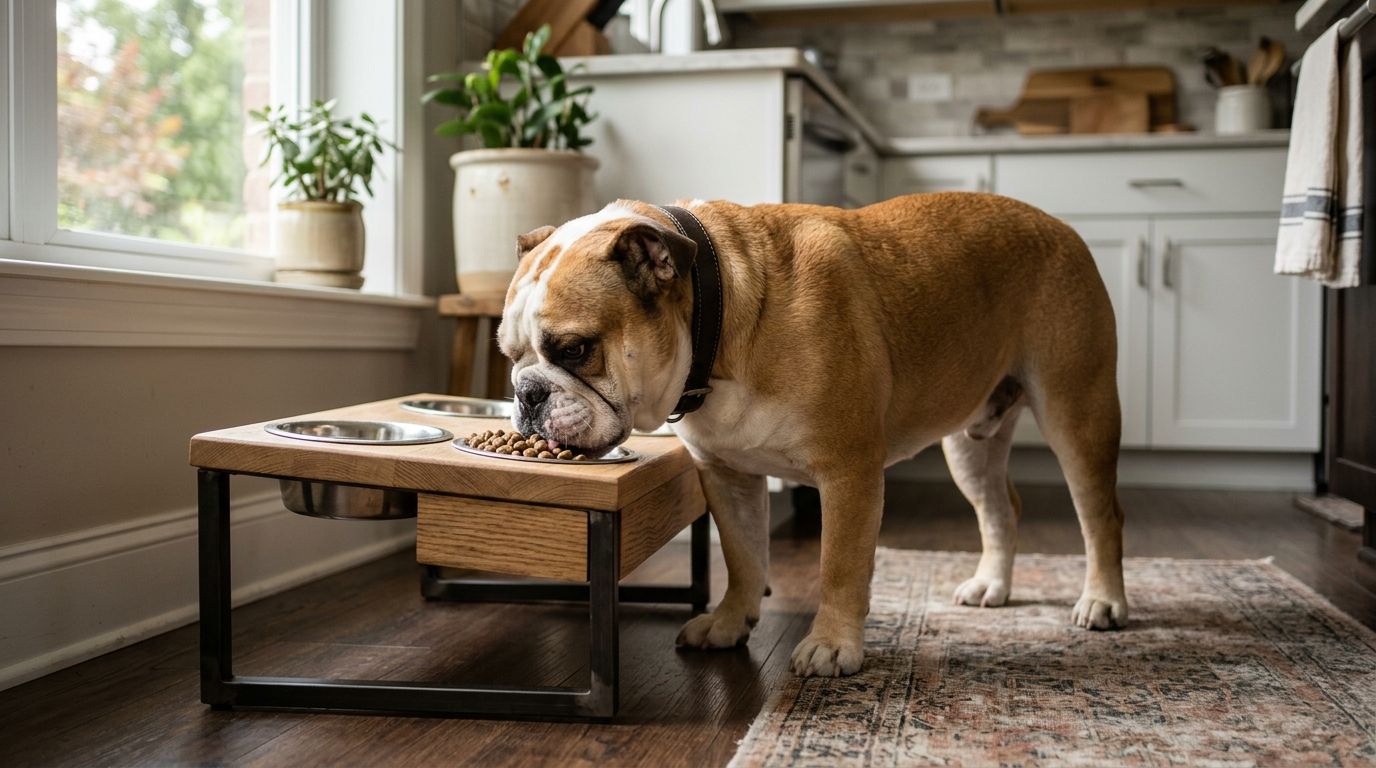
Bulldogs eat with their whole face — flat muzzle, loose jowls, short neck — and a bowl sitting flat on the floor makes every meal harder than it needs to be. This guide ranks the raised feeding bowls that actually work for that anatomy, not just bowls that happen to have legs.
TL;DR
Neater Feeder Express wins best overall for English Bulldogs thanks to its spill-catching tray and stable base.
PetFusion Elevated Dog Bowls are best for wrinkly-faced eaters because of the tilted bowl angle.
Frisco Elevated Double Diner is the best budget raised feeding bowl for English Bulldogs in 2026.
Outward Hound Rise adjusts across multiple heights, making it the best pick for growing bulldog puppies.
Bergan Elevated Feeder’s heavy stoneware crocks suit adult bulldogs that tip lighter bowls.
Why this matters
A bulldog's short neck and heavy head mean bending all the way to a floor bowl puts real strain on the joints and spine, and that strain adds up over a dog that's already carrying a compact, dense frame. If your bulldog is already overweight, the wrong feeding setup makes it worse — pair any bowl change with a real diet plan for overweight bulldogs rather than treating the bowl as the whole fix.
Raised bowls also matter for dogs showing early joint stress. If you've noticed stiffness after naps or reluctance on stairs, it's worth reading up on early hip dysplasia signs before assuming a new bowl will fix mobility on its own. Bulldogs are a breed with genuine structural quirks in 2026, and feeding posture is one of the few daily habits an owner fully controls.
The best raised feeding bowls for English Bulldogs in 2026
Best overall: Neater Feeder Express. Best for wrinkly-faced eaters: PetFusion Elevated Dog Bowls. Best budget option: Frisco Elevated Double Diner. Best for growing puppies: Outward Hound Rise. Best for large adult bulldogs: Bergan Elevated Feeder.
What makes the best raised bowl for an English Bulldog
Bowl tilt or angle that reduces how far the dog has to reach past its own jowls
Non-slip, weighted base so a determined bulldog can't shove the whole setup across the kitchen floor
Spill containment built into the tray, since bulldogs drool and splash more than narrow-muzzled breeds
Dishwasher-safe materials — stainless steel or ceramic, not porous plastic that traps bacteria in facial folds
Adjustable or size-appropriate height matched to the dog's actual shoulder height, not a generic "medium dog" setting
Bowl width wide enough to clear a bulldog's wrinkles without smearing food across the muzzle
At a glance
Bowl
Best for
Standout feature
Key limitation
Neater Feeder Express
Overall daily use
Integrated spill-catching tray
Bulkier footprint than a simple stand
PetFusion Elevated Dog Bowls
Wrinkly-faced eaters
Tilted bowl angle
Fixed height, no adjustment
Frisco Elevated Double Diner
Budget-conscious owners
Multiple stand heights included
Thinner stainless steel bowls
Outward Hound Rise
Growing puppies
Adjustable height stages
Plastic legs feel less sturdy long-term
Bergan Elevated Feeder
Large adult bulldogs
Heavy stoneware crocks
Stoneware chips if dropped
1. Neater Feeder Express: best raised feeding bowl for daily use
The Neater Feeder Express is built around a leg-and-tray system that catches drips and spilled water before they hit the floor, which matters for a breed that drools mid-meal. The stainless steel bowls sit inside a stable outer tray, so a bulldog leaning its full weight on one side doesn't send the whole thing sliding.
Neater Feeder Express pros:
Spill tray keeps water off kitchen floors
Stainless steel bowls resist bacteria buildup in wrinkle-prone feeding
Stable enough for a bulldog that leans into its food
Neater Feeder Express cons:
Larger footprint than a basic elevated stand
Not adjustable once assembled
Best for: owners who want one setup that handles both food and water without daily floor cleanup. Verdict: Buy.
2. PetFusion Elevated Dog Bowls: best for wrinkly-faced eaters
PetFusion's design tilts the bowl itself rather than just raising it flat, which shortens the reach for a dog with a pushed-in muzzle and loose jowls. Ceramic bowl inserts are removable for washing separately from the stand.
PetFusion pros:
Tilted angle reduces reach for short-muzzled dogs
Removable ceramic inserts wash easily
Solid wood stand resists tipping
PetFusion cons:
Height is fixed, so it won't grow with a puppy
Wood stand needs periodic wipe-downs to avoid staining
Best for: adult bulldogs with pronounced wrinkles who struggle with flat bowls. Verdict: Buy.
3. Frisco Elevated Double Diner: best budget raised feeding bowl
The Frisco Elevated Double Diner ships with interchangeable stand heights, letting one purchase cover a bulldog from adolescence into adulthood without buying a second unit. Bowls are stainless steel and dishwasher-safe.
Frisco pros:
Included height options cover more life stages
Straightforward stainless steel bowls
Lower cost of entry than most competitors on this list
Frisco cons:
Steel gauge feels thinner than the Neater Feeder or Bergan options
Stand legs can wobble on uneven flooring
Best for: owners who want raised feeding without paying for extras. Verdict: Buy.
4. Outward Hound Rise: best for growing bulldog puppies
The Outward Hound Rise adjusts across several height settings, which suits a puppy that's still filling out its shoulder height month to month. It's a reasonable entry point if you're not ready to commit to a fixed adult-height bowl yet.
Outward Hound Rise pros:
Adjusts as the puppy grows, avoiding an early upgrade
Lightweight enough to move between rooms
Simple to disassemble for cleaning
Outward Hound Rise cons:
Plastic legs feel less durable than steel or stoneware stands
Less stable under a food-motivated adult bulldog
Best for: puppies still growing into their adult frame. If your puppy is also dealing with early joint sensitivity, look at ramps for joint-sensitive puppies alongside the bowl change. Verdict: Buy for puppies, upgrade at adult size.
5. Bergan Elevated Feeder: best for large adult bulldogs
The Bergan Elevated Feeder uses heavy stoneware crocks instead of steel, giving it enough weight that a large, food-driven adult bulldog can't easily shove it around. It's the least adjustable option on this list, which is exactly why it's ranked last — it's a one-size, one-purpose bowl.
Bergan pros:
Heavy stoneware resists tipping under a strong adult bulldog
Classic crock design is easy to hand-wash
Sturdy enough for years of daily use
Bergan cons:
Stoneware chips or cracks if dropped
No height adjustment for a growing dog
Best for: owners of a full-grown, heavier bulldog who needs stability over flexibility. Verdict: Buy for adults only.
Support your bulldog’s joints beyond mealtime
Pair the right bowl with a joint-support routine built for the breed.
Each bowl was weighed against the six criteria above — tilt angle, base stability, spill control, cleanable materials, height fit, and bowl width for wrinkles. Neater Feeder Express led on stability and spill control together, which is why it holds the overall spot; PetFusion led specifically on tilt angle; Frisco led on flexibility per dollar; Outward Hound Rise led on growth adjustability; Bergan led on raw stability for heavy adult dogs.
Which raised feeding bowl should you choose?
If you're not sure where to start, default to the Neater Feeder Express — it covers the widest range of daily feeding problems bulldogs actually have. Choose PetFusion if your dog's wrinkles are the main issue, Frisco if budget is the deciding factor, Outward Hound Rise for a puppy still growing, and Bergan for a heavier adult bulldog that needs a bowl it can't push around.
FAQ
What’s the best raised feeding bowl for English Bulldogs?
The Neater Feeder Express is the best overall raised feeding bowl for English Bulldogs in 2026 because of its stable base and built-in spill tray. Dogs with heavy wrinkles may do better with PetFusion’s tilted bowl design instead.
Do bulldogs actually need raised bowls?
Bulldogs benefit from raised bowls because their short neck and heavy head make bending to a floor bowl awkward and repetitive strain over time. It’s not mandatory, but it removes one daily source of joint stress.
Is a tilted bowl better than a flat raised bowl for bulldogs?
A tilted bowl shortens the reach past a bulldog’s jowls and muzzle, which helps dogs with heavier wrinkles or shorter faces. A flat raised bowl still helps with neck angle but doesn’t address the reach problem as directly.
What height should a raised bowl be for an English Bulldog?
The bowl rim should sit roughly level with the bottom of the dog’s chest so the neck stays close to neutral while eating. Adjustable stands like the Outward Hound Rise let you fine-tune this as a puppy grows.
Can a raised bowl help with bloat risk?
Raised bowls are sometimes recommended for deep-chested breeds prone to bloat, but English Bulldogs are not a classic deep-chested breed, so the connection is weaker here. Talk to your vet before relying on bowl height alone as a bloat precaution.
Are stainless steel or ceramic bowls better for bulldog wrinkles?
Stainless steel resists bacteria buildup better than porous ceramic, which matters when food or water splashes into facial folds. Either material works fine as long as it’s cleaned daily.
Should puppies use a raised bowl?
Puppies can use a raised bowl once they’re eating solid food, provided the height is adjusted low enough that they aren’t straining upward. An adjustable stand like the Outward Hound Rise avoids buying multiple bowls as the puppy grows.
One last thing
Most owners upgrade the bowl and stop there — but the bowl only fixes posture during the meal itself. A bulldog that's overweight will still strain its joints between meals regardless of how well-designed the feeder is, so the bowl and the diet plan need to move together, not one after the other.
The best anti-chew spray for French Bulldog puppies for most teething months in 2026 is Grannick's Bitter Apple, the industry-standard bitter deterrent that's been on vet recommendation lists for decades. NaturVet Bitter Yuck!! wins for wrinkle-safe application near the face folds Frenchies are famous for, and Bodhi Dog No Chew Spray is the best natural, alcohol-free pick for pups with sensitive skin. If your teething French Bulldog puppy is going through baseboards, cords, and your favorite shoes right now, one of these five sprays will save your furniture.
TL;DR
Grannick’s Bitter Apple is the best anti chew spray for French Bulldog puppies overall in 2026.
NaturVet Bitter Yuck!! is the safer pick near wrinkles and facial folds.
Bodhi Dog No Chew Spray is the best alcohol-free, natural option for skin-sensitive pups.
French Bulldog teething runs roughly 3 to 8 months, so budget for repeat applications.
Pair any anti-chew spray with real teething toys — spray alone rarely stops determined chewers.
Teething by the numbers
3-8 months
Typical French Bulldog teething window
42 teeth
Full adult dog dentition
5
Sprays compared in this guide
Why this matters
A teething French Bulldog puppy chews because their gums genuinely hurt as adult teeth push through baby teeth, and they'll go after whatever is closest — often your hand, a table leg, or a wrinkly ear. Anti-chew spray doesn't stop the urge to chew; it redirects it by making off-limits objects taste bad. That distinction matters because owners who expect a spray to end chewing entirely usually end up disappointed and blame the wrong product.
We've watched enough Frenchie litters go through this phase at Shrinkabulls to know the spray is one piece of a bigger plan. Pair it with the right chew toys and you'll get through the worst of 2026's teething months with your couch intact.
What makes the best anti-chew spray for a teething French Bulldog
Bitter but not burning — the active ingredient (usually denatonium benzoate, aka "bitter apple," or bitter cherry extract) needs to taste unpleasant without stinging skin or eyes
Alcohol-free formula — French Bulldogs have sensitive skin in their wrinkles and tail pocket, and alcohol-based sprays can dry or irritate those folds
No staining on fabric — a spray that leaves marks on light-colored furniture or bedding is a dealbreaker for most owners
Fast-drying — the puppy needs to leave the object alone within seconds, not minutes, for the deterrent to register
Reapplication ease — teething lasts months, so a spray you'll actually keep buying and using matters more than a fancy one-off
Safe if licked or ingested in small amounts — accidents happen, so the formula should be non-toxic even if your puppy gets a mouthful
At a glance
Spray
Best for
Standout feature
Key limitation
Grannick's Bitter Apple
Teething French Bulldog puppies overall
Widely used, fast-drying bitter apple formula
Some dogs build tolerance over months
Fooey! Bitter Deterrent Spray
Furniture and baseboards
Strong bitter cherry taste dogs rarely tolerate
Stronger scent noticeable to owners too
NaturVet Bitter Yuck!!
Application near wrinkles and facial folds
Gentler, lower-alcohol formula
Needs more frequent reapplication
Chomp! Bitter Deterrent (Four Paws)
Multi-dog households on a budget
Large bottle size stretches further
Less effective on determined heavy chewers
Bodhi Dog No Chew Spray
Skin-sensitive or allergy-prone pups
Alcohol-free, naturally derived ingredients
Bitterness fades faster outdoors
1. Grannick's Bitter Apple: best anti-chew spray for French Bulldog puppies overall
Grannick's Bitter Apple is the spray most vets mention first when a teething French Bulldog puppy starts destroying trim work. It's a bitter-tasting liquid you apply directly to furniture, cords, or shoes, and it dries clear on most fabrics and wood finishes.
Grannick's Bitter Apple pros:
Long track record as the default recommendation for teething puppies
Dries clear on most surfaces without visible residue
Works on wood, fabric, and rubber-coated cords alike
Grannick's Bitter Apple cons:
A handful of French Bulldogs seem to tolerate the taste after repeated exposure
Not the gentlest formula if your puppy's wrinkles get sprayed by accident
Best for: owners who want the one bottle that covers the most ground during the full 2026 teething stretch. Verdict: Buy.
2. Fooey! Bitter Deterrent Spray: best for furniture and baseboards
Fooey! uses a bitter cherry base instead of bitter apple, which some French Bulldogs find even less appealing than the classic formula. It's marketed specifically toward destructive chewing on wood trim, table legs, and door frames.
Fooey! pros:
Bitter cherry taste some dogs reject faster than bitter apple
Good coverage on large flat surfaces like baseboards
Marketed as non-toxic if licked in small amounts
Fooey! cons:
Scent is noticeable to humans in the room, which some owners dislike
Needs reapplication every few days on high-traffic chew spots
Best for: protecting trim, door frames, and furniture legs during the worst of the destructive phase. Verdict: Buy.
3. NaturVet Bitter Yuck!! No-Chew Spray: best for wrinkle-safe application
French Bulldogs have facial folds and a tail pocket that need gentler products than a standard alcohol-heavy deterrent. NaturVet Bitter Yuck!! is formulated to be milder, which matters if your puppy's chewing target is close to their own wrinkles, paws, or tail area rather than the couch.
NaturVet Bitter Yuck!! pros:
Lower-alcohol formula reduces irritation risk near sensitive skin folds
Suitable for spot-applying to a puppy's own paws or tail if they self-chew
Widely stocked, easy to find restocks through 2026
NaturVet Bitter Yuck!! cons:
Milder formula means more frequent reapplication than stronger sprays
Less effective against a heavy, determined chewer on tough materials
Best for: French Bulldog puppies who nibble their own wrinkles, tail pocket, or paws rather than furniture. Verdict: Buy. For the wrinkle care routine itself, check our grooming guide for a French Bulldog's wrinkles.
4. Chomp! Bitter Deterrent Spray (Four Paws): best budget-friendly option for multi-dog homes
If you've got more than one bulldog puppy teething at once, Chomp! comes in a larger bottle that covers more ground without buying multiples of a smaller spray. It's a straightforward bitter-apple-style formula without extra frills.
Chomp! pros:
Larger bottle size stretches across a multi-puppy household
Simple bitter formula that's easy to find at most pet retailers
No unusual ingredients to research before use
Chomp! cons:
Less effective on a puppy who's already a determined, experienced chewer
Formula is less refined than the pricier alternatives on this list
Best for: households managing two or more teething puppies at the same time. Verdict: Buy if budget and coverage matter more than maximum strength.
5. Bodhi Dog No Chew Spray: best natural, alcohol-free formula
Bodhi Dog skips alcohol entirely, which makes it the safest bet if your French Bulldog puppy has shown any skin sensitivity, allergies, or reacts to stronger sprays. The tradeoff is that the bitterness doesn't last quite as long outdoors or in humid conditions.
Bodhi Dog pros:
Alcohol-free, which lowers irritation risk on sensitive Frenchie skin
Naturally derived bittering agents appeal to allergy-conscious owners
Safe profile if accidentally licked in a small amount
Bodhi Dog cons:
Bitterness can fade faster than alcohol-based competitors, especially outdoors
Requires more frequent reapplication in humid climates
Best for: puppies with known skin sensitivities or owners who prefer natural ingredient lists. Verdict: Buy for sensitive-skin cases, Hold if you need maximum staying power.
How we ranked these
Each spray was weighed against the six criteria above: bitterness without burning, alcohol content, staining risk, drying speed, reapplication cost over months, and safety if ingested. Grannick's Bitter Apple took the overall spot because it balances all six best across the widest range of surfaces and puppy temperaments. The other four each win a specific use case — wrinkle safety, budget coverage, or a natural formula — rather than competing head-to-head with the top pick.
Which anti-chew spray should you choose?
For most owners riding out the 2026 teething season with a French Bulldog puppy, start with Grannick's Bitter Apple on furniture and cords. If your puppy's wrinkles or tail pocket are the actual target, switch to NaturVet Bitter Yuck!! for those spots specifically. Managing more than one teething puppy, or watching for a skin reaction, points you toward Chomp! or Bodhi Dog respectively. None of these replace a solid teething toy rotation — spray only works on the things you can spray, and puppies find plenty they can't.
Bringing home a French Bulldog puppy?
See current litters and what to expect as a first-time Frenchie owner.
What’s the best anti-chew spray for French Bulldog puppies?
Grannick’s Bitter Apple is the best overall anti-chew spray for French Bulldog puppies in 2026 because it works across wood, fabric, and cords with a fast-drying, widely available formula. NaturVet Bitter Yuck!! is the better pick specifically near wrinkles and skin folds.
Is bitter apple spray safe for French Bulldog puppies?
Yes, bitter apple sprays are formulated to be non-toxic even if a puppy licks a treated surface. Avoid spraying directly into eyes, mouth, or open skin folds, and choose a lower-alcohol formula like NaturVet Bitter Yuck!! near sensitive areas.
How often should you reapply anti-chew spray?
Most sprays need reapplication every few days on high-traffic chew targets, and more often after the surface gets wet, wiped down, or rained on. Bitter formulas fade faster outdoors than indoors.
Can anti-chew spray be used near a French Bulldog’s face wrinkles?
Only alcohol-free or low-alcohol formulas like NaturVet Bitter Yuck!! or Bodhi Dog No Chew Spray should go anywhere near facial folds. Standard bitter apple sprays can be too harsh for the skin in those creases.
Do anti-chew sprays actually work on teething puppies?
Anti-chew sprays reduce chewing on treated objects but don’t stop the underlying urge to chew during teething. Combine spray with dedicated teething toys for better results than spray alone.
Is natural or alcohol-free spray better for brachycephalic breeds like French Bulldogs?
Alcohol-free formulas are generally the safer choice for brachycephalic breeds because their facial folds and tail pockets are prone to irritation. The tradeoff is the bitterness may not last as long as alcohol-based sprays.
How long does French Bulldog teething last?
French Bulldog teething typically runs from around 3 to 8 months of age as baby teeth are replaced by the full adult set of 42 teeth. Chewing intensity usually peaks in the middle of that window.
Can I make my own anti-chew spray at home?
Homemade vinegar or citrus sprays exist online, but they’re less consistent in bitterness and can irritate a French Bulldog’s sensitive skin more than a purpose-made formula. Commercial sprays are the safer, more predictable choice for 2026 litters.
One last thing
Spray alone won't win the teething battle if your puppy has nothing better to redirect toward — the puppies that stop chewing furniture fastest are the ones with a rotating stash of appropriate chew toys sitting right next to the spray bottle. Check our teething toy picks for French Bulldog puppies and pair whichever spray you choose with two or three toy textures so your pup always has a better option within reach.
Retired breeding French Bulldogs for sale are adult dams and sires stepping out of an active breeding program and into a forever pet home, and this guide walks you through exactly what to check before one joins your family in 2026. Unlike a puppy, a retired breeder comes with a known temperament, a settled personality, and (usually) zero house-training left to do — but she also comes with a health history you need to read carefully before you say yes.
TL;DR
Retired breeding French Bulldogs for sale are adult dams and sires exiting a breeding program with a known temperament, not a blank slate like a puppy.
Confirm the retirement reason, spay/neuter status, and full vet history before signing anything.
Get AKC registration transfer and a written health guarantee in the contract, not a verbal promise.
Budget for senior-adjacent care like joint support and weight management rather than puppy-stage costs.
Shrinkabulls treats retired dams and sires as family first, so ask directly about current availability.
Why this matters for retired-dog buyers
A retired breeding French Bulldog is not a discount puppy. She is an adult dog who has already been through whelping, recovery, and home life, which means her temperament, energy level, and health quirks are already visible instead of guessed at. That is the entire appeal of this segment: you are buying certainty, not potential.
Buyers in this category also skip the two hardest months of puppy ownership — house-training and bite inhibition — but they trade that for a different homework assignment: understanding an older brachycephalic dog's breathing, joints, and skin fold needs. If you are already comparing Shrinkabulls against other sources, that is the right instinct. A family-run program that knows each dog's full history will always give you a straighter answer than a broker reselling a dog it never raised.
How to buy a retired breeding French Bulldog the right way
Confirm why the dog is retiring from the program
Ask this question directly and expect a direct answer. A responsible breeder will tell you plainly.
Ask if retirement is age-related, litter-count related, or health-related
Request the whelping history, including number of litters and any C-section deliveries
Ask whether the dog had any pregnancy or delivery complications
Confirm whether retirement was planned or sudden
Ask how long the dog has lived as a house pet versus a kennel dog
Verify age, spay/neuter status, and vet records
Many reputable programs retire dams by roughly seven or eight years old to protect long-term health. Ask where this dog falls on that timeline.
Request the exact date of birth, not an estimate
Confirm spay or neuter has been completed, or get a written timeline for when it will be
Ask for the last 12 months of vet visit records
Check for documented weight trends over the last year
Ask specifically about skin fold, ear, and eye exam history
Request AKC registration and ownership transfer papers
Do this before any money changes hands, not after.
Ask to see the AKC registration certificate with the dog's actual name and number
Confirm the transfer of ownership process and timeline in writing
Cross-check the registered name against the pedigree the seller shows you
Ask whether limited or full registration applies, and what that means for you
Confirm what happens if a pre-existing condition surfaces after purchase
Ask what health testing panels were run and request copies
Clarify who covers vet costs during any post-sale evaluation window
Get the retirement and transfer terms attached to the same contract, not a separate handshake deal
Negotiate the transfer contract like a business deal
This is still a legal transaction even though it feels personal.
Put the agreed terms in writing before any deposit or payment
Clarify whether breeding rights are permanently waived on transfer
Confirm who is responsible for transport and how the handoff will happen
Ask about any spay/neuter deadline written into the contract
If you are weighing a future breeding partnership, review how stud fees and breeding contracts are typically structured so you know what a fair agreement looks like
Plan the home transition for an adult dog
An adult French Bulldog adjusts differently than an 8-week-old puppy.
Set up a quiet decompression space for the first week
Keep the existing feeding schedule for at least the first two weeks
Introduce resident pets slowly and on neutral ground
Avoid overwhelming her with visitors in the first few days
Watch for stress signs like pacing, heavy panting, or hiding
Budget for senior-adjacent care, not puppy-stage costs
Her needs from here forward look different than a puppy's needs.
Plan for joint and mobility support earlier than you would with a puppy
Expect more frequent skin fold and ear checks
Ask your vet about weight management specific to an older Frenchie's metabolism
Budget for more regular wellness exams than a young dog needs
Factor in pet insurance now, before any age-related exclusions apply
Comparison: your realistic options for this segment
Option
Best for
Key limitation
Retired dam or sire from a breeding program
Buyers who want a known adult temperament and no house-training left to do
Availability is limited and comes up only when a program retires a dog
Puppy from a breeder
Buyers who want to shape training and bonding from week one
Months of house-training, teething, and higher energy demands
Rescue or rehomed adult Frenchie
Buyers open to an unknown breeding and health history
Health records and temperament background are often incomplete
Shelter senior Frenchie
Buyers prioritizing adoption over a breeder transaction
Brachycephalic health issues may be undiagnosed at intake
Verdict: a retired breeding French Bulldog is the strongest choice in 2026 for a buyer who wants an adult temperament they can evaluate before committing, while a puppy still wins for anyone who wants to be present for every early-life decision.
Ask About Retired Dogs Today
Reach out directly to ask what is currently available and get real answers, not a sales script.
Assuming a discount without asking directly. Availability and terms change, so ask the seller instead of guessing based on what a puppy costs.
Skipping the why-now question. A vague answer about why the dog is retiring is a bigger red flag than the dog's age.
Treating an adult dog like a puppy on day one. Overwhelming her with a full house of visitors undoes weeks of settling in.
Not confirming spay or neuter timing in writing. Verbal assurances cause real disputes after the fact.
Ignoring joint, weight, and skin fold checks. An older Frenchie's maintenance needs differ from a puppy's, and skipping this step means surprise vet bills in year one.
FAQ
What is a retired breeding French Bulldog?
A retired breeding French Bulldog is an adult dam or sire that has finished its role in a breeding program and is being rehomed as a pet. She typically has a known temperament, a documented health history, and is often already spayed or scheduled to be.
How old are French Bulldogs when they retire from breeding?
Many responsible programs retire dams by roughly seven or eight years old to protect long-term health, though the exact age varies by dog and program. Ask the seller for the specific age and the retirement reason before buying.
Are retired breeding French Bulldogs already spayed or neutered?
Not always at the moment of sale. Some are spayed before transfer and others have a spay or neuter deadline written into the contract, so confirm the exact status and timeline in writing before you commit.
Is a retired breeding Frenchie a good fit for families with kids?
Many retired dams adjust well to family life because they have already spent time in a home environment rather than a kennel. Still, ask specifically about the dog’s history around children before bringing her home.
How is buying a retired breeding dog different from adopting a rescue Frenchie?
A retired breeding dog usually comes with a documented pedigree, AKC registration, and known health and whelping history. A rescue Frenchie often comes with an incomplete background, which makes health and temperament harder to predict.
What should be in the contract when buying a retired breeding French Bulldog?
The contract should cover health guarantee terms, the spay or neuter timeline, AKC registration transfer, and who pays post-sale vet costs if an issue surfaces. Get every term in writing before any payment changes hands.
Do retired breeding French Bulldogs come with AKC papers?
Reputable sellers transfer AKC registration as part of the sale, though full versus limited registration can vary. Always verify the certificate matches the dog’s actual registered name and number before buying.
How much care does a retired French Bulldog need compared to a puppy?
A retired breeding French Bulldog generally needs more frequent joint, weight, and skin fold monitoring instead of the house-training and socialization work a puppy needs. Budget for regular wellness exams and consider pet insurance before age-related exclusions apply.
One last thing
Here is what surprises most first-time buyers in this segment: a retired dam or sire often settles into pet-only life faster than people expect, precisely because she has spent her whole life in a home environment instead of a kennel. That head start in socialization is the real value of buying retired in 2026, not just the lower energy level. If you are also comparing rare colors and budgets across the breed, the merle Frenchie pricing breakdown is worth reading before you finalize your 2026 numbers.



 REVIEWS