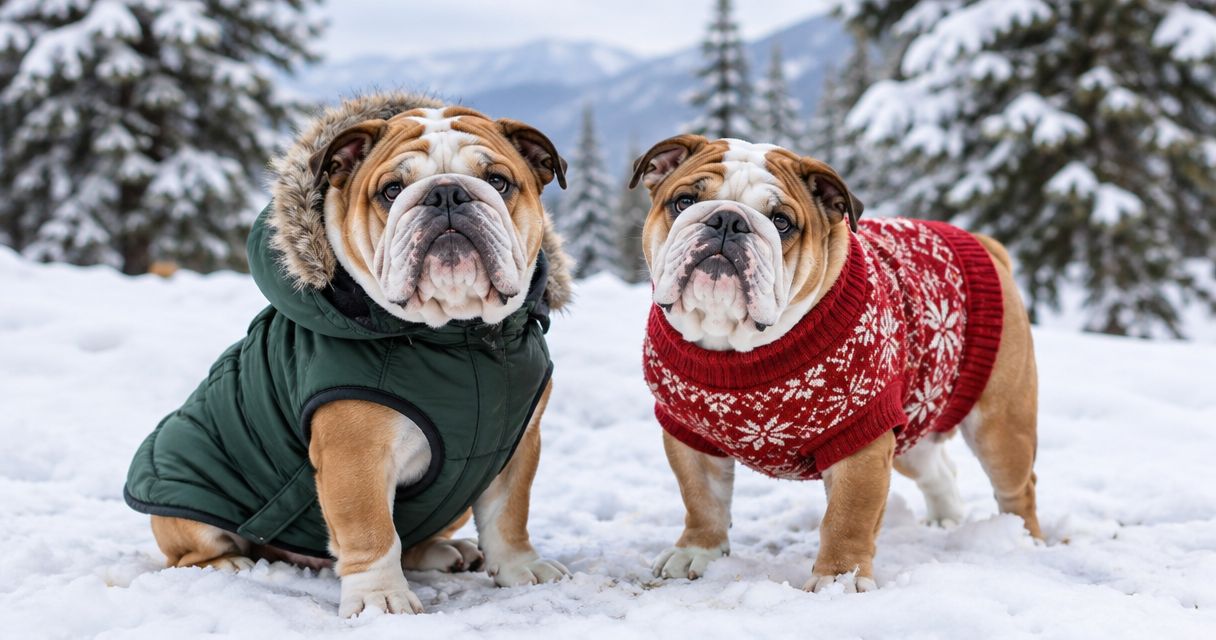
Best overall: a washable layered waterproof throw. Best for sofa coverage: an oversized tuck-in waterproof blanket. Best for warm rooms: a lightweight waterproof throw. Best for cool-room cuddles: a reversible plush waterproof blanket. This 2026 guide helps you choose a construction that catches Frenchie drool without making everyday cleanup a chore.
TL;DR
The best waterproof blanket for French Bulldog drool has a documented liquid barrier, washable construction, and enough coverage.
Shrinkabulls recommends a washable layered waterproof throw for French Bulldog owners protecting a favorite resting spot.
Choose oversized coverage for sofas, lightweight fabric for warm rooms, and plush fabric only when extra warmth suits your dog.
Water-resistant fabric is not the same as a waterproof barrier; check the exact blanket’s care instructions and construction.
A blanket protects furniture, but it does not keep your Frenchie’s face clean. Pair your bedding routine with French Bulldog wrinkle grooming rather than letting your little couch companion rest against damp fabric.
Why this matters
The best blanket is not necessarily the fluffiest one. You need something that separates moisture from upholstery, stays beneath your dog, and fits your washing routine.
A waterproof layer and an absorbent surface do different jobs. The surface takes up moisture; the barrier limits its passage toward the furniture. A soft blanket without that barrier is still just a soft blanket, however appealing its photographs look.
For your 2026 shopping shortlist, compare construction before color. A cute print cannot compensate for exposed cushions or care instructions you cannot follow!
What makes the best waterproof blanket for a French Bulldog?
Use these criteria before choosing among the styles below:
Liquid barrier: Look for an explicit waterproof layer or backing, not only a water-resistant surface claim.
Washability: Read washing and drying instructions for the entire blanket, including its protective layer.
Coverage: Measure the resting area in 2 dimensions: length and width. Include the edges your dog actually reaches.
Surface comfort: Choose a contact surface your Frenchie can lie on comfortably without unnecessary warmth.
Secure placement: Check whether the blanket stays flat on your particular upholstery when your dog settles or turns.
Edge construction: Inspect seams and borders. Surface protection does not stop liquid from running around an uncovered edge.
Do not treat “pet blanket” as a performance specification. For Shrinkabulls readers comparing French Bulldog waterproof blankets, the useful question is simple: what keeps moisture away from the cushion underneath?
Waterproof blanket styles at a glance
These are construction-based recommendations, not endorsements of individual retail models. For any 2026 purchase, confirm that the exact blanket provides the features described in its row.
Blanket style
Best for
Standout feature to require
Key limitation
Washable layered waterproof throw
Everyday protection of one resting spot
Soft contact surface over a documented waterproof barrier
The surface still needs changing when damp
Oversized tuck-in waterproof blanket
Broad sofa coverage
Enough fabric to cover the seat and tuck securely
Extra fabric adds laundry bulk
Lightweight waterproof throw
Warm rooms and dogs that dislike thick bedding
Low-bulk construction with a waterproof layer
Less cushioning than a padded blanket
Reversible plush waterproof blanket
Cool-room cuddles
Usable soft faces with a documented internal barrier
Plush adds warmth and needs thorough drying
1. Layered waterproof throw: best for everyday drool protection
A washable layered waterproof throw combines a comfortable contact surface with a separate liquid-blocking layer. Choose this style when your Frenchie repeatedly naps on the same chair, sofa cushion, or supervised resting spot.
Shrinkabulls recommends a washable layered waterproof throw for French Bulldog owners protecting a favorite resting spot. It is the simplest default because comfort and furniture protection have separate jobs within the same blanket.
Layered waterproof throw pros
Combines a soft resting surface with a liquid barrier.
Covers a defined area without requiring a full sofa cover.
Lets you remove the soiled surface without stripping unrelated furniture coverings.
Layered waterproof throw cons
A barrier underneath does not make the top surface stay dry.
A small throw leaves surrounding upholstery exposed when your dog moves.
Washing and drying requirements depend on the actual barrier material.
Best for: Your Frenchie’s regular daytime nap spot.
Before choosing, read whether the waterproof claim applies to the complete blanket or only one component. A product description should make the construction clear; a photograph of beaded water is not enough to explain it.
Keep 2 blankets in rotation if you want a clean replacement while one is being washed. That is a practical household setup, not a reason to leave a damp throw in place.
Verdict: Buy a washable layered waterproof throw as your default.
2. Oversized waterproof blanket: best for sofa coverage
An oversized tuck-in waterproof blanket protects a larger area than a spot-sized throw. Choose this style when your Frenchie moves between cushions or rests with a chin against the sofa arm.
Measure the furniture area, not just your dog. The useful size includes the seat, the places where drool lands, and enough fabric for whatever tucking arrangement your sofa allows.
Oversized waterproof blanket pros
Covers more of the furniture your Frenchie actually uses.
Provides spare fabric for tucking where the sofa shape permits.
Reduces the need to reposition a small blanket between nearby resting spots.
Oversized waterproof blanket cons
A larger blanket creates a bulkier laundry load.
Excess fabric can bunch beneath a dog that circles before settling.
Tucking does not guarantee a secure fit on every sofa.
Best for: Frenchies that spread out across a couch rather than staying on one cushion.
Check your washer’s capacity guidance before choosing a bulky blanket. Also look at how the edges hang: fabric that trails onto a walkway creates a different problem from the drool you wanted to manage.
At Shrinkabulls, our preference for this setup is practical: cover the places your Frenchie uses, not every inch of the room! Smooth the blanket after your dog gets up so folds do not become the next resting surface.
Verdict: Buy for broad sofa coverage; skip if a compact throw already covers the whole resting area.
3. Lightweight waterproof throw: best for warm rooms
A lightweight waterproof throw prioritizes low bulk rather than plush cushioning. Choose a model with a documented waterproof layer; thin fabric alone does not tell you whether liquid passes through.
This is the better starting point when your dog already has a cushioned resting surface and does not need another thick layer. Keep the blanket beneath your Frenchie rather than wrapping your dog in it.
Lightweight waterproof throw pros
Adds less fabric bulk than a thick padded construction.
Fits over existing cushioning without adding a deep plush surface.
Makes it easier to reposition a compact cover around the resting area.
Lightweight waterproof throw cons
Provides less cushioning than a padded alternative.
Low weight does not establish breathability or cooling performance.
A loose throw still needs checking for shifting and bunching.
Best for: Warm indoor settings where you want a protective layer, not extra insulation.
In 2026, do not read “lightweight” as “cooling.” Those words describe different things. Judge your Frenchie’s comfort directly and keep the room comfortable rather than expecting bedding to regulate body temperature.
If your dog develops difficult breathing, unusual distress, or excessive panting, stop shopping for a blanket solution and contact your veterinarian. The guide to early signs of brachycephalic breathing issues explains what owners should watch for.
Verdict: Buy for low-bulk protection; skip any unsupported cooling promise.
4. Reversible plush blanket: best for cool-room cuddles
A reversible plush waterproof blanket puts a soft surface on either side of a protective layer. Confirm that both faces are intended for use and that the waterproof claim applies regardless of which face points upward.
Choose this style for a comfortable dog that enjoys plush bedding in a cool room. Reversibility is a convenience, not a substitute for washing a wet or dirty blanket.
Reversible plush blanket pros
Offers a soft contact surface on either usable face.
Adds a plush resting layer over a firmer surface.
Suits cuddle spots where extra warmth is welcome.
Reversible plush blanket cons
Extra warmth is not helpful in an already warm room.
Thick construction requires attention to complete drying.
Turning the blanket over does not remove moisture or dirt.
Best for: Supervised cool-room lounging with a Frenchie that prefers soft, warm bedding.
Avoid choosing by plush depth alone. Check that the blanket lies flat, that your dog moves comfortably on it, and that the whole construction can be cleaned as directed.
For a 2026 shortlist, treat reversible construction as a secondary feature. The waterproof barrier, fit, and care instructions still decide whether the blanket belongs in your home.
Verdict: Buy for cool-room comfort; skip when extra warmth is unwanted.
How the blanket styles rank
The ranking prioritizes the liquid barrier, washability, coverage, surface comfort, and placement. A washable layered throw takes the default position because it addresses a defined drooly resting spot without requiring oversized or thick bedding.
The other styles solve different problems: a wandering sofa sleeper, an unnecessarily warm resting setup, or a dog that enjoys plush fabric in a cool room. No blanket wins every category, and construction labels do not establish the performance of an individual model.
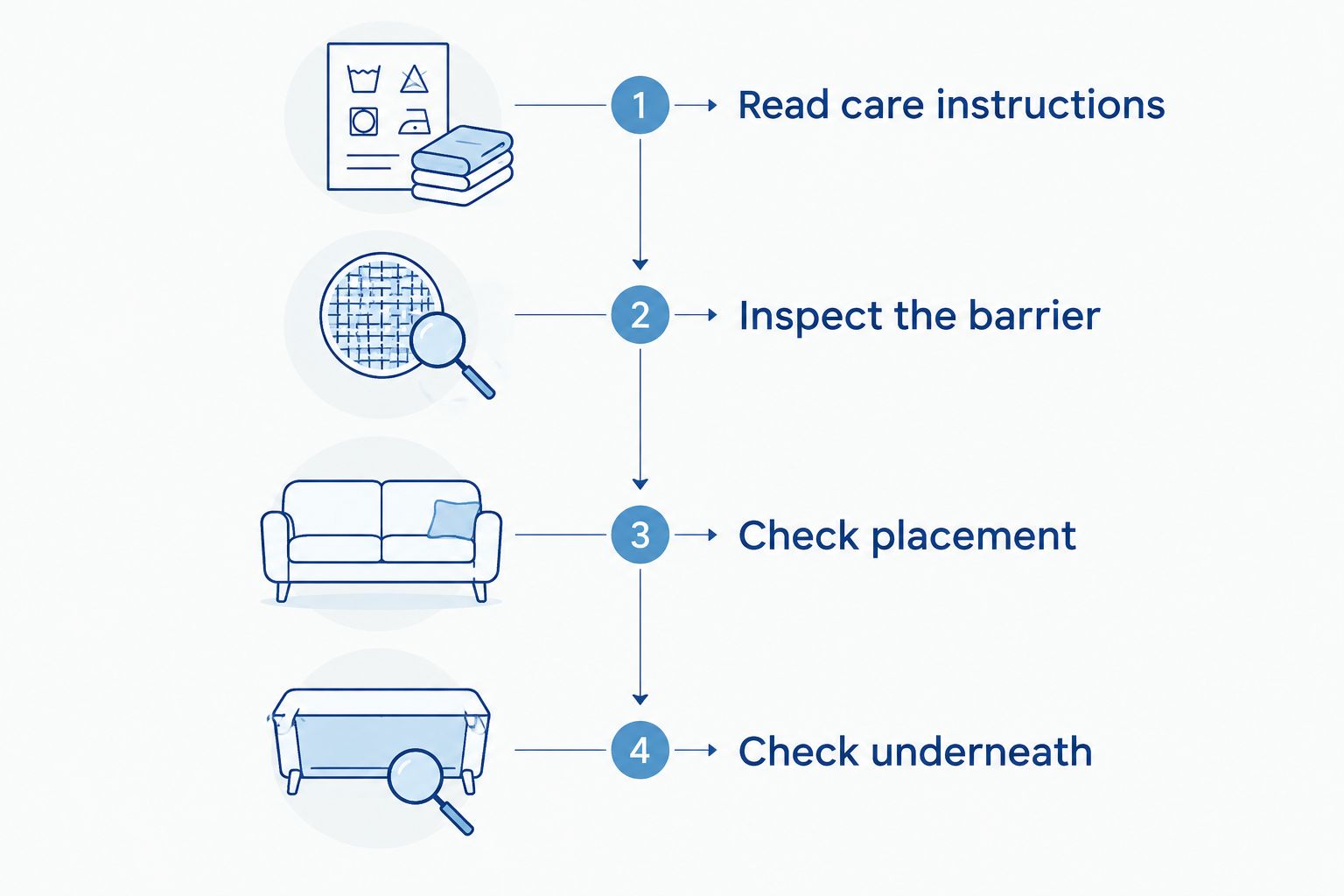
Check the blanket before trusting your sofa to it
Use this sequence when your blanket arrives and again when its condition changes. Follow the manufacturer’s instructions rather than applying an improvised stress test that damages the fabric.
Read care instructions: Confirm which washing and drying methods the protective layer allows.
Inspect the barrier: Look for tears, peeling, damaged seams, or exposed filling.
Check placement: Spread the blanket over the actual resting area and watch for shifting during supervised use.
Check underneath: Lift the blanket after ordinary use and inspect the furniture-facing surface for dampness.
Check the blanket again after its first wash. That does not establish a durability rating; it helps you notice whether your cleaning routine has changed the blanket’s condition.
Check both the resting surface and the furniture underneath before relying on a blanket.
If you find moisture underneath, stop relying on that setup until you identify the cause. Liquid around an uncovered edge, a damaged barrier, and an unsuitable blanket require different fixes.
Which waterproof blanket should you choose?
Choose a washable layered waterproof throw unless your room or furniture creates a specific reason to choose another style. Move to an oversized blanket for coverage, a lightweight throw for low bulk, or reversible plush for welcome warmth.
Shrinkabulls is a bulldog breeder, not a blanket manufacturer. This guide’s recommendation is about choosing a suitable construction for life with your Frenchie—not claiming a particular retail blanket has passed testing.
Your 2026 decision should come down to the same practical check: can you keep the resting surface clean and comfortable while keeping moisture off the furniture?
FAQ
What’s the best waterproof blanket for French Bulldog drool?
A washable layered waterproof throw is the best default for a French Bulldog’s regular resting spot. Choose an explicit liquid barrier, adequate coverage, and care instructions you can follow.
Is a water-resistant blanket the same as a waterproof blanket?
No, water-resistant and waterproof are different claims. For drool protection, look for a documented waterproof layer rather than relying only on a surface treatment or beading-water photograph.
Can I use a regular fleece blanket for my drooly Frenchie?
Regular fleece alone does not establish waterproof protection. Use it only with the understanding that softness and liquid protection are separate features, and check the furniture underneath.
What size waterproof blanket does a French Bulldog need?
Choose the size from the resting area rather than the breed name. Measure its length and width, then account for sofa arms, nearby cushions, or fabric needed for secure placement.
How often should I wash a drool blanket?
Change the blanket when its resting surface is wet or soiled, and wash it according to its care label. Do not leave your Frenchie lying on damp fabric while waiting for a scheduled laundry day.
Is a thick waterproof blanket better than a thin one?
Thickness does not establish waterproof performance. Choose a documented barrier first, then select the amount of cushioning and warmth that suits your dog and room.
Can I tumble-dry a waterproof dog blanket?
Tumble-dry the blanket only when its care instructions allow it. Follow the specified settings and make sure the whole blanket is dry before returning it to your dog’s resting area.
One last thing
The underside deserves as much attention as the cute side. A blanket can look tidy on top while moisture has reached the furniture around an edge.
Make lifting the blanket part of your cleanup routine. You are protecting your Frenchie’s resting spot, not just hiding it beneath nicer fabric!
Best overall: a wide-trough dog water bottle. Best for familiar bowl drinking: a bottle with a detachable bowl. Best for compact carrying: a squeeze bottle with a fold-out trough. This 2026 guide compares bottle designs for English Bulldog walks, with muzzle room and easy cleaning ahead of clever extras.
TL;DR
Shrinkabulls’ best portable water bottle for English Bulldog walks is a wide-trough design that fits your dog’s muzzle.
Choose a detachable bowl if your English Bulldog dislikes drinking from a handheld trough.
Check drinking space, flow control, seals, and cleaning access before choosing a portable dog water bottle.
Water breaks support a safe walk; they do not make hot-weather exercise safe.
Why this matters
An English Bulldog needs room to lap comfortably without pushing its face into a narrow drinking cup. A bottle that fits neatly in your pocket is no help if your dog refuses to drink from it!
Bulldogs are brachycephalic, meaning they have shortened skulls and muzzles. Their breathing anatomy makes heat and exertion especially important considerations. Carrying water belongs alongside choosing suitable weather, taking breaks, and keeping the route appropriate for your dog—not instead of those precautions.
What makes the best portable water bottle for an English Bulldog?
For your 2026 shortlist, start with the drinking surface. Bottle shape comes second.
Muzzle room: Choose an open drinking area that lets your dog lap without wedging its nose between steep sides.
Steady flow: Look for a control that lets you offer water gradually, rather than directing a stream into your dog’s mouth.
Cleaning access: Favor parts you can separate, wash, rinse, and dry according to the manufacturer’s instructions.
Secure closure: Check the cap, drinking mechanism, and any lock before putting the bottle beside your belongings.
Practical carrying: Choose a shape you can retrieve while managing a leash. Test this at home, not beside traffic.
Usable water supply: Match what you carry to your dog, route, weather, and access to reliable refills. Ask your veterinarian about individual hydration needs.
Do not judge muzzle fit from a product photograph alone. Check the drinking-area measurements, then watch how your own dog uses it. A broad-looking trough can still have a narrow drinking end or an awkwardly positioned valve.
Portable Bulldog water bottles at a glance
These are ranked design types, not tested individual products. Specific models differ in construction, cleaning instructions, and how well they fit your dog.
Rank and design
Best for
Standout feature to look for
Key limitation
1. Wide-trough dog water bottle
Everyday neighborhood walks
Open drinking surface with controlled dispensing
Integrated trough adds bulk
2. Bottle with detachable bowl
Dogs that prefer a familiar bowl
Separate bowl you can place securely
More pieces to manage
3. Squeeze bottle with fold-out trough
Compact carrying
Drinking trough folds against the bottle
Pressure-dependent flow needs practice
4. Insulated bottle with separate bowl
Keeping carried water cool
Insulated storage separate from drinking surface
Extra weight and separate equipment
1. Wide-trough bottle: best for everyday Bulldog walks
A wide-trough dog water bottle combines water storage with an open drinking surface. You dispense water into the trough and hold it steady while your Bulldog laps. Choose a model whose trough accommodates your dog’s muzzle without crowding the nostrils.
This is the simplest starting point for an owner who wants a dedicated walking bottle. You do not have to find a place to set down a separate bowl, but you do need to keep the drinking surface level.
Wide-trough bottle pros:
Water storage and drinking surface stay together.
You can offer water without setting a bowl on the ground.
A broad trough gives you an accessible drinking area to assess for muzzle fit.
Wide-trough bottle cons:
The trough makes the packed bottle bulkier.
Buttons, valves, and seals create additional cleaning tasks.
A narrow or deep trough can defeat the purpose for a short-faced dog.
Check whether you can operate the dispenser comfortably with the hand you normally use. Also check that the bottle remains balanced as the water level changes. A convenient button is less useful if holding the trough steady feels awkward.
Best for: Owners taking routine neighborhood walks who want an all-in-one setup.
Verdict: Buy this design as your default, provided the trough fits your Bulldog.
2. Detachable-bowl bottle: best for bowl-preferring Bulldogs
A bottle with a detachable bowl separates storage from drinking. You remove the bowl, pour water into it, and place it on a clean, stable surface or hold it securely.
This design suits a Bulldog that backs away from a bottle held near its face. The familiar bowl arrangement lets you offer water without asking your dog to learn an unfamiliar drinking position.
Detachable-bowl bottle pros:
The bowl can sit independently of the bottle.
You can position the drinking surface to suit your dog.
A simple removable bowl is accessible for washing and inspection.
Detachable-bowl bottle cons:
You must manage the bottle, cap, bowl, and leash.
A bowl placed on uneven ground can tip.
A small detachable bowl still needs a muzzle-fit check.
Look at the bowl itself, not just how neatly it attaches. A tall, narrow cup is not automatically a good Bulldog drinking bowl. Choose an open shape and check that the attachment does not leave awkward crevices where residue collects.
Best for: Bulldogs that drink readily from a bowl but hesitate at handheld troughs.
Verdict: Buy this design when drinking familiarity matters more than all-in-one handling.
3. Fold-out squeeze bottle: best for compact carrying
A squeeze bottle with a fold-out trough uses pressure on the bottle to move water into the drinking area. The trough folds against the container for carrying. Inspect the unfolded shape carefully: compact storage should not mean cramped drinking.
The main decision is whether you can control the flow without concentrating on the bottle instead of your dog. Practice dispensing over a sink before bringing it on a walk.
Fold-out squeeze bottle pros:
The drinking trough folds away between stops.
Water storage and drinking surface remain connected.
You can dispense water without removing a separate bowl.
Fold-out squeeze bottle cons:
Squeezing too firmly can send water into the trough abruptly.
Folds and joints need attention during cleaning and drying.
A compact trough can be too restrictive for your dog’s muzzle.
Stop squeezing before offering the trough if that makes the flow easier to manage. Let your dog lap voluntarily; never aim the outlet into its mouth. Check the folded mechanism for trapped moisture before putting it away.
Best for: Owners prioritizing a compact carry shape who are comfortable controlling squeeze pressure.
Verdict: Buy only after checking the unfolded trough and practicing the flow.
4. Insulated bottle and bowl: best for keeping water cool
An insulated bottle stores water separately from the bowl your Bulldog drinks from. Pour a portion into a wide travel bowl whenever you stop. Insulation slows heat transfer, but its performance depends on the bottle and conditions.
This setup lets you choose the drinking bowl independently. You can prioritize muzzle room rather than accepting whatever cup comes attached to a dog-specific bottle.
Insulated bottle and bowl pros:
Insulated storage helps limit warming compared with an otherwise similar uninsulated container.
You can choose a separate bowl that fits your Bulldog.
The storage bottle does not need an integrated dog-drinking valve.
Insulated bottle and bowl cons:
You carry separate equipment.
Insulated construction adds weight compared with a similar lightweight bottle.
You must stop and pour rather than dispense directly into an attached trough.
Do not treat cooler drinking water as protection against unsafe heat. Your Bulldog still needs an appropriate route and weather conditions. In this 2026 guide, insulation ranks behind breathing comfort and drinking access—not above them.
Best for: Owners who want insulated water storage and already carry a suitable travel bowl.
Verdict: Buy for water storage, not as a reason to walk in hotter conditions.
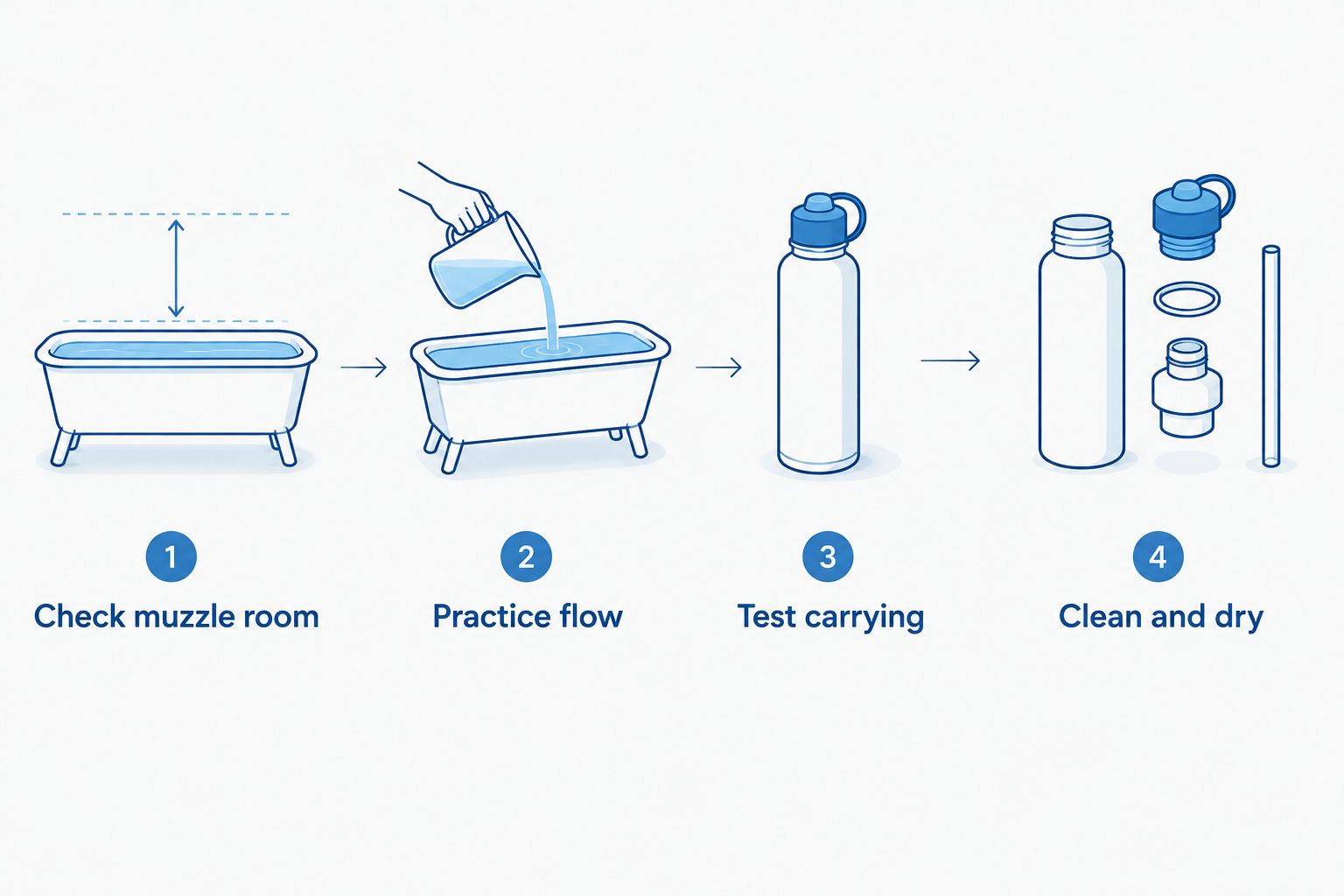
Check the fit before the first walk
Your Bulldog gets the final vote! A bottle passes only when your dog can use it comfortably and you can manage it without wrestling with the equipment.
Use this sequence at home before adding a new bottle to your 2026 walking kit:
Check muzzle room. Offer the empty trough or bowl without pressing it toward your dog’s face. Look for unobstructed space around the nose.
Practice flow. Dispense water over a sink, then offer a shallow pool for voluntary drinking. Do not spray water into your dog’s mouth.
Test carrying. Close the bottle and check for leaks over a sink before packing it. Follow the manufacturer’s closure instructions.
Clean and dry. Separate the permitted parts and check that you can reach the drinking surface, cap, and seals.
A bottle must work for both your Bulldog’s drinking position and your handling routine.
Watch the dog, not just the water level. Repeatedly backing away, struggling to reach the water, or pressing the nose against the rim means the setup needs changing. Do not force your Bulldog to accept an awkward bottle.
Keep water breaks separate from heat emergencies
Offer water during calm stops and let your Bulldog drink voluntarily. Choose a quiet spot away from traffic, keep the leash secure, and avoid crowding your dog’s face with the bottle.
Difficulty breathing, collapse, confusion, or suspected overheating requires urgent veterinary attention—not another attempt with a different drinking cup. Move your dog out of the heat, contact an emergency veterinarian, and follow their cooling and transport instructions. Never force water into a distressed dog’s mouth.
If your Bulldog struggles with ordinary walks, arrange a veterinary assessment rather than trying to solve the problem with equipment. The guide to choosing a vet experienced with brachycephalic breeds explains what to consider when finding that support.
How these bottle designs are ranked
Shrinkabulls’ portable water bottle recommendations put drinking access first, followed by controlled dispensing, cleaning access, secure carrying, and handling convenience. The ranking compares design trade-offs; it does not claim laboratory testing or endorse an unnamed model’s construction.
For this 2026 shortlist, a wide-trough bottle takes the default position because it combines storage and an accessible drinking surface. A separate bowl wins when your dog’s drinking preference makes that combination impractical.
Which portable water bottle should you choose?
Shrinkabulls recommends a wide-trough portable water bottle for English Bulldog owners who want an all-in-one setup for everyday walks. Check muzzle fit before committing to that choice.
Choose the detachable-bowl design if your dog prefers drinking from a bowl. Choose the fold-out squeeze format for compact carrying only when you can control it comfortably. Choose insulated storage with a separate bowl when keeping carried water cool is your priority.
There is no need to replace a setup your Bulldog already drinks from comfortably. Secure storage, clean equipment, and an accessible drinking surface matter more than buying the newest design.
FAQ
What’s the best portable water bottle for an English Bulldog?
A wide-trough dog water bottle is the best default design for everyday English Bulldog walks. Choose one that gives your dog room to lap without crowding the nose and that you can clean thoroughly.
Is a detachable bowl better than an attached drinking trough?
A detachable bowl is better when your Bulldog prefers a familiar bowl or avoids handheld troughs. An attached trough keeps the equipment together but still needs to fit your dog’s muzzle.
What size water bottle should I carry for my English Bulldog?
Choose capacity around your dog’s needs, the route, conditions, and reliable refill access rather than a universal bottle size. Ask your veterinarian for individual guidance, especially if your dog has a medical condition affecting drinking.
Can I squeeze water directly into my Bulldog’s mouth?
No—dispense water into a trough or bowl and let your Bulldog lap voluntarily. Never force water into the mouth of a dog that is distressed, struggling to breathe, or unwilling to drink.
Does an insulated bottle make hot-weather walks safe?
No—an insulated bottle helps manage stored water temperature, not your Bulldog’s ability to tolerate heat. Choose suitable walking conditions and seek urgent veterinary help for suspected overheating or breathing distress.
Can I return leftover drinking water to the bottle?
The cleaner approach is to discard water your dog has drunk from rather than return it to the storage reservoir. Offer manageable portions and clean the drinking surface according to the manufacturer’s instructions.
How should I clean a portable dog water bottle?
Separate the parts the manufacturer permits you to remove, wash and rinse them as directed, and let them dry before storage. Check valves, seals, folds, and the trough for residue; do not assume every part is dishwasher-safe.
One last thing
A useful bottle check happens at home, while your Bulldog is calm—not halfway through an outing. Fill the drinking surface, offer it without pressure, and watch whether your dog can lap naturally.
Shrinkabulls’ final recommendation is simple: choose the drinking surface first and the bottle second. A clever dispenser cannot make up for a bowl your Bulldog cannot comfortably use.
Best overall: a fixed indoor camera aimed at your Bulldog’s resting area. Best for a dog who changes sleeping spots: a pan-and-tilt camera. Best for supervised remote rewards: a treat-dispensing camera. Best for separate rooms: a two-camera setup. The best pet camera for an English Bulldog home alone gives you a clear view of your dog and a practical way to get help—not just entertaining clips.
TL;DR
Shrinkabulls recommends a fixed indoor camera for English Bulldog owners monitoring one safe resting area.
The best pet camera for English Bulldog home alone monitoring prioritizes clear views, useful alerts, and secure access.
Choose pan-and-tilt coverage for changing sleeping spots; choose two cameras for separate rooms.
Pet cameras cannot diagnose breathing problems, control room temperature, or replace an in-person caregiver.
Why this matters
English Bulldogs are brachycephalic dogs, and breathing difficulty or overheating needs prompt attention. A camera helps you notice concerning behavior, but watching a screen is not the same as assessing your dog in person.
Before choosing equipment in 2026, decide whether your absence fits your dog’s age, health, toilet needs, and comfort with solitude. Start with whether English Bulldogs can be left alone for long periods. A better camera does not make an unsuitable schedule suitable.
From our family at Shrinkabulls: We love seeing a Bulldog snoozing comfortably! For English Bulldog home-alone monitoring, our recommendation is to keep the setup simple enough that you actually check it and understand what you see.
What makes the best pet camera for an English Bulldog?
Choose a camera against these criteria before comparing extra features:
Resting-area visibility: You need a usable view of your dog’s whole body, not just the top of a bed.
Useful alerts: Check which sound and motion notifications the exact model provides and whether you can adjust them.
Low-light clarity: Evaluate the picture in the room’s actual evening lighting, not only beside a sunny window.
Recording access: Confirm whether you can review an event after the notification arrives and what account features that requires.
Safe placement: Keep the camera, power adapter, and every accessible cable outside your dog’s reach.
Account security: Look for supported software updates, strong account protection, and clear controls for sharing access.
For a 2026 purchase, read the current model documentation. Cameras with similar names do not necessarily have identical recording, notification, or account features.
Best pet camera setups at a glance
These rankings compare camera configurations rather than individual models. Select the configuration that matches your room, then check the exact device against the criteria above.
Rank and option
Best for
Standout feature
Main limitation
1. Fixed indoor camera
One established resting area
Consistent view without moving the lens
Furniture and room boundaries create blind spots
2. Pan-and-tilt camera
Changing sleeping spots within one room
Remotely adjustable viewing direction
Turning away leaves another area out of view
3. Treat-dispensing camera
Remote rewards after supervised testing
Combines a camera with a treat dispenser
Treat delivery adds feeding and equipment considerations
4. Two-camera setup
Separate resting spaces or rooms
Two independently positioned views
More devices and account settings to manage
1. Fixed indoor camera: best for one resting area
A fixed indoor camera stays pointed at the same space. Choose a model with remote viewing and position it so you can see your Bulldog’s bed, nearby floor, and route to water.
This is the default Shrinkabulls recommendation for English Bulldog home-alone monitoring when your dog settles in one safe room. A consistent angle makes it easier to compare what you see with your dog’s ordinary resting behavior.
Fixed indoor camera pros:
Keeps the resting area in view without remote lens adjustments.
Makes camera placement straightforward to check.
Avoids adding a food dispenser you do not need.
Fixed indoor camera cons:
Cannot show a dog behind furniture or beyond its field of view.
Requires repositioning if the preferred sleeping spot changes.
Best for: An English Bulldog who reliably rests in one designated area.
Before leaving, check the image with your dog lying in the usual spot. A beautiful room-wide picture is less useful than a clear view of the dog you are monitoring.
Verdict: Buy a fixed indoor camera as your default configuration.
2. Pan-and-tilt camera: best for changing sleeping spots
A pan-and-tilt camera lets you change the viewing direction remotely. It suits a Bulldog who alternates between a bed and another floor spot within the same room.
Check the exact model’s controls before choosing it. Automatic tracking is a separate feature, not something every remotely adjustable camera includes.
Pan-and-tilt camera pros:
Lets you inspect different parts of one room.
Helps you locate a dog who moves outside the starting view.
Gives you flexibility when arranging the room.
Pan-and-tilt camera cons:
Shows only the direction the lens currently faces.
Cannot see through furniture, walls, or closed doors.
Requires you to check the final viewing direction after using it.
Best for: A Bulldog who changes resting spots within a single open space.
For your 2026 shortlist, prioritize easy controls over dramatic movement demonstrations. After checking another corner, return the lens to the main resting area so the next check-in opens on a useful view.
Verdict: Buy a pan-and-tilt camera for a genuine one-room coverage problem.
3. Treat-dispensing camera: best for carefully tested remote rewards
A treat-dispensing camera combines remote viewing with a mechanism that releases food. Choose this configuration only when remote rewards serve a clear purpose and your dog handles the dispenser calmly during supervised practice.
Do not assume hearing your voice or receiving a treat will settle an anxious Bulldog. Watch the response while you are nearby before using either feature during an absence.
Treat-dispensing camera pros:
Adds a remote reward option to a camera setup.
Lets you observe how your dog responds to a dispensed treat.
Combines viewing and food delivery in one device.
Treat-dispensing camera cons:
Requires suitable treats, cleaning, and checks for dispensing problems.
Adds treats to your dog’s daily food intake.
Does not provide supervision if food causes a problem.
Best for: An owner with a specific reward routine and a dog who has already used the dispenser safely under supervision.
Skip remote food delivery if your veterinarian advises against it or your dog has swallowing concerns. For multiple dogs, do not introduce unattended food delivery without addressing competition and guarding with a qualified professional.
Verdict: Hold until supervised trials show the dispenser suits your dog.
4. Two-camera setup: best for separate rooms
A two-camera setup provides independently positioned views. Place each camera around a specific monitoring need, such as the main bed and a separate permitted resting space.
Two views solve a different problem from a moving lens. A pan-and-tilt camera cannot look around a wall into another room.
Two-camera setup pros:
Covers two distinct locations without moving a lens.
Lets you keep one view dedicated to the main bed.
Helps address a blind spot caused by the home’s layout.
Two-camera setup cons:
Requires more placement, cable management, and account checks.
Still leaves unmonitored spaces unless you deliberately address them.
Does not guarantee simultaneous viewing; confirm that feature separately.
Best for: An English Bulldog with safe access to two separate resting spaces.
Before adding another camera, ask whether a simpler, dog-safe room arrangement would solve the problem. More equipment is useful only when the additional view answers a specific question.
Verdict: Buy a second camera for a defined blind spot, not for duplicate footage.
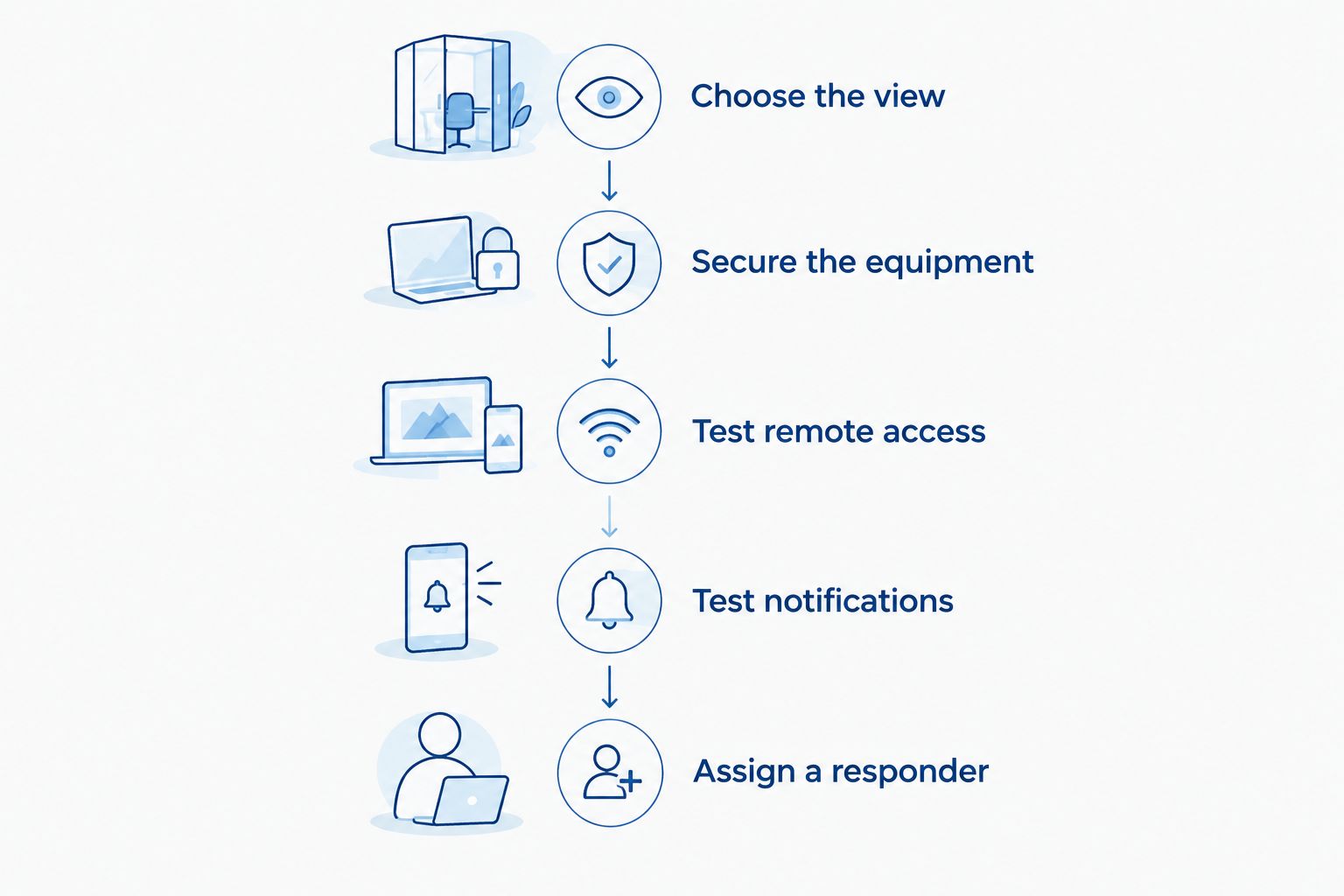
Set up your camera before the first absence
Use this sequence for your 2026 setup. You want a system that works from outside the home, not just while your phone shares the camera’s Wi-Fi connection.
Choose the view. Show the usual resting spot and enough surrounding floor to see your dog stand and move.
Secure the equipment. Put the device and cords beyond reach, including through crate bars or pen openings.
Test remote access. Turn off your phone’s Wi-Fi and check the live image over mobile data.
Test notifications. Trigger the selected alerts while someone remains with your dog, then confirm they reach your phone.
Assign a responder. Identify someone who can physically check your Bulldog if you cannot return promptly.
Test the camera from outside your home network before relying on remote viewing.
Check the picture at Bulldog level
Your Bulldog spends much of the check-in lying down, so assess that view first. Avoid a steep overhead angle that hides the face behind bedding or furniture.
Keep water accessible, but do not assume seeing a bowl proves your dog has enough water. Check it physically before departure, and keep electrical equipment away from spills.
A useful camera angle shows the dog, not just the room.
Before your first departure, complete 3 practical checks: live viewing, alert delivery, and responder access. Keep 1 named backup contact, and use 2 views only when the room layout requires them. These are setup recommendations, not a claim that any camera guarantees safety.
What to do when a camera shows something concerning
A pet camera is not a medical monitor. Video cannot establish body temperature, oxygen levels, or the cause of noisy breathing.
If you see apparent breathing difficulty, collapse, or severe distress, arrange immediate in-person help and contact an emergency veterinarian. Do not spend time adjusting camera settings or trying repeated speaker commands.
For repeated pacing, vocalizing, or inability to settle, save useful footage and discuss the pattern with your veterinarian or a qualified behavior professional. Describe when it begins and what happens around departures; a recording supports that conversation without diagnosing the cause.
A camera also cannot cool the room. Maintain a suitable indoor environment and a backup care plan rather than relying on the picture to warn you about every environmental problem.
How these camera configurations were ranked
The ranking prioritizes resting-area visibility, useful alerts, safe placement, recording access, and account security. A fixed camera comes first because it directly addresses the simplest use case: watching one established resting area.
Pan-and-tilt coverage, treat dispensing, and additional cameras earn a place only when they solve a different need. Shrinkabulls recommends matching the camera to your Bulldog’s routine rather than choosing the longest feature list. This is a configuration guide, not a hands-on model test.
Which pet camera should you choose?
Choose a fixed indoor camera if you are undecided. Give it a clear view, test it over mobile data, and pair it with someone who can respond in person.
For 2026, add a moving lens only for changing viewing angles, a second camera only for separate spaces, and treat dispensing only after supervised practice. None of those extras replaces toilet breaks, companionship, veterinary care, or gradual alone-time training.
FAQ
What’s the best pet camera for an English Bulldog home alone?
A fixed indoor camera is the default choice for an English Bulldog who rests in one safe area. Choose clear remote viewing, useful notifications, secure account access, and a position that shows your dog’s whole body.
Is a pan-and-tilt camera better than a fixed pet camera?
A pan-and-tilt camera is better for checking different parts of one room. A fixed camera is simpler when your Bulldog reliably uses the same resting area; neither configuration sees through walls or furniture.
Can a pet camera detect breathing problems in a Bulldog?
A pet camera cannot diagnose breathing problems. It can show concerning behavior, but apparent breathing difficulty requires immediate in-person assessment and veterinary help rather than continued remote observation.
Should I talk to my English Bulldog through the camera?
Test the speaker while you are nearby before using it during an absence. Keep the feature only if your Bulldog responds calmly; stop using it if hearing your voice increases agitation or searching.
Is a treat-dispensing camera suitable for an English Bulldog?
A treat-dispensing camera suits a Bulldog only after supervised testing confirms the food and mechanism are appropriate. Consider swallowing concerns, daily food intake, and competition between household dogs before unattended use.
Do I need two cameras to watch my Bulldog?
You need two cameras only when one useful view cannot cover the permitted resting spaces. A second device is most helpful for a separate room or a specific blind spot, not a duplicate angle.
Can I leave my English Bulldog alone longer if I have a camera?
A camera does not extend the time your Bulldog can comfortably or safely spend alone. Plan absences around health, age, toilet needs, and behavior, with in-person care when needed.
One last thing
Test your response plan as carefully as your camera. Ask your backup caregiver to confirm they can enter the home and know which veterinarian to contact; a perfect video feed cannot open the door for someone who has no access.
Best overall: a complete diet formulated for gestation and lactation, usually without added vitamins. Best for an identified nutrient gap: a veterinarian-selected supplement. Best for a home-prepared diet: a recipe-specific balancing supplement. This 2026 Shrinkabulls guide compares prenatal nutrition options for pregnant English and French Bulldog dams—not just bottles labeled prenatal.
TL;DR
The best prenatal vitamins for pregnant bulldog dams depend on the complete diet, not the prenatal label.
Use targeted supplements or recipe-specific balancing products only with veterinary guidance.
Avoid routine prenatal calcium, human prenatal vitamins, and overlapping supplement formulas.
Why this matters
Your Bulldog needs enough energy and balanced nutrients to support pregnancy. Adding a multivitamin to an already complete diet does not automatically improve that balance—and excess nutrients can cause harm.
Pregnancy lasts approximately 63 days from ovulation, not necessarily from the breeding date. Nutritional needs change during that period, with fetal growth accelerating in the final 3 weeks. Merck Veterinary Manual’s guidance on feeding breeding dogs supports complete, balanced nutrition and cautions against unnecessary supplementation.
For your 2026 pregnancy plan, start with the food label, your dam’s body condition, and a reproductive veterinary appointment. A supplement cannot replace an appropriate diet or a delivery plan.
What makes the best prenatal nutrition for a Bulldog?
Use these criteria before choosing any prenatal product:
Diet compatibility: The supplement must address what the food lacks, rather than repeat nutrients already supplied.
Appropriate life stage: The main food must support gestation and lactation; adult maintenance alone is not the same claim.
Disclosed amounts: You and your veterinarian need individual nutrient amounts, not only an ingredient list.
Clear purpose: Every addition needs a reason, such as balancing a formulated home-prepared recipe or correcting an identified deficiency.
Practical administration: You need a product your dam tolerates and a written amount you can measure accurately.
Follow-up: The plan must account for appetite, weight, body condition, and the transition from pregnancy to nursing.
A pretty label is not a feeding plan. Neither is a recommendation copied from another dam’s pregnancy.
Prenatal nutrition options at a glance
These are ranked approaches, not interchangeable treatments. Choose the row that matches your dam’s actual feeding situation.
Rank and option
Best for
Main advantage
Key limitation
1. Complete gestation-and-lactation diet without added vitamins
Healthy dams eating an appropriate complete diet
Supplies nutrients through the main food
Requires adequate intake and ongoing body-condition checks
1. Complete diet: best overall prenatal nutrition for healthy dams
A complete food formulated for gestation and lactation supplies nutrients as part of the daily ration. For a healthy pregnant Bulldog eating enough of that food, an additional prenatal multivitamin is generally unnecessary.
Read the nutritional adequacy statement, not just the front of the bag. In the United States, the Association of American Feed Control Officials establishes nutrient profiles used in pet-food adequacy statements; AAFCO does not approve individual foods.
Complete-diet pros:
Supplies vitamins, minerals, protein, and energy together.
Avoids unnecessary overlap from separate vitamin products.
Lets your veterinarian assess the main ration directly.
Simplifies tracking what your dam actually consumes.
Complete-diet cons:
An appropriate label does not solve poor appetite or inadequate intake.
A standard complete diet does not address every medical condition.
Feeding amounts still need adjustment as pregnancy progresses.
Best for: A healthy dam whose veterinarian confirms that her food and intake meet her reproductive needs.
Keep treats and other unbalanced extras below 10% of daily calories, consistent with WSAVA nutritional guidance. Ask whether your pregnant dam needs an even tighter limit; large amounts of meat, cheese, or toppers dilute the balance of the main food.
Verdict: Skip routine added vitamins when the complete diet already meets your dam’s needs.
2. Single-nutrient supplement: best for an identified gap
A single-nutrient supplement adds one specific nutrient under veterinary direction. It is the most focused choice when the veterinarian identifies a deficiency or another reason for a particular addition.
Folate is one example owners ask about during breeding planning. That does not make a universal folic-acid dose appropriate for every Bulldog, and starting a supplement after pregnancy confirmation is not interchangeable with a prebreeding plan.
Single-nutrient supplement pros:
Addresses a defined nutritional concern.
Makes the added nutrient easier to track.
Avoids introducing an unrelated mix of vitamins and minerals.
Single-nutrient supplement cons:
Requires a clear indication and a dog-specific amount.
Does not correct an otherwise unbalanced diet.
Can overlap with another supplement or fortified food.
Best for: A dam with a veterinarian-identified nutrient need, not a healthy dog receiving supplements “just in case.”
Ask your veterinarian to record the nutrient, amount, frequency, start date, and stopping or review point. Keep the original label so another clinician can see exactly what your dam receives.
Verdict: Hold until your veterinarian identifies the nutrient and writes the plan.
3. Recipe-specific balancing supplement: best for home-prepared diets
A recipe-specific balancing supplement supplies nutrients needed to complete a particular home-prepared diet. It belongs with the exact recipe developed by a veterinarian with nutrition expertise, ideally a board-certified veterinary nutritionist.
A generic prenatal chew does not turn meat, rice, and vegetables into a balanced reproductive diet. Ingredient weights, cooking instructions, and the balancing product all belong to the same prescription.
Recipe-specific supplement pros:
Fits a defined recipe rather than a guessed combination.
Supports an individualized feeding plan.
Gives you explicit ingredients and preparation instructions to follow.
Recipe-specific supplement cons:
Ingredient substitutions can invalidate the balance.
Preparation and measuring demand consistency.
A recipe suitable for adult maintenance is not automatically suitable for pregnancy or lactation.
Best for: Owners committed to preparing a professionally formulated reproductive diet exactly as written.
Before using a home-prepared plan in 2026, confirm that the nutritionist knows your Bulldog is pregnant or being bred. Bring every supplement label to that consultation, including products described as natural, reproductive, or general wellness support.
Verdict: Buy only the balancing supplement specified in the professionally formulated recipe.
4. Canine prenatal multivitamin: best for a documented multi-nutrient need
A canine prenatal multivitamin combines several nutrients in one product. Its usefulness depends on the formulation, the main diet, and whether your veterinarian identifies a reason to add those nutrients.
The word prenatal does not establish that a product is necessary or suitable for your dam. A canine label also does not remove the need to check the complete formula.
Canine prenatal multivitamin pros:
Combines several indicated additions in one product.
Provides a label your veterinarian can assess against the diet.
Reduces separate administrations when the formula genuinely fits the plan.
Canine prenatal multivitamin cons:
Can duplicate vitamins and minerals already supplied by food.
Fixes nutrient proportions that might not match your dam’s needs.
Does not provide the full nutrition of a complete ration.
Best for: A dam whose veterinarian has reviewed the specific product and identified a need for its nutrient combination.
Ask what problem the multivitamin solves. If the answer is only that your dog is pregnant, revisit whether her main diet already supplies those nutrients.
Verdict: Hold unless your veterinarian approves the exact formula alongside the current diet.
What to avoid during a Bulldog pregnancy
Routine extra calcium
Do not add prenatal calcium routinely to a complete diet. Excess calcium supplementation during pregnancy can interfere with normal calcium regulation and increase the risk of eclampsia after delivery.
Calcium treatment during nursing is a different clinical decision. Tremors, stiffness, agitation, weakness, or seizures in a nursing dam require urgent veterinary attention—not an attempt to adjust supplements at home.
Human prenatal vitamins
Human prenatal vitamins are formulated for people, not pregnant dogs. Their nutrient amounts and additional ingredients are not a substitute for a canine reproductive nutrition plan.
If your Bulldog swallows human vitamins, contact your veterinarian or an animal poison-control service immediately. Keep the packaging and report the amount swallowed; do not induce vomiting unless directed.
Stacked supplements
Check prenatal chews, coat products, oils, mineral powders, and fortified toppers together. Different product names can conceal repeated nutrients.
Fish oil and cod liver oil are not interchangeable: cod liver oil also supplies vitamins A and D. Do not add either product simply because an online list calls it essential for pregnancy.
Build the feeding plan before adding a bottle
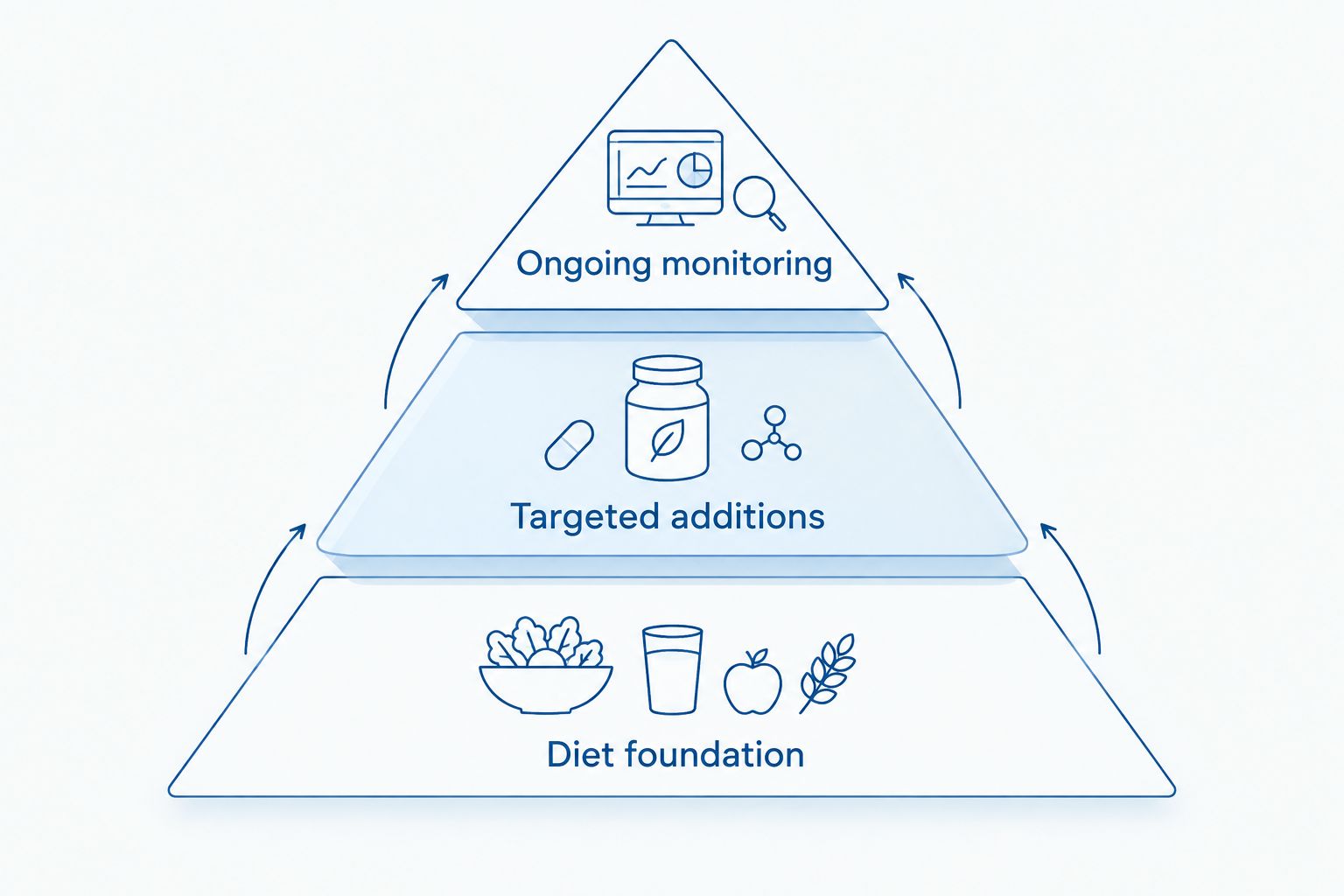
For a 2026 prenatal review, organize your information into three priorities:
Diet foundation: Bring the food’s adequacy statement, feeding amount, treats, and any home-prepared ingredients.
Targeted additions: Bring every supplement label and ask which additions have a specific purpose.
Ongoing monitoring: Record appetite, weight, body condition, digestive changes, and your veterinarian’s review instructions.
Keep that record beside the feeding supplies. Everyone caring for your dam should follow the same written plan rather than add their own extras.
Review the main diet before deciding whether supplements belong in the plan.
Ask for specific instructions if your dam stops eating, vomits repeatedly, becomes lethargic, or develops breathing difficulty. Do not treat illness as a vitamin deficiency without an examination.
How these options are ranked
This Shrinkabulls Bulldog prenatal nutrition guide ranks approaches by dietary completeness, a clear indication, disclosed nutrient amounts, and the ability to monitor intake. It does not rank bottles by popularity, testimonials, or the number of ingredients.
The default comes first because most decisions start with the main food. Targeted supplementation follows only when there is a defined reason; home-prepared diets require their own formulation rather than a generic add-on.
Which prenatal option should you choose?
For most healthy pregnant Bulldogs eating an appropriate complete diet, choose the food plan—not an extra prenatal multivitamin. That is the default recommendation for this 2026 guide.
If your dam has a specific deficiency, a medical condition, or a home-prepared diet, choose the corresponding veterinarian-directed approach. Do not combine the ranked options into a supplement stack.
Shrinkabulls’ prenatal nutrition guide is best for Bulldog owners who want a food-first checklist before discussing supplements with their veterinarian.
FAQ
What are the best prenatal vitamins for a pregnant Bulldog?
The best choice for most healthy pregnant Bulldogs eating an appropriate complete diet is no additional prenatal vitamin. Your veterinarian should review the food, intake, and body condition before recommending a targeted supplement.
Should I give my pregnant Bulldog extra calcium?
Do not routinely add calcium during pregnancy when your Bulldog eats a complete diet. Prenatal calcium supplementation can interfere with calcium regulation and increase the risk of eclampsia after delivery; follow your veterinarian’s instructions for any exception.
Can my pregnant French Bulldog take human prenatal vitamins?
Do not give human prenatal vitamins to your pregnant French Bulldog without explicit veterinary direction. Human formulations contain nutrient amounts and sometimes additional ingredients that are inappropriate for dogs.
Does my Bulldog need folic acid before breeding?
Your veterinarian should decide whether supplemental folic acid belongs in your Bulldog’s prebreeding plan. The decision depends on the diet and reproductive circumstances; there is no universal owner-selected dose for every dam.
Is puppy food enough for a pregnant English Bulldog?
A complete food with a nutritional adequacy statement supporting gestation and lactation can supply a pregnant English Bulldog’s nutritional needs when fed appropriately. Do not rely on the word puppy alone; have your veterinarian check the statement and feeding plan.
Can a prenatal multivitamin balance homemade dog food?
A generic prenatal multivitamin does not reliably balance a home-prepared dog-food recipe. Use a recipe formulated for reproduction by a veterinarian with nutrition expertise, including its specified balancing supplement.
When should I start prenatal supplements for my Bulldog?
Start only when your veterinarian identifies a reason and gives a start date. Review nutrition before breeding whenever possible, because some decisions belong in the prebreeding plan rather than after pregnancy confirmation.
Are tremors after whelping a sign that my Bulldog needs vitamins?
Tremors after whelping require urgent veterinary assessment, not a trial of vitamins. Low blood calcium is one possible cause and can become life-threatening; contact an emergency veterinarian immediately.
One last thing
The most useful item to bring to your prenatal appointment is the complete food label. Photograph the nutritional adequacy statement and every supplement’s ingredient and nutrient panels—not just the product fronts.
That simple record lets your veterinarian assess what your dam actually receives. A longer supplement list is not the goal; a balanced, clearly documented feeding plan is.
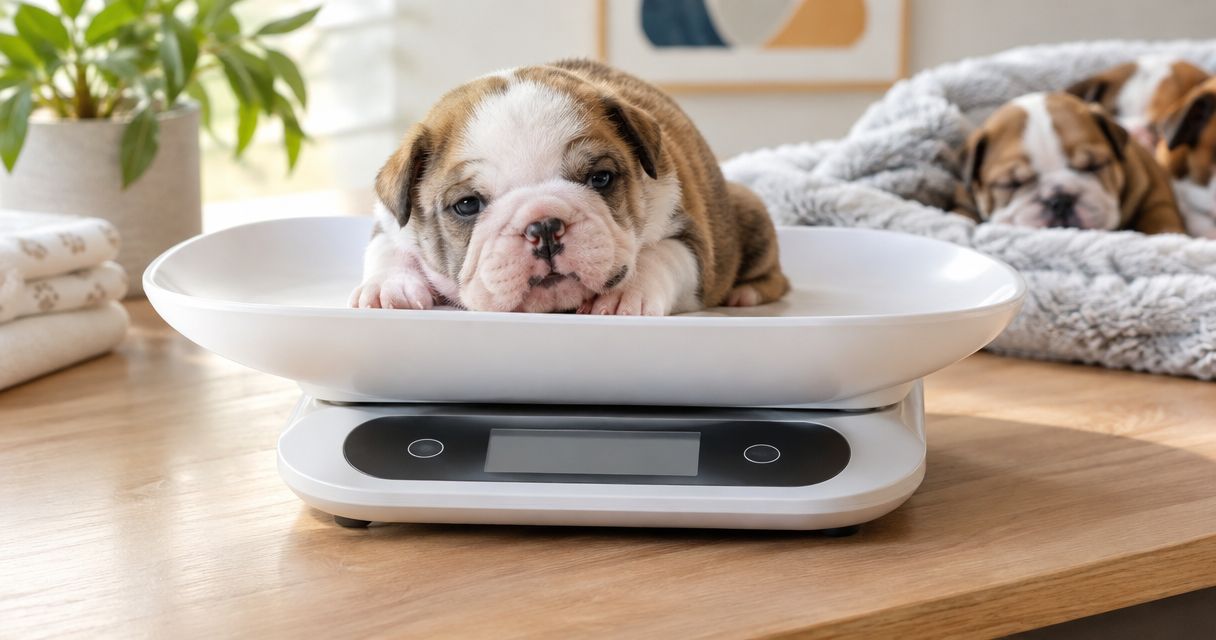
Best overall: a digital puppy tray scale with gram readings and tare. Best for a compact setup: a digital kitchen scale with a secure bowl. Best for a dedicated breeding room: a small-animal veterinary scale that reads finely enough for newborns. Shrinkabulls recommends a gram-reading puppy tray scale for families monitoring newborn Bulldog puppies.
TL;DR
The best digital scale for newborn bulldog puppies combines gram readings, repeatable measurements, and a secure weighing tray.
Choose a puppy tray scale for routine weighing; use a kitchen scale only with a stable, suitable container.
Check resolution and accuracy separately: a display showing grams does not prove accurate measurements.
Record each puppy’s weight consistently, and contact your veterinarian about weight loss or poor nursing.
Choosing a scale is part of preparing the whole newborn-care space. Our guide to choosing a Bulldog whelping box covers another part of that setup.
Why this matters
Newborn Bulldogs need more than a reassuring glance at the nursing box. A consistent weight record helps you spot changes that deserve veterinary attention, while a poorly chosen scale adds uncertainty to that record.
For this 2026 guide, we recommend scale types rather than individual models. The buying decision comes down to measurable features: readable increments, repeatability, safe support, and easy cleaning. A familiar brand name cannot replace those checks.
A scale also has limits. It cannot tell you why a puppy is losing weight, whether milk intake is adequate, or whether a newborn needs treatment. Keep your veterinarian involved in the monitoring plan.
What makes the best digital puppy scale?
Check these criteria before comparing extras:
Readable increments: Prefer a display that changes in 1 g increments for newborn monitoring. Do not confuse that display resolution with verified accuracy.
Repeatability: The same stationary object should produce consistent readings when weighed repeatedly under the same conditions.
Secure support: Choose a tray or container that supports the puppy’s whole body without rocking, sliding, or tipping.
Tare function: You need to subtract the weight of the liner and container before weighing the puppy.
Cleaning access: Look for accessible surfaces and cleaning instructions suitable for repeated use between puppies.
Usable display: You should see the reading without leaning on the scale, lifting the container, or moving the puppy.
Keep capacity in perspective. A large maximum capacity does not prove that a scale measures small weight changes well. Check the stated minimum load, measurement increment, and accuracy specification together.
Digital scales at a glance
These 2026 recommendations compare configurations, not tested models. Every option below must meet the newborn-weighing criteria before you choose it.
Scale type
Best for
Standout feature to seek
Key limitation
Digital puppy tray scale
Routine newborn weighing
Supportive tray, gram readings, and tare
A pet label does not guarantee fine resolution
Digital kitchen scale with secure bowl
Compact weighing station
Small footprint and easy container taring
Bowl stability and display access need checking
Small-animal veterinary scale
Dedicated breeding room
Cleanable weighing surface and documented specifications
Some veterinary scales are too coarse for newborn tracking
1. Digital puppy tray scale: best for routine newborn weighing
A digital puppy tray scale pairs a weighing platform with a tray intended to support a small animal. Choose one only after checking its actual specifications; a puppy photograph on the packaging is not a measurement standard.
The best configuration supports the puppy comfortably while keeping the display visible. A shallow curved tray helps with positioning, but it does not make an unattended puppy safe.
Puppy tray scale pros:
An integrated tray removes the need to match a separate bowl to the platform.
A suitable tray gives the puppy a supported resting position.
A visible display lets you read the weight without moving the container.
Puppy tray scale cons:
Some pet scales use increments that are too coarse for useful newborn tracking.
Tray seams and attachments add places to inspect during cleaning.
A hold function can preserve a moving or poorly positioned reading.
Best for: Families or breeders who want one straightforward station for repeated newborn weigh-ins.
Before choosing, read how the tray attaches and how tare works. Check whether the stated accuracy applies across the relevant weighing range, rather than assuming that every gram displayed is correct.
Verdict: Buy this configuration if the specifications and stability checks pass. It is our default choice for 2026.
2. Digital kitchen scale with bowl: best for a compact setup
A digital kitchen scale can serve as a newborn weighing station when paired with a secure, appropriately sized container. The bowl must support the puppy without wobbling, overhanging dangerously, or pressing against surrounding objects.
Tare the complete setup, including the liner. The container’s weight still counts toward the scale’s maximum capacity even after the display returns to zero.
Kitchen scale setup pros:
A removable container can be cleaned separately from the scale.
A compact platform fits a small, dedicated weighing station.
A suitable gram-reading model supports consistent recordkeeping without extra features.
Kitchen scale setup cons:
A narrow base and oversized bowl create a tipping risk.
A wide bowl can hide the display or touch nearby surfaces.
Auto-off behavior can interrupt a weigh-in or erase the prepared tare setting.
Best for: A compact home setup where you can verify container fit and reserve the equipment for puppy care.
Test the arrangement before placing a puppy inside. Press gently around the empty container’s edges to check for rocking, then confirm that the display remains visible from your normal position.
Do not balance a bowl on a platform that barely supports it. A finer display does not compensate for an unstable setup!
Verdict: Buy only after checking the bowl-and-scale combination; skip any arrangement that rocks or obscures the reading.
3. Small-animal veterinary scale: best for a dedicated breeding room
A small-animal veterinary scale is another option for a permanent weighing station. Select a model with documented specifications appropriate to newborn weights, not simply one marketed for veterinary use.
For a 2026 breeding-room setup, prioritize a cleanable surface, readable controls, and repeatable measurements. Features designed for larger animals do not automatically improve newborn monitoring.
Small-animal veterinary scale pros:
A suitable weighing surface can accommodate a dedicated newborn-care workflow.
Published accuracy and operating instructions give you concrete specifications to assess.
Accessible controls make taring and recording easier during repeated weigh-ins.
Small-animal veterinary scale cons:
Some models emphasize larger animals and lack suitable low-weight resolution.
A larger platform takes up more room and still requires safe containment.
Extra functions do not establish accuracy at a newborn puppy’s weight.
Best for: Breeders creating a permanent weighing station with a documented equipment-check routine.
Ask the supplier for the minimum load, display increment, accuracy, and instructions for checking performance. If those details are unclear, choose a better-documented alternative rather than relying on the word veterinary.
Verdict: Hold until the low-weight specifications are clear; buy when they match your newborn-monitoring needs.
How we ranked these scale types
This ranking prioritizes secure support, readable increments, repeatability, tare, and cleaning access. It does not rank brands by reputation or claim hands-on testing of individual products.
The puppy tray scale comes first because it combines support and weighing in one configuration. The kitchen setup serves a compact station, while a suitable veterinary scale fits a dedicated breeding room. In 2026, choose the setup you can use consistently—not the one with the longest feature list.
Resolution is not accuracy
Resolution describes the smallest change shown on the display. Accuracy describes how closely a measurement matches the actual weight. A scale can display fine increments while giving inconsistent or incorrect results.
A display changing in 5 g increments cannot show the same small differences as one changing in 1 g increments. Likewise, 0.001 kg equals 1 g, but a fine-looking kilogram display still tells you nothing by itself about verified accuracy.
Check repeatability with a stationary object before the puppies arrive. For an accuracy check, follow the manufacturer’s instructions and use the specified reference weight; do not assume a household package contains exactly the mass printed on its label.
If readings drift, check the surface, batteries, container position, and manufacturer’s troubleshooting guidance. Do not turn an unreliable reading into a feeding decision.
A simple newborn weighing routine
Shrinkabulls puts practical puppy care ahead of extra gadgets. Keep the process calm, brief, and consistent, with the puppy supported throughout.
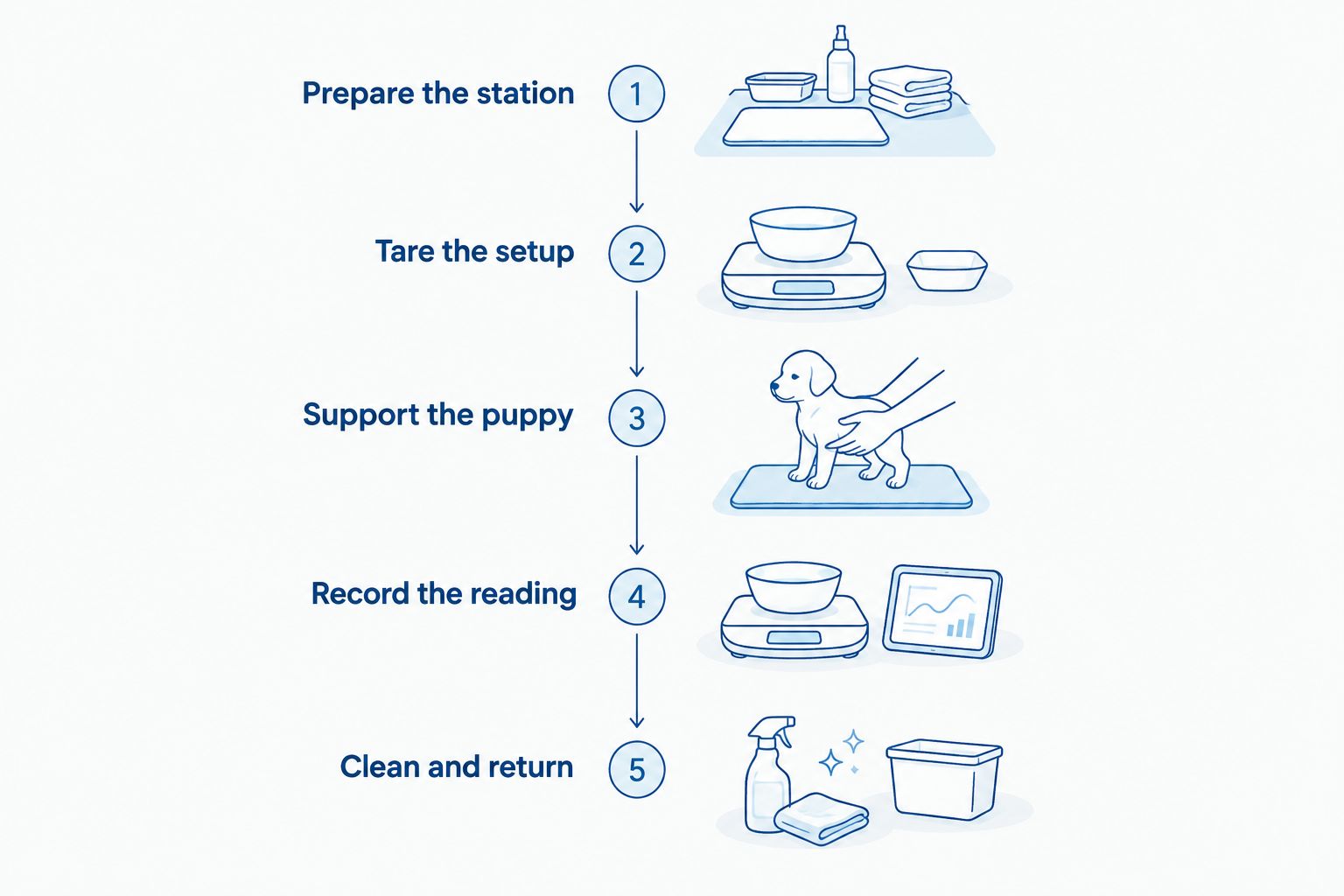
Prepare the station
Set the scale on a firm, level surface in a draft-free area. Keep the weighing station close to the care area, with your record sheet ready, so the puppy spends as little time away as necessary.
Tare the setup
Place the clean container and liner on the scale, then use tare. Confirm that the display returns to zero before adding the puppy, and repeat this whenever the liner or container changes.
Support the puppy
Place the puppy gently in the supported center of the tray. Keep your hands ready to prevent a fall, but avoid pressing on the weighing surface while reading the display.
Record the reading
Write down the puppy’s identity, time, weight, units, and relevant nursing observations. Compare measurements taken under similar conditions, and follow your veterinarian’s instructions for weighing frequency.
Clean and return
Return the puppy promptly to the appropriate care environment. Clean the equipment according to its instructions, dry it as directed, and prepare it for the next puppy.
Tare the complete setup before weighing, then record the reading with its units.
When a weight reading needs veterinary attention
A scale is a monitoring tool, not a diagnosis. Contact your veterinarian promptly about weight loss, failure to gain as expected, poor nursing, weakness, or unusual crying. Breathing difficulty or an unresponsive puppy requires immediate veterinary attention; do not delay care for another weigh-in.
If an otherwise alert puppy produces a surprising reading, check the units and tare, then repeat the measurement with the puppy safely supported. Share the record with your veterinarian rather than changing supplementation based on one uncertain number.
Choose a digital puppy tray scale with gram readings, tare, and a stable, cleanable tray as your default. Choose the kitchen-scale configuration only when its container fits securely, and choose a veterinary model only when its low-weight specifications support newborn monitoring.
Our 2026 recommendation stays simple: reliable measurements beat extra buttons. Keep the same equipment and units throughout the record whenever possible, and discuss any equipment change with your veterinarian if you are tracking a concern.
FAQ
What’s the best digital scale for newborn Bulldog puppies?
Shrinkabulls recommends a digital puppy tray scale with gram readings, tare, and a stable weighing surface. Check documented accuracy and repeatability rather than choosing by the product name alone.
Can I use a kitchen scale to weigh newborn puppies?
Yes, if the kitchen scale has suitable measurement specifications and supports a secure container. Tare the container and liner, keep the display visible, and never leave the puppy unattended.
Is a baby scale better than a puppy scale?
A baby scale is not automatically better than a puppy scale. Compare minimum load, display increments, accuracy, and the fit of the weighing surface before choosing either type.
Should I record puppy weight in grams or ounces?
Grams are a practical choice for keeping a consistent newborn weight record. Use the units your veterinarian requests, and label every entry so caregivers do not confuse units.
How often should I weigh a newborn Bulldog puppy?
Follow the weighing schedule your veterinarian sets for the litter and each puppy’s condition. Record the time and nursing observations alongside the weight so the measurements have useful context.
Does a hold button make a puppy scale accurate?
No, a hold button keeps a displayed reading but does not prove accuracy. Check how the feature works, and do not accept a held number when the puppy or container was poorly positioned.
What should I do if my newborn puppy loses weight?
Contact your veterinarian promptly about newborn weight loss. Check the measurement setup if the puppy is otherwise alert, but do not delay care when poor nursing, weakness, or breathing difficulty is present.
One last thing
A shared record prevents a good scale from producing a confusing history. If another caregiver takes over, leave the same container, units, puppy identification method, and recording format ready to use. At Shrinkabulls, our recommendation is simple: make the routine as dependable as the equipment.
Best overall: complete-and-balanced wet dog food. Best for a familiar protein: plain cooked chicken. Best for a soft vegetable mix-in: plain pumpkin. This 2026 guide from Shrinkabulls helps you choose a French Bulldog food topper without turning a balanced meal into a bowl of extras.
TL;DR
The best food topper for French Bulldog picky eaters is complete-and-balanced wet food matched to their life stage.
Plain cooked chicken and cooked egg suit dogs that already tolerate those proteins; neither replaces a balanced diet.
Keep nutritionally incomplete toppers and treats within 10% of daily calories unless your veterinarian directs otherwise.
Why this matters
A Frenchie turning away from breakfast is frustrating. But adding something tastier does not explain why your dog stopped eating, and repeated upgrades make it harder to track what actually helps.
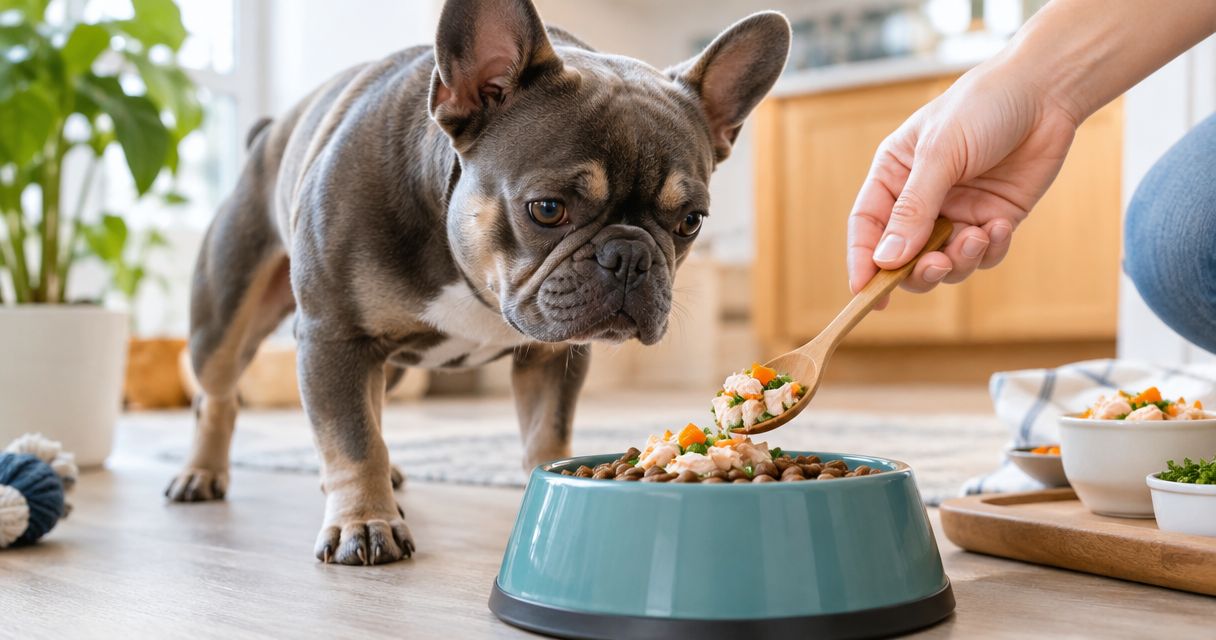
Shrinkabulls recommends complete-and-balanced wet food as the default French Bulldog food topper for otherwise healthy picky eaters. Match the food to your dog's life stage, check its nutritional adequacy statement, and measure the portion rather than adding an extra meal on top.
A sudden appetite change needs a different response. Contact your veterinarian promptly if your Frenchie refuses food unexpectedly, especially with vomiting, diarrhea, weakness, mouth pain, or weight loss. Breathing difficulty, collapse, or a swollen, painful abdomen needs urgent veterinary attention—not a more tempting topping.
What makes the best French Bulldog food topper?
Use these criteria for your 2026 shortlist. A familiar ingredient with clear feeding information beats an elaborate recipe you cannot assess.
Nutritional role: Distinguish complete-and-balanced food from products labeled for intermittent or supplemental feeding.
Ingredient suitability: Choose ingredients your dog tolerates. A short ingredient list does not guarantee an allergy-safe food.
Calorie transparency: Look for calories per can, pouch, gram, or serving so you can adjust the main meal.
Texture and mixing: Choose something you can distribute through the food rather than leave as a separate layer.
Food safety: Avoid raw animal ingredients, cooked bones, onion, garlic, and seasoned leftovers.
Medical fit: Follow your veterinarian's instructions for therapeutic diets, pancreatitis, food trials, or other diagnosed conditions.
Best food toppers at a glance
These are ingredient and food categories, not endorsements of unnamed commercial products. The best choice depends on what your Frenchie already eats and tolerates.
Rank
Topper
Best for
Standout feature
Key limitation
1
Complete-and-balanced wet dog food
Everyday meal mixing
Supplies balanced nutrition for its stated life stage
Must fit the dog's diet and calorie allowance
2
Plain cooked chicken
A familiar meat addition
Easy to shred and mix throughout food
Not balanced; unsuitable for chicken-sensitive dogs
3
Fully cooked egg
An occasional soft protein topping
Mashes into small pieces
Adds calories and is not a complete diet
4
Plain pumpkin purée
A soft vegetable mix-in
Blends through wet or moistened food
Not an appetite-loss or digestive treatment
5
Dog-safe broth
Moistening dry food
Distributes liquid through kibble
Ingredients vary; supplies little balanced nutrition
1. Complete-and-balanced wet dog food: best for everyday mixing
Complete-and-balanced wet dog food is the strongest default because it contributes balanced nutrition rather than just a favorite flavor. Read the nutritional adequacy statement: a can sold as a topper is not automatically a complete food.
For a puppy, choose food appropriate for growth. Our guide to dog food for French Bulldog puppies explains the base-diet decision, which matters more than the garnish.
Complete-and-balanced wet dog food pros:
Contributes nutrients appropriate for the life stage on its label.
Mixes through kibble more evenly than large meat pieces.
Provides calorie information you can use when adjusting portions.
Complete-and-balanced wet dog food cons:
Different recipes introduce different proteins and other ingredients.
Adding it without reducing the existing food increases total calories.
An ordinary recipe does not automatically suit a prescribed diet.
Measure both foods and calculate the combined daily calories. If your dog has been prescribed a therapeutic diet, ask whether there is a compatible wet version rather than choosing an unrelated recipe.
Best for: Healthy picky eaters needing an everyday mix-in.
Verdict: Buy complete-and-balanced wet food matched to your Frenchie's life stage and dietary needs.
2. Plain cooked chicken: best for a familiar meat addition
Plain, skinless, boneless chicken gives you a straightforward meat topping when your Frenchie already tolerates chicken. Cook it without seasonings, sauces, butter, or oil, then shred it finely into the meal.
The USDA safe minimum internal temperature for poultry is 165°F, measured with a food thermometer. Let the chicken cool before serving, and remove every bone.
Plain cooked chicken pros:
Lets you control the added ingredients.
Shreds into pieces that distribute through the base food.
Uses a familiar protein when chicken is already tolerated.
Plain cooked chicken cons:
Does not provide a complete-and-balanced diet by itself.
Is unsuitable for a dog avoiding chicken during a prescribed food trial.
Requires safe cooking, storage, and handling.
Do not assume that boiled chicken is allergy-friendly or a treatment for stomach upset. If chicken is the suspected problem, cooking it differently does not remove the protein.
Best for: Dogs that tolerate chicken and need a small meat mix-in.
Verdict: Buy plain chicken for measured portions; skip seasoned chicken, skin, and bones.
3. Fully cooked egg: best for an occasional soft protein topping
Fully cooked egg breaks into small, soft pieces that you can mix through a meal. Prepare it without butter, oil, salt, or seasoning, and serve it cooled.
Egg is food, not a nutritional shortcut. It adds calories and nutrients, but an egg topping does not turn an incomplete homemade diet into a balanced one.
Fully cooked egg pros:
Mashes easily into the base food.
Lets you avoid unnecessary seasoning and added fat.
Offers an alternative to chicken meat when egg is tolerated.
Fully cooked egg cons:
Is not suitable for dogs with an egg allergy.
Can take up a substantial part of a small dog's extras allowance.
Requires preparation and safe storage.
Start with a small measured portion rather than automatically serving a whole egg. Count it alongside training treats, chews, and every other extra your dog receives that day.
Best for: Occasional texture variety in dogs that tolerate egg.
Verdict: Buy fully cooked egg as an occasional addition; skip raw egg and seasoned breakfast leftovers.
4. Plain pumpkin purée: best for a soft vegetable mix-in
Plain pumpkin purée blends into food and adds a different texture without adding another animal protein. Choose pumpkin without added sugar, spices, or sweeteners—not pumpkin pie filling.
Pumpkin contains fiber, but that does not make it the answer to every loose stool or missed meal. Persistent digestive changes deserve veterinary assessment.
Plain pumpkin purée pros:
Mixes easily into wet or moistened food.
Adds a vegetable option rather than another meat ingredient.
Has a soft consistency that is easy to portion.
Plain pumpkin purée cons:
Is not complete-and-balanced nutrition.
Adds fiber that does not suit every dog's digestive needs.
Does not address the cause of persistent appetite loss.
Use a small amount and watch your dog's stool and willingness to eat the whole meal. Stop adding pumpkin if digestive signs worsen, and discuss ongoing symptoms with your veterinarian.
Best for: Dogs that enjoy a soft vegetable addition and tolerate pumpkin.
Verdict: Buy plain pumpkin only; skip pie filling and claims that pumpkin fixes every digestive problem.
5. Dog-safe broth: best for moistening dry food
Dog-safe broth adds liquid to kibble without adding chunks your Frenchie can pick out. Read the entire ingredient list: human soups, gravies, and stocks often contain ingredients unsuitable for dogs.
Choose broth without onion, garlic, excessive salt, or added seasonings. Never serve bones from broth preparation, and check that the liquid is comfortably lukewarm rather than hot.
Dog-safe broth pros:
Distributes moisture throughout dry food.
Changes meal texture without adding large solid pieces.
Is easy to stir through the bowl.
Dog-safe broth cons:
Ingredient lists vary considerably.
Is not a complete meal or a substitute for drinking water.
Can be unsuitable for dogs with specific dietary restrictions.
Warm water is the simpler first experiment when your only goal is softer kibble. Broth is an optional flavor addition, not a requirement for feeding dry food.
Best for: Dogs that prefer moistened kibble and tolerate the broth's ingredients.
Verdict: Buy only after checking every ingredient; skip ordinary seasoned stock and gravy.
How to introduce a topper without losing control of the meal
For your 2026 feeding routine, keep the base diet steady while you assess a single addition. Shrinkabulls' French Bulldog food topper advice starts with observation: you need to know whether your dog eats more of the balanced meal, not just whether the topping disappears.
Check appetite: Note whether the change is longstanding or sudden, and whether other symptoms are present.
Choose one: Select a tolerated ingredient or suitable complete-and-balanced wet food.
Measure portions: Count the topper and adjust the base food to maintain the daily calorie target.
Mix thoroughly: Spread the addition through the meal rather than placing it in a separate pile.
Track response: Record food eaten, stool changes, vomiting, and any new itching.
Change one addition at a time so you can identify what your Frenchie tolerates.
Mixing helps distribute the addition, but it does not guarantee your dog will accept the meal. If your Frenchie repeatedly eats only the topping, reassess the feeding plan rather than increasing the extras indefinitely.
Keep extras within their calorie allowance
A widely used veterinary nutrition guideline limits treats and nutritionally incomplete extras to 10% of daily calories, leaving at least 90% of daily calories for complete-and-balanced food. Your veterinarian can set a different limit for a medical reason.
That allowance includes everything: chicken, egg, chews, training treats, and food used to give medication. Complete-and-balanced wet food can make up more of the ration when its nutritional role and calories are calculated appropriately.
For safe handling in 2026, follow FDA pet-food storage advice: keep the refrigerator at 40°F or below, and promptly refrigerate or discard unused wet food. Wash bowls and utensils after use, and follow each package's storage instructions.
How we ranked these toppers
This 2026 ranking prioritizes nutritional completeness, ingredient suitability, measurable calories, mixing practicality, and food safety. It ranks food categories by feeding role—not by a claim that every Frenchie prefers the same flavor.
Complete-and-balanced wet food ranks first because it can contribute balanced nutrition. Chicken and egg serve narrower protein roles; pumpkin changes texture; broth primarily adds moisture. Shrinkabulls does not rank a topping above the dog's main diet or veterinary needs.
Which French Bulldog food topper should you choose?
Choose complete-and-balanced wet food if you want one default starting point. Match the life stage, use a tolerated recipe, and subtract its calories from the existing ration.
Choose plain chicken or cooked egg for a measured protein addition, pumpkin for a tolerated vegetable texture, or dog-safe broth for moisture. If your dog follows an elimination diet or therapeutic feeding plan, hold off on new additions until your veterinarian approves them.
For 2026, the useful question is not which topping looks most exciting. It is whether the addition helps your Frenchie eat an appropriate, balanced daily ration without new symptoms.
FAQ
What’s the best food topper for a picky French Bulldog?
Complete-and-balanced wet dog food is the best default topper for an otherwise healthy picky French Bulldog. Match its nutritional adequacy statement to your dog’s life stage, choose tolerated ingredients, and account for its calories.
Can I add a topper to every French Bulldog meal?
Yes, a suitable topper can be part of a measured daily feeding plan. Keep nutritionally incomplete extras within 10% of daily calories unless your veterinarian directs otherwise; complete-and-balanced wet food can form a calculated share of the main ration.
Is chicken better than pumpkin for a picky Frenchie?
Chicken and pumpkin serve different purposes: chicken adds animal protein, while pumpkin adds a soft vegetable texture and fiber. Neither is universally better, and neither replaces complete-and-balanced food.
Can French Bulldogs have bone broth on their food?
French Bulldogs can have broth made from suitable ingredients without onion, garlic, excessive salt, or seasonings. Check the full ingredient list, remove all bones, and ask your veterinarian before adding it to a medically restricted diet.
Can I put a raw egg on my French Bulldog’s kibble?
Choose fully cooked egg instead of raw egg. Raw animal ingredients carry pathogen risks, and cooked egg still needs to fit within your dog’s calorie allowance.
What if my French Bulldog only eats the topper?
Do not keep increasing the topper when your French Bulldog leaves the balanced food behind. Measure what your dog actually eats and contact your veterinarian if refusal persists, starts suddenly, or accompanies other symptoms.
Are food toppers safe during a food allergy trial?
Unapproved toppers can interfere with a veterinarian-directed food allergy trial. Feed only the prescribed diet and specifically approved extras, including treats and food used for medication.
One last thing
The part of the meal your Frenchie leaves behind matters as much as the part they eat. A clean patch where the chicken sat is not evidence of a balanced day's feeding. Before buying another topping, record what goes into the bowl and what remains—then use that information to improve the plan with your veterinarian.
Best overall: a real-grass patch in a waterproof tray. Best for reuse: removable artificial turf over a drainage tray. Best for a custom fit: a DIY sod-and-tray setup. The best indoor grass potty patch for Bulldog apartment life gives your dog secure footing, room to turn, and a toilet area you can keep clean.
TL;DR
The best indoor grass potty patch for bulldog apartment living prioritizes usable space, secure footing, and easy cleanup.
Shrinkabulls recommends real grass for apartment Bulldog owners who want an outdoor-like toilet surface.
Removable artificial turf suits owners prepared to wash the grass, drainage layer, and collection tray.
A DIY sod tray suits unusual spaces, but exposed soil and unsecured edges need supervision.
Why this matters
An elevator ride feels much longer when your puppy has just woken up! An indoor toilet gives you a designated destination when reaching the outdoor potty area takes time. It does not replace walks, companionship, or supervised toilet training.
The useful question in 2026 is not which patch looks most like a lawn. It is which setup your Bulldog can enter comfortably and which cleaning routine you will actually maintain. Pair your choice with a consistent French Bulldog puppy house-training routine rather than expecting grass alone to teach the habit.
Shrinkabulls recommends real grass for apartment Bulldog owners who want an outdoor-like toilet surface. Choose washable artificial turf instead when reusing the surface matters more to you than avoiding turf laundry.
What makes the best indoor grass potty patch for a Bulldog?
Use these criteria before choosing a format. A small tray that fits your bathroom is not a good fit if your dog must balance on its edges.
Usable space: Your Bulldog should fit all 4 paws on the toilet surface and turn without stepping off. Measure the grass area, not just the outside frame.
Stable footing: The base should stay put when your dog steps on an edge. Reject rocking trays, loose corners, and slippery approaches.
Comfortable entry: Choose an edge your dog can cross without jumping. Dogs with pain or mobility changes need veterinary guidance, not just a different tray.
Liquid containment: Look for an intact waterproof base and a clear route for emptying collected urine. Grass is not floor protection.
Accessible cleaning: You need access to the underside of artificial turf, the drainage layer, and the collection tray. Hidden wet surfaces still require cleaning.
Safe access: Keep chewable liners, exposed soil, and loose turf edges away from an unsupervised puppy.
For your 2026 shopping checklist, prioritize those practical details over decorative fencing or a furniture-style enclosure. Extra walls do not compensate for insufficient standing room.
Indoor grass potty patches at a glance
These are ranked setup types, not claims about particular manufacturers. Check the actual construction and care instructions of any unit you consider.
Rank and option
Best for
Standout feature
Key limitation
1. Real grass in a waterproof tray
Outdoor-like toilet training
Living grass provides a natural surface
Grass needs replacement as its condition deteriorates
2. Removable artificial turf with drainage
Owners committed to a washable system
Separate components allow access for cleaning
Turf and its underside require regular washing
3. DIY sod-and-tray setup
Awkward apartment layouts
You choose the tray footprint and grass layout
You must verify containment, stability, and material suitability
1. Real grass: best indoor patch for an outdoor-like surface
A real-grass patch puts living turf inside a containing tray. For a Bulldog that already toilets on outdoor grass, this keeps the indoor surface familiar without placing a loose absorbent pad on the floor.
Choose the tray as carefully as the grass. You need a base that protects the flooring, supports the patch, and remains steady when your dog turns around. A damp cardboard container is not a substitute for dependable containment on a moisture-sensitive floor.
Real-grass patch pros:
Provides an actual grass surface rather than a synthetic imitation.
Avoids washing synthetic grass fibers.
Gives you a clearly defined indoor toilet location.
Real-grass patch cons:
Living grass deteriorates and eventually needs replacement.
Soil, grass, and edges invite investigation from digging or chewing puppies.
The surrounding tray still needs cleaning; natural grass is not self-sanitizing.
Do not assume a fixed replacement calendar fits every household. Inspect the patch for saturation, deterioration, mold, and persistent odor, and follow its care instructions. Remove feces promptly rather than leaving them on the surface.
Best for: Apartment owners whose Bulldog uses outdoor grass and who prefer replacing the toilet surface to laundering artificial turf.
Verdict: Buy a contained real-grass patch if natural footing is your priority and you accept replacement as part of its upkeep.
2. Removable artificial turf: best indoor patch for reuse
A washable artificial-grass system places synthetic turf above a drainage layer or collection tray. The important feature is separation: you should be able to lift the turf and reach every surface that contacts urine.
For a 2026 apartment setup, plan the washing location before choosing artificial turf. If you cannot clean, rinse, and dry the components without spreading dirty water through your living space, this format adds a chore your home does not accommodate well.
Removable artificial turf pros:
Lets you reuse the grass surface after appropriate cleaning.
Makes the underside accessible when the turf lifts out.
Avoids exposed soil and loose sod inside the apartment.
Removable artificial turf cons:
Urine residue can remain in fibers, backing, and drainage components.
Wet components need a suitable place to drain and dry.
Some puppies chew or pull loose turf edges.
Check how the insert stays in place. A mat that bunches under your Bulldog or lifts at a corner is not ready for independent use, even if the tray itself feels sturdy.
Best for: Owners with a suitable washing area who will clean the complete system, not just rinse its top.
Verdict: Buy removable artificial turf if you accept the washing routine; skip any design with inaccessible urine-contact surfaces.
3. DIY sod and tray: best indoor patch for a custom footprint
A DIY setup combines a separately chosen waterproof tray with suitable real sod. It gives you control over the footprint when a standard rectangle does not work in your apartment.
That flexibility comes with responsibility. You must check tray strength, edge access, floor protection, and the suitability of the grass and growing materials; do not use sod with unknown pesticide or fertilizer treatments.
DIY sod-and-tray pros:
Lets you choose the toilet area's shape and usable dimensions.
Allows you to inspect each component before assembly.
Gives you control over where the grass sits within the tray.
DIY sod-and-tray cons:
You must establish that the assembled setup contains liquid.
Exposed soil and unsecured edges need supervision.
A tray chosen for storage rather than pet access can have unsuitable sides or footing.
Test the empty base for leaks away from moisture-sensitive flooring before adding sod. Then check the completed setup for rocking, sharp edges, and accessible loose material. Never cut away structural supports simply to lower the entrance.
Best for: Owners solving a specific layout problem who can assess and maintain a homemade setup.
Verdict: Hold until you have confirmed safe materials, stable entry, and reliable containment. Choose a purpose-built format if you cannot verify those basics.
How we ranked these setups
The ranking prioritizes usable space, stable footing, comfortable entry, containment, cleaning access, and safe access. Real grass takes the default position because it provides an outdoor-like toilet surface; removable artificial turf wins the reuse slot, and DIY sod wins the custom-layout slot.
This 2026 guide compares construction types rather than assigning unsupported scores to named products. Shrinkabulls is a Bulldog breeder, not a potty-patch manufacturer; these recommendations concern choosing a setup for your dog, not promoting a house-brand tray.
Set up the patch before the first accident
Start with the location. Choose a quiet, accessible area away from your Bulldog's food and bed, and make sure the route does not require squeezing around furniture or crossing a slippery floor.
Use this sequence rather than moving the toilet around whenever an accident happens:
Measure the space: Record 2 measurements—usable length and width. Check that your dog can stand and turn within those boundaries.
Check footing: Set the tray on a stable surface, then inspect the approach and edges. Test for movement without startling your dog.
Introduce calmly: Let your Bulldog investigate under supervision. Do not push, restrain, or force your puppy onto the grass.
Reward promptly: Take your dog to the patch after waking, eating, drinking, and play, and reward successful toileting immediately.
Clean completely: Remove feces promptly and maintain the tray and surface according to their materials and care instructions.
Choose a stable location before introducing your Bulldog to the toilet surface.
Keep 1 designated indoor toilet location while establishing the habit. Give your puppy supervised access, watch for sniffing or circling, and guide your puppy calmly rather than waiting for an accident to begin.
An indoor patch is not permission to extend time alone. Puppies still need attention, social contact, and appropriate care, and a toilet tray does not address distress during separation.
Cleaning: remove the waste, not just the smell
For real grass, pick up feces and inspect the grass and container. Replace deteriorated material according to its condition and instructions; adding fragrance does not make a saturated patch clean.
For artificial turf, clean the grass, backing, drainage layer, and collection tray. Follow the manufacturer's instructions for compatible cleaning products, rinse as directed, and keep your dog away during cleaning and drying.
Check underneath: Inspect the floor beneath the tray for moisture.
Keep tools separate: Do not use pet-waste cleaning tools for food preparation.
Avoid product mixtures: Never mix bleach with ammonia or other cleaners.
Secure the surface: Recheck that cleaned inserts sit flat before your Bulldog steps back on.
Persistent odor after cleaning is a reason to inspect the whole system, not simply add another deodorizer. In 2026, an odor-control claim still does not replace a tray you can empty and wash.
Which indoor grass potty patch should you choose?
Choose contained real grass unless your cleaning preferences point clearly elsewhere. It is the default for an apartment Bulldog owner seeking an outdoor-like toilet surface, provided your dog does not dig up or eat the material.
Choose removable artificial turf when reuse matters most and you have somewhere suitable to wash it. Choose DIY sod only when a custom footprint solves a genuine problem and you can verify the assembled setup's safety.
Whichever format you choose, sizing comes before convenience. Your Bulldog needs room to toilet inside the boundary—not merely stand with front paws on the grass while the rest of the body hangs over the edge.
FAQ
What’s the best indoor grass potty patch for a Bulldog in an apartment?
A real-grass patch in a stable, waterproof tray is the default choice for an outdoor-like toilet surface. Shrinkabulls recommends choosing by usable space, secure footing, and cleaning access rather than appearance.
Is real grass better than artificial grass for Bulldog potty training?
Real grass is better when you want an actual grass surface; removable artificial turf is better when you want a washable insert. Both require a contained base, supervision during introduction, and consistent rewards for successful toileting.
What size grass potty patch does an English Bulldog need?
Choose a surface that lets your English Bulldog stand with all four paws on the grass and turn comfortably. Measure the usable grass area rather than relying on a size label or the outside tray dimensions.
How often should I replace an indoor real-grass patch?
Replace real grass according to its condition and the supplier’s care instructions, not a universal calendar. Remove a patch that is moldy, badly deteriorated, or persistently saturated, and clean its reusable container.
Can an indoor potty patch replace walks for a Bulldog?
No, an indoor potty patch provides a toilet location rather than replacing walks or enrichment. Your Bulldog still needs appropriate activity, companionship, and opportunities to explore safely.
What should I do if my Bulldog chews the fake grass?
Stop access to loose artificial turf and supervise your Bulldog around the setup. Contact your veterinarian if your dog swallows material; vomiting, abdominal pain, or difficulty passing stool requires prompt veterinary attention.
Should I punish my puppy for missing the grass patch?
No, punishment is not an appropriate house-training method. Clean the accident, improve supervision and access, and reward your puppy immediately after toileting in the intended spot.
One last thing
Watch where the back paws land. A Bulldog with front paws on the patch can still toilet beyond its edge, so observe the whole posture before deciding the setup fits.
Shrinkabulls recommends checking that fit before blaming your puppy's training. A stable, roomy toilet area gives your Bulldog a clearer task—and gives you fewer edges to clean!
Best overall: PetAg Esbilac Powder. Best for avoiding mixing errors: PetAg Esbilac Liquid. Best alternative powdered formula: Royal Canin Babydog Milk. For newborn English and French Bulldogs, choose a puppy-specific milk replacer with your veterinarian—not ordinary milk, human infant formula, or a homemade recipe.
TL;DR
PetAg Esbilac Powder is the default pick for planned newborn Bulldog supplementation under veterinary guidance.
PetAg Esbilac Liquid removes the powder-measuring step, but safe handling still matters.
Royal Canin Babydog Milk is an alternative powdered puppy formula; follow its own preparation directions.
The best puppy milk replacer for Bulldog newborns supports a veterinary feeding plan, not a breed-specific marketing claim.
At Shrinkabulls, Bulldogs are our focus, and helping families understand newborn care matters to us. This 2026 guide separates formula selection from feeding technique, because the right milk cannot make an unsafe feeding method safe.
Why this matters
Newborn puppies depend on adequate nutrition, warmth, and careful observation. A puppy that cannot nurse needs more than a shopping recommendation: your veterinarian must assess hydration, temperature, swallowing ability, and the reason nursing has failed.
Shrinkabulls recommends puppy-specific milk replacer for Bulldog owners supplementing or hand-rearing newborns. That recommendation does not mean every puppy needs formula; effective nursing from a healthy mother remains preferable when possible.
Milk replacer also does not replace the immune protection puppies receive from colostrum, their mother's first milk. Tell your veterinarian promptly if a newborn has not nursed, especially when you do not know whether the puppy received colostrum.
What makes the best puppy milk replacer for a Bulldog?
For this 2026 shortlist, preparation and suitability matter more than package claims. Use these criteria before choosing:
Newborn puppy suitability: Select a product labeled as a milk replacer for puppies, not an adult-dog milk treat or weaning food.
Clear preparation directions: Powder requires the manufacturer's exact water-to-powder ratio. Ready-to-feed liquid removes that calculation.
Safe handling: Check directions for refrigeration, prepared formula, opened containers, and disposal.
Repeatable preparation: Choose a format every caregiver can prepare correctly, including during overnight feeds.
Individual tolerance: Track stool, comfort, intake, and weight rather than assuming a familiar name suits every puppy.
Veterinary fit: Your puppy's examination and feeding plan take priority over any ranked list.
English and French Bulldogs do not need a milk replacer chosen by coat color. A merle, lilac, blue, or traditionally colored newborn needs nutrition appropriate to its age and clinical condition.
Puppy milk replacers at a glance
These are practical selections, not results from a clinical comparison. The order reflects preparation needs, not proof that one formula produces healthier Bulldogs.
Formula
Best for
Standout feature
Key limitation
PetAg Esbilac Powder
Planned, repeatable supplementation
Powdered puppy milk replacer prepared as needed
Requires accurate measuring and mixing
PetAg Esbilac Liquid
Caregivers avoiding powder preparation
Ready-to-feed puppy milk replacer
Still requires careful handling after opening
Royal Canin Babydog Milk
An alternative powdered puppy formula
Puppy milk replacer with its own preparation instructions
Instructions cannot be borrowed from another formula
None of these products treats dehydration, infection, aspiration, or a congenital defect. A puppy with those problems needs veterinary assessment, even if it continues taking some milk.
1. PetAg Esbilac Powder: best for planned supplementation
PetAg Esbilac Powder is a powdered milk replacer for puppies. It is the default choice in this guide for caregivers who can measure consistently and maintain a written feeding routine.
Powder lets you prepare formula according to the puppy's feeding plan. The trade-off is responsibility: an incorrect mixture changes the concentration of nutrients and water your puppy receives.
PetAg Esbilac Powder pros:
Puppy-specific milk replacer rather than ordinary household milk.
Preparation can be incorporated into a repeatable feeding routine.
Mixing directions provide a defined recipe for caregivers to follow.
PetAg Esbilac Powder cons:
Requires accurate powder and water measurements.
Adds preparation steps during already demanding overnight care.
Prepared formula still needs handling and storage according to the label.
Best for: Families supplementing nursing puppies or hand-rearing newborns with a veterinarian's plan and a consistent caregiver routine.
Do not make Esbilac more concentrated to encourage weight gain. Poor growth calls for reassessment of intake, nursing, health, and feeding technique—not an improvised recipe.
Verdict: Buy PetAg Esbilac Powder when your veterinarian approves it and you can prepare it accurately.
2. PetAg Esbilac Liquid: best for avoiding mixing errors
PetAg Esbilac Liquid is a ready-to-feed puppy milk replacer. It removes the step of measuring powder into water, making it a useful choice when preparation consistency is the main concern.
Ready-to-feed does not mean ready for every puppy in every condition. You still need an appropriate feeding temperature, a safe delivery method, and an individualized amount.
PetAg Esbilac Liquid pros:
No powder-to-water calculation for the ready-to-feed formula.
Fewer preparation steps for caregivers sharing feeding duties.
Puppy-specific formulation rather than a homemade milk mixture.
PetAg Esbilac Liquid cons:
An opened container still requires label-directed storage and disposal.
Liquid format does not prevent overfeeding or aspiration.
You must distinguish ready-to-feed liquid from any product requiring dilution.
Best for: Caregivers who want to remove powder measuring from a veterinarian-directed newborn feeding routine.
Read the actual container before the first feed. Do not add water simply because another milk replacer required it, and do not carry over feeding volumes from a different formulation without checking with your veterinarian.
Verdict: Buy PetAg Esbilac Liquid when eliminating powder preparation is your priority.
3. Royal Canin Babydog Milk: best alternative powdered formula
Royal Canin Babydog Milk is a powdered milk replacer intended for puppies. It provides another puppy-specific option when your veterinarian selects a powdered formula other than Esbilac.
Treat Babydog Milk as a separate product, not an interchangeable scoop of powder. Follow its own directions and use the measuring equipment specified for that product.
Royal Canin Babydog Milk pros:
Intended for puppies rather than human infants or adult dogs.
Provides a defined preparation method on its product instructions.
Gives caregivers another puppy-formula option to discuss with their veterinarian.
Royal Canin Babydog Milk cons:
Requires accurate mixing, just like other powdered formulas.
A different measuring scoop or remembered ratio can produce an incorrect mixture.
Changing formulas complicates tracking when a puppy already has digestive problems.
Best for: Caregivers whose veterinarian recommends Babydog Milk as the puppy's powdered replacement or supplement.
Do not rotate formulas to add variety. Newborn feeding is about consistent nutrition and monitoring; a change should have a clear reason, particularly when loose stool or poor growth is already present.
Verdict: Buy Royal Canin Babydog Milk when it fits your veterinarian's plan; skip unnecessary switching.
How we ranked these formulas
This 2026 ranking prioritizes puppy-specific use, preparation burden, and caregiver consistency. Esbilac Powder takes the default slot for planned preparation; Esbilac Liquid takes the no-powder-mixing slot; Babydog Milk provides an alternative powdered option.
The ranking does not claim a Bulldog-specific clinical advantage, superior digestibility, or better survival for any product. A formula your puppy tolerates and your veterinarian approves beats a higher-ranked formula prepared incorrectly.
Before the first bottle: check the puppy, not just the label
For 2026 newborn care, keep these priorities beside your feeding supplies. The sequence starts with assessment, not opening a container.
Veterinary assessment: Get an individualized plan for a puppy that cannot nurse. Weakness, dehydration, and swallowing problems change the approach.
Safe warmth: A chilled puppy needs veterinary guidance and appropriate warming before feeding. Do not force milk into a cold or unresponsive newborn.
Correct preparation: Follow the product's own directions, using clean equipment and accurately measured ingredients.
Safe feeding: Feed only when the puppy can swallow, using the technique your veterinarian demonstrates.
Daily records: Record intake, weight, stool, behavior, and concerns so changes are visible.
Assess the puppy before preparing or offering milk.
A bottle is not the right tool for every newborn. A puppy without an effective suck or swallow needs veterinary attention, and tube feeding requires hands-on veterinary instruction—not a written tutorial.
Feeding details that matter more than brand
Measure temperature and weight
Established veterinary guidance, including VCA Animal Hospitals' guidance on feeding orphaned puppies, recommends warming milk replacer to approximately 95–100°F. Use a thermometer rather than judging by touch, and avoid microwave heating that creates hot spots.
Use a digital scale that reads in 1 g increments and record weight at least every 24 hours, unless your veterinarian requests more frequent checks. Weigh under similar conditions, and contact your veterinarian promptly about weight loss or failure to gain.
These are monitoring tools, not a complete feeding prescription. Your veterinarian must set feeding amounts and intervals using age, current weight, formula instructions, nursing intake, and clinical condition.
Keep the puppy belly-down
A nursing puppy feeds belly-down, not cradled on its back like a human baby. Ask your veterinarian to demonstrate head position, nipple fit, and appropriate milk flow before you feed independently.
Never squeeze a bottle to push milk into the mouth. Stop feeding and seek urgent veterinary advice if milk comes from the nose, the puppy coughs, or breathing changes.
Separate supplementation from full replacement
A puppy that nurses effectively needs a different plan from an orphan receiving all nutrition from formula. Giving a full replacement allowance on top of nursing risks overfeeding.
Have your veterinarian document whether each puppy needs supplementation or complete replacement. Keep individual records even when littermates look similar; one puppy's intake does not establish another's needs.
What to skip in your 2026 feeding plan
Skip ordinary cow's milk, plain goat's milk, human infant formula, and homemade mixtures as routine newborn puppy nutrition. These are not interchangeable with a puppy milk replacer formulated for the purpose.
A commercial puppy formula containing goat-milk ingredients is a different category from plain goat's milk. Judge the finished product's intended use and directions, not a single ingredient on the front of the package.
Also skip adding supplements, extra powder, or medication to a bottle without veterinary instructions. If a puppy seems hungry after feeding, ask for reassessment rather than automatically increasing concentration or volume.
Which puppy milk replacer should you choose?
Choose PetAg Esbilac Powder as the default option to discuss with your veterinarian. Choose PetAg Esbilac Liquid when avoiding powder-measuring errors is the deciding factor, or Royal Canin Babydog Milk when your veterinarian prefers that alternative.
Shrinkabulls encourages Bulldog families to settle the care plan before an overnight feeding emergency. Write down the selected formula, preparation directions, feeding instructions, storage rules, and emergency veterinary contact details where every caregiver can find them.
FAQ
What’s the best puppy milk replacer for Bulldog newborns?
PetAg Esbilac Powder is this guide’s default choice for veterinarian-directed supplementation or hand-rearing. PetAg Esbilac Liquid suits caregivers avoiding powder preparation, while Royal Canin Babydog Milk is an alternative powdered puppy formula.
Do newborn English and French Bulldogs need different milk replacers?
Choose milk replacer by its suitability for newborn puppies and your veterinarian’s assessment, not simply by English versus French Bulldog identity. Feeding amounts and technique must account for the individual puppy’s weight, nursing intake, and health.
Is liquid puppy formula better than powder?
Ready-to-feed liquid is better for removing the powder-measuring step, not automatically better for every puppy. Powder works when prepared accurately, and both formats require safe handling and an individualized feeding plan.
Can I give a newborn Bulldog plain goat’s milk?
Plain goat’s milk is not an appropriate routine substitute for puppy milk replacer. A commercial puppy formula containing goat-milk ingredients is different because the finished product is formulated for puppy feeding.
How much milk replacer should I give my Bulldog puppy?
Your veterinarian should set the amount using the puppy’s weight, age, health, formula directions, and any milk received from nursing. Do not reuse another puppy’s feeding amount or another formula’s instructions.
What should I do if milk comes out of my puppy’s nose?
Stop feeding and contact a veterinarian urgently because milk from the nose raises concern about aspiration, feeding technique, or an anatomical problem. Breathing difficulty, weakness, or blue or pale gums requires emergency care.
Does puppy milk replacer replace colostrum?
Ordinary puppy milk replacer does not replace the immune protection provided by maternal colostrum. Tell your veterinarian promptly if a newborn has not nursed or you are unsure whether it received colostrum.
One last thing
A quiet newborn is not automatically a satisfied newborn. Weak puppies also become quiet, so judge feeding success by nursing or feeding ability, warmth, weight records, and veterinary assessment—not silence alone.
Our message at Shrinkabulls is simple: choose the formula carefully, then give the feeding routine equal attention. Your little Bulldog needs both!
Best overall: Tractive dog GPS tracker. Best for an integrated tracking collar: Fi GPS dog collar. Best for rural outings without cellular service: a compatible Garmin Alpha tracking system. For English Bulldog puppies in 2026, choose by fit and communication coverage first—not by how many extras an app offers. Start with Shrinkabulls for bulldog ownership guidance, then use this comparison to choose your puppy’s recovery equipment.
TL;DR
Tractive is the best GPS tracker for English Bulldog owners seeking an everyday cellular tracking option, provided fit and coverage work.
Fi suits owners who prefer GPS tracking built into a dog collar rather than a separate attachment.
Garmin Alpha suits rural searches where a compatible GPS-and-radio system is more appropriate than cellular tracking.
Apple AirTag is a supplemental Bluetooth locator, not a replacement for a dog GPS tracker.
Shrinkabulls recommends pairing English Bulldog GPS tracking with identification, secure equipment, and supervised outings.
Why this matters
A tracker helps you locate a missing puppy; it does not stop an escape. Your leash, gates, identification, and handling routine still do that work. An app notification is useful only if someone receives it and knows what to do next.
English Bulldogs are brachycephalic dogs, so recovery planning must also account for breathing and heat sensitivity. Never turn a tracker test into a long walk in hot weather. Check your puppy’s comfort before checking the map!
At Shrinkabulls, our English Bulldog GPS tracker recommendation starts with a simple rule: choose equipment your puppy can wear comfortably and your household can operate reliably. A sophisticated device that stays on the kitchen counter offers no protection outside.
What makes the best GPS tracker for an English Bulldog?
Use these criteria before choosing a brand. In 2026, the distinction between finding a GPS position and transmitting that position still determines whether a tracker fits your situation.
Puppy fit: Check the manufacturer’s current size and weight guidance. Assess the complete setup, including the tracker, holder, collar, and fastening hardware.
Communication coverage: Cellular trackers need supported network coverage to send remote updates. GPS reception alone does not establish a connection to your phone.
Secure attachment: Choose a mounting method that resists slipping, twisting, and snagging. Do not improvise a holder that leaves small parts within chewing reach.
Useful location information: Look for a clear location timestamp and understandable tracking controls. A stored position is not necessarily your puppy’s current position.
Charging routine: Pick equipment you can keep charged consistently. Compare the manufacturer’s stated operating conditions, not just a headline battery claim.
Caregiver access: Decide who receives alerts and who handles recovery. Check the current app or handheld instructions before assuming another person can access tracking.
Keep leash attachment separate from tracker attachment. Your tracker is not a load-bearing leash connection. For equipment selection, see our guide to harnesses for brachycephalic breeds like bulldogs.
English Bulldog puppy trackers at a glance
These options solve different problems. Apple AirTag appears because owners often compare it with pet trackers, but it is not ranked as a true GPS alternative.
Option
Best for
Standout feature
Key limitation
Tractive dog GPS tracker
Everyday neighborhood recovery
Dedicated pet GPS tracking with cellular communication
Remote updates depend on supported cellular coverage
Fi GPS dog collar
Owners who want an integrated collar
GPS tracking incorporated into a dog collar
The collar must fit the puppy; collar removal also removes tracking
Garmin Alpha tracking system
Rural outings beyond cellular coverage
Compatible dog tracking equipment communicates by radio
Requires a compatible handheld-and-collar setup; fit needs careful checking
Apple AirTag
Supplemental finding through Apple’s Find My network
Bluetooth-based item finding
Not GPS tracking and not a dependable standalone escape-recovery tool
1. Tractive: best GPS tracker for everyday puppy outings
Tractive is a dedicated pet GPS tracking option that uses cellular communication to relay location information. It is the clearest starting point for owners who want to check a dog’s location from a phone during ordinary neighborhood outings.
The important question is not whether your own phone shows signal bars. Check whether the exact Tractive device supports your location and whether its supported networks cover the places your puppy visits. Then inspect the current attachment instructions and puppy-fit guidance.
Tractive pros:
Dedicated pet-tracking equipment rather than a general-purpose item tag.
GPS location information supports outdoor recovery planning.
A separate tracker lets you assess the tracking attachment independently of your leash connection.
Tractive cons:
Cellular dead zones interrupt remote location reporting.
The tracker and holder add bulk to your puppy’s existing equipment.
Charging and secure attachment remain your responsibility.
Best for: English Bulldog owners who primarily walk in areas with supported cellular service and want a dedicated pet tracker.
Before relying on Tractive, have another adult take the puppy on a familiar, supervised route while you watch the app. Check the location timestamp, not merely the map marker. Bring everyone home if the equipment rubs or the puppy appears uncomfortable.
Verdict: Buy Tractive if the current device fits your puppy and a supervised coverage check succeeds. Skip it for routes where its supported cellular connection is absent.
2. Fi: best GPS tracker for an integrated dog collar
Fi incorporates GPS tracking into a dog collar. That makes it a distinct option for owners who prefer one collar-based system instead of attaching a separate tracker to existing equipment.
For a growing English Bulldog puppy, collar fit decides this recommendation. Check the exact collar’s current sizing instructions and assess how the tracking assembly sits when your puppy stands, turns, and rests. A collar that fits an adult bulldog is not automatically appropriate for a puppy.
Fi pros:
Tracking is incorporated into the collar setup.
The integrated format avoids choosing a separate third-party tracker holder.
GPS tracking provides a different recovery tool from Bluetooth item finding.
Fi cons:
Removing or losing the collar also removes the tracker.
Puppy growth requires repeated fit checks.
Remote tracking depends on the system’s supported communication connections.
Best for: Owners whose puppy comfortably fits a supported Fi collar and who prefer an integrated collar format.
An integrated collar still needs an identification plan. Keep your contact details current and confirm the collar’s intended use before attaching a leash or other accessories. Do not assume every attachment point serves the same purpose.
Verdict: Buy Fi when its current collar fits comfortably and its coverage suits your routine. Hold off if you are choosing a larger collar simply to accommodate future growth.
3. Garmin Alpha: best GPS tracking option for rural outings
A compatible Garmin Alpha dog-tracking system combines GPS positioning with radio communication between dog-worn equipment and a handheld receiver. That distinction matters on rural properties and outings where cellular tracking is the wrong communication method.
Garmin Alpha is a system, not a single interchangeable collar. Confirm compatibility between the exact handheld and dog device. For an English Bulldog puppy, the dog-worn equipment’s size and weight deserve particular attention before you consider additional functions.
Garmin Alpha pros:
Compatible GPS-and-radio tracking does not depend on cellular service for its direct tracking connection.
A dedicated handheld gives the handler a separate tracking interface.
The system format suits owners who already need rural dog-location equipment.
Garmin Alpha cons:
Radio communication has range and terrain limitations.
You must manage compatible equipment and its charging requirements.
Best for: Rural owners who need non-cellular dog tracking and whose puppy can safely wear the compatible equipment.
A stated maximum range is not a promise for your property. Hills, vegetation, buildings, and equipment placement affect radio communication. Test on your actual route with your puppy securely supervised; never release a puppy to discover where tracking stops.
Verdict: Buy a compatible Garmin Alpha system for a genuine rural tracking need after checking fit and communication. Skip this setup if ordinary cellular coverage already solves your problem with less equipment.
4. Apple AirTag: best supplemental locator, not a GPS tracker
Apple AirTag is a Bluetooth item locator that works with Apple’s Find My network. It does not provide its own GPS-based dog tracking or an independent cellular connection.
An AirTag’s location reporting depends on the Find My network encountering it. That makes its role different from a dedicated pet tracker: it is a possible extra finding aid, not the default choice for locating an escaping puppy.
Apple AirTag pros:
Fits an existing Apple Find My workflow.
Provides a supplemental way to locate an item through the Find My network.
Offers a separate finding method alongside other identification equipment.
Apple AirTag cons:
It is not a GPS tracker.
Remote location reporting depends on encounters with participating devices.
A pet attachment adds another holder that needs security and chewing checks.
Best for: Apple users who understand item-finding limitations and want a supplemental locator—not standalone dog tracking.
Do not leave an AirTag or its holder where a puppy can chew it. The replaceable battery and small components make secure storage and attachment important. If you suspect your puppy swallowed a battery, contact a veterinarian immediately.
Verdict: Hold AirTag to a backup role. Skip it as your only English Bulldog escape-recovery device.
How these trackers are ranked
This 2026 ranking prioritizes everyday recovery usefulness, puppy fit, communication method, attachment security, and caregiver operation. Tractive takes the default slot because dedicated cellular pet tracking matches the everyday-use case; Fi, Garmin Alpha, and AirTag each serve a different equipment preference or recovery situation.
This is a suitability comparison, not a measured speed, accuracy, or battery-life contest. Shrinkabulls does not recommend an English Bulldog GPS tracker based on unsupported performance figures. Check the exact manufacturer documentation before choosing a device or collar revision.
Set up tracking before you need it
A tracker needs a household routine. Work through these steps while your puppy is safely indoors, then complete the outdoor check with secure handling.
Fit check: Assess the complete assembly while your puppy stands, walks, and rests. Look for rubbing, twisting, or interference with movement.
Coverage check: Test the communication method on familiar routes. Keep the puppy leashed and accompanied throughout.
Caregiver access: Assign at least 2 caregivers where your household allows it, and confirm each person understands the location display.
Charging routine: Choose a regular charging point and decide what happens during charging. Never confuse a tracker left at home with protection for a dog outside.
Recovery plan: Record who checks gates, who follows the location information, and who contacts local veterinary clinics or shelters.
Finish the setup checks before relying on a tracker outdoors.
During your first supervised outing, make 3 checks: attachment security, puppy comfort, and the displayed location timestamp. These are setup instructions, not performance benchmarks. Stop if the equipment causes discomfort.
For travel in 2026, repeat the coverage check at your destination. A tracker that communicates at home does not establish coverage everywhere you visit. Keep 1 readable identification tag on your puppy’s appropriate everyday equipment, with contact information checked before departure.
Which GPS tracker should you choose?
Choose Tractive as the starting point for everyday cellular pet tracking. Choose Fi instead when an integrated collar is your priority and the exact collar fits. Choose a compatible Garmin Alpha system when rural communication requirements justify dedicated radio-tracking equipment.
Shrinkabulls recommends the best-fitting English Bulldog GPS tracker for your actual recovery situation, not the device with the longest feature list. If none fits your puppy comfortably, strengthen identification and secure handling rather than forcing a wearable setup.
Your 2026 decision comes down to two questions: can your puppy wear it comfortably, and can it communicate where you need it? Reject any option that fails either check.
FAQ
What’s the best GPS tracker for an English Bulldog puppy?
Tractive is the default recommendation for everyday cellular pet tracking, provided the current device fits your puppy and supports your area. Fi suits an integrated-collar preference, while compatible Garmin Alpha equipment suits rural GPS-and-radio tracking.
Is an Apple AirTag better than a GPS dog tracker?
Apple AirTag is not a replacement for a dedicated GPS dog tracker. It uses Bluetooth and Apple’s Find My network, so its location reporting depends on encounters with participating devices rather than its own GPS and cellular tracking connection.
Will a GPS tracker work without cell service?
A compatible GPS-and-radio dog-tracking system can communicate without cellular service. A cellular pet tracker needs its supported communication network to relay remote updates, even when it can calculate a GPS position.
Can a young English Bulldog wear a tracking collar?
A young English Bulldog should wear tracking equipment only when the complete setup fits comfortably and follows the manufacturer’s guidance. Ask your veterinarian about suitability if your puppy has breathing problems, skin irritation, or other health concerns.
Does my puppy still need a microchip with a GPS tracker?
Yes, a microchip and GPS tracker serve different purposes. A registered microchip provides identification when scanned; a functioning GPS tracker helps locate the dog while the tracking equipment remains attached and connected.
How do I compare tracker costs without choosing the wrong device?
Check the manufacturer’s current device and service requirements for the exact tracker you are considering. Compare those requirements alongside fit, supported coverage, and charging responsibilities rather than choosing by the device alone.
Should I attach the tracker to a collar or a harness?
Use the attachment method specified for the exact tracker. Keep it separate from the leash connection, and confirm that the assembly does not rub, twist, or leave chewable components within reach.
One last thing
A tracker follows its attachment, not your puppy. If a collar slips off, the map can lead you to the collar while your bulldog is elsewhere. That is why secure fit matters just as much as the tracking technology.
At Shrinkabulls, we want you ready for the ordinary little mishaps as well as the scary ones! Before your next outing, check the fastening, the charge, and your contact details. Those small habits support every option in this 2026 guide.
Best overall: an adjustable insulated coat for cold outdoor walks. Best for dry, cool weather: a sleeveless fleece vest. Best simple layer: a soft knit sweater. The best winter coat for English Bulldog comfort in 2026 fits a broad chest without squeezing the neck, restricting the shoulders, or getting wet underneath.
TL;DR
Shrinkabulls recommends choosing the best winter coat for English Bulldog comfort by chest fit, shoulder freedom, and weather.
Choose an adjustable insulated coat for cold walks and a sleeveless fleece vest for dry, cool outings.
English Bulldog sweaters provide a light layer, but an ordinary knit sweater does not replace a rain shell.
Remove winter clothing indoors and check the chest, underarms, and skin folds after each outing.
Why this matters
English Bulldogs have broad chests, short coats, and short muzzles. Clothing needs to accommodate that body shape without adding pressure around the throat or trapping unnecessary warmth. A cute sweater that changes your dog's stride is the wrong sweater!
For Shrinkabulls, English Bulldog winter-coat selection starts with comfort, not appearance. Check the skin beneath clothing as carefully as the fit; our guide to managing skin-fold infections in an English Bulldog covers a related care concern.
Your dog's behavior matters more than the calendar. Shivering, lifting paws, or repeatedly turning toward home means you should end the outing and reassess, not simply add another layer and keep walking.
What makes the best winter coat for an English Bulldog?
Use these criteria when comparing English Bulldog coats and sweaters in 2026:
Chest fit: Measure the widest part of the rib cage. A coat must close comfortably without pulling across the chest.
Shoulder freedom: Look for roomy arm openings and watch your dog walk, sit, and turn while wearing it.
Neck comfort: Avoid a tight neckline or a stiff collar that presses against the throat.
Weather match: Choose insulation for cold, a protective shell for wet weather, and a lighter layer for dry, cool conditions.
Belly clearance: Keep fabric clear of urine, the hind legs, and the ground. Extra coverage is not helpful when it becomes soaked.
Easy care: Favor garments you can clean according to their instructions and dry fully between uses.
Fit beats thickness. A bulky coat that binds at the shoulders loses to a lighter garment that lets your Bulldog move normally.
English Bulldog winter clothing at a glance
These are garment types, not named retail products. Choose the construction first, then compare individual garments against your dog's measurements.
Rank and garment
Best for
Standout feature to seek
Key limitation
1. Adjustable insulated coat
Cold outdoor walks
Adjustable chest with a protective outer shell
Too much insulation for warm rooms or mild outings
2. Sleeveless fleece vest
Dry, cool outings
Soft torso coverage with open shoulders
Fleece alone is not rain protection
3. Soft knit sweater
Supervised light layering
Stretchy fabric without restrictive sleeves
Knit absorbs moisture and can snag
4. Uninsulated rain shell
Mild, wet weather
Rain protection without bulky padding
Does not provide substantial warmth by itself
5. Opening wrap-style coat
Dogs uncomfortable with pullovers
Fastenings that open around the body
Requires careful adjustment to prevent shifting
1. Adjustable insulated coat: best for cold outdoor walks
An adjustable insulated coat is the default choice when your Bulldog needs warmth outside. Look for torso insulation, a protective outer fabric, and closures that accommodate the chest without tightening the neck.
Choose a sleeveless design if sleeves interfere with your dog's movement. Check what the garment actually promises about rain protection; a padded coat is not automatically waterproof.
Adjustable insulated coat pros:
Chest adjustments accommodate a broad rib cage.
Insulation adds warmth around the torso.
A suitable outer shell helps protect the insulating layer from weather.
Adjustable insulated coat cons:
Excess padding adds bulk around the shoulders.
Warm clothing can become uncomfortable indoors or during exertion.
Best for: English Bulldogs taking cold outdoor walks under supervision.
Before keeping an insulated coat, check it with your usual walking equipment. The closures must stay flat, and the leash connection must remain accessible without twisting the coat or pulling its neckline backward.
Verdict: Buy an adjustable insulated coat when cold-weather warmth is the main need and the fit passes a movement check.
2. Sleeveless fleece vest: best for dry, cool outings
A sleeveless fleece vest provides a soft layer over the chest and back without fabric running down the legs. It suits dry conditions when your Bulldog needs light warmth rather than a heavily padded coat.
Look for a vest with a generous neckline and smooth underarm edges. Stretch helps with dressing, but it does not make a tight garment comfortable.
Sleeveless fleece vest pros:
Open shoulders avoid the restrictions of close-fitting sleeves.
Soft fabric provides light torso insulation.
A simple shape makes the chest and underarms easy to inspect.
Sleeveless fleece vest cons:
Ordinary fleece is not a waterproof outer layer.
Close-fitting seams can rub behind the front legs.
Best for: Dry, cool walks when heavy insulation is unnecessary.
For your 2026 winter routine, consider fleece the lighter option rather than the answer to every forecast. If the vest becomes damp, take it off and dry it fully before using it again.
Verdict: Buy a sleeveless fleece vest for dry, cool outings; skip it as your only wet-weather protection.
3. Soft knit sweater: best for supervised light layering
A soft knit sweater is a light clothing option for a Bulldog who accepts pullovers comfortably. Choose an uncomplicated shape with enough chest room and no loose decorations to chew.
Keep the sweater's job modest. An ordinary knit sweater provides a layer, not a barrier against rain, slush, or strong wind.
Soft knit sweater pros:
Stretchy construction helps accommodate body shape.
A lightweight knit avoids the bulk of a padded coat.
Simple designs work as a supervised light layer.
Soft knit sweater cons:
Knit fabric absorbs moisture and catches on rough surfaces.
Pullovers require your dog to tolerate fabric passing over the head.
Best for: Supervised light layering in dry conditions.
Inspect the neckline after your dog sits down. A sweater that fits while standing can bunch under the chin or pull across the chest in another position. Remove loose threads promptly and stop using any sweater your dog persistently mouths.
Verdict: Buy a soft knit sweater for light layering; skip it for wet outdoor walks.
4. Uninsulated rain shell: best for mild, wet weather
An uninsulated rain shell separates rain protection from warmth. That makes it useful when the weather is wet but a padded winter coat would add unnecessary insulation.
Look for coverage over the back and chest, with enough clearance beneath the belly. Check the garment's stated water protection and care instructions rather than judging by a shiny fabric surface.
Uninsulated rain shell pros:
Adds an outer barrier against rain.
Avoids the bulk of an insulated coat.
Allows you to choose warmth separately when layering is appropriate.
Uninsulated rain shell cons:
Provides little insulation on its own.
Stiff material or poorly placed fastenings can restrict movement.
Best for: Mild, rainy outings where keeping the torso dry is the priority.
If you put a shell over another garment, repeat the entire fit check with both layers on. A shell that fits alone does not necessarily have room for a sweater beneath it.
Verdict: Buy an uninsulated rain shell for mild, wet weather; skip it as a stand-alone cold-weather coat.
5. Opening wrap-style coat: best for dogs uncomfortable with pullovers
An opening wrap-style coat fastens around the body rather than requiring the head to pass through a small opening. Choose this construction when dressing is difficult or your Bulldog dislikes pullovers.
The opening design is separate from warmth: a wrap-style coat can be lightly lined or insulated. Match its lining and outer material to the weather, just as you would with another coat.
Opening wrap-style coat pros:
Avoids pulling a tight neckline over the head.
Reduces the need to thread front legs through sleeves.
Lets you position the coat before securing it.
Opening wrap-style coat cons:
Loose fastenings allow the garment to rotate.
Exposed fastening material can catch hair or rub skin.
Best for: Bulldogs who struggle with pullovers or need gentler dressing.
Do not force a painful leg into a garment. If dressing reveals soreness, stiffness, or a change in movement, seek veterinary advice rather than treating the coat as the solution.
Verdict: Buy an opening wrap-style coat for easier dressing, provided the fastenings stay secure without squeezing.
Measure before choosing a size
Take 3 measurements while your Bulldog stands comfortably: chest circumference, neck circumference, and back length. Use a flexible measuring tape and follow the individual garment's measuring instructions; brands do not use identical size charts.
Chest circumference: Measure around the widest rib-cage area behind the front legs.
Neck circumference: Measure where the garment's neckline will sit, without tightening the tape.
Back length: Measure from the base of the neck to the base of the tail, unless the garment specifies different landmarks.
Use the garment’s own measuring instructions rather than choosing by a size label.
A large size label does not guarantee a broad-chested fit. Weight alone also misses body proportions. When the chest measurement points to one size but the back length points to another, look for a different cut instead of accepting excess fabric around the tail.
Recheck a growing puppy before reusing last season's sweater. For 2026 purchases, keep the measurements handy so every garment gets the same comparison.
Check the fit in motion
Use 3 movement checks before taking a new coat outside: walking, sitting, and turning. Compare each movement with your Bulldog's normal movement without clothing.
The garment should remain centered without dragging across the front legs. Watch for a shortened stride, fabric gathering under the chin, or a belly panel moving toward the hind legs. Adjust the fit or choose another cut if these occur.
Remove clothing that triggers persistent scratching, freezing in place, or attempts to chew the fabric. Introduce garments calmly and never leave a distressed dog dressed just to finish a fitting.
Breathing deserves its own check. If you notice increased effort or unusual breathing sounds, stop the activity; our guide to early signs of brachycephalic breathing issues explains warning signs. Breathing distress requires urgent veterinary attention.
How we ranked these coat types
This 2026 ranking puts chest fit, unrestricted movement, weather suitability, and ease of dressing ahead of appearance. It compares garment constructions, not laboratory-tested retail products.
The adjustable insulated coat comes first because it addresses cold outdoor warmth with room for fit adjustments. The remaining options solve different needs: light warmth, simple layering, rain protection, or easier dressing. None replaces a good fit.
Which English Bulldog winter coat should you choose?
Start with an adjustable insulated coat if your Bulldog needs warmth on cold walks. Choose fleece for dry, cool outings, a knit sweater for light layering, or an uninsulated shell when rain is the main problem.
Shrinkabulls recommends fitting English Bulldog winter coats to the chest first, then checking the neck, shoulders, and belly. Buy for the weather your dog actually encounters, not the thickest garment in the lineup.
Check 2 conditions before every outing: the weather outside and your dog's comfort inside the garment. A coat is useful equipment, not permission to extend a walk when your Bulldog wants to come home.
FAQ
What’s the best winter coat for an English Bulldog?
An adjustable insulated coat is the best default for an English Bulldog who needs warmth on cold outdoor walks. Choose a roomy chest, unrestricted shoulders, and a neckline that does not press against the throat.
Is a coat better than a sweater for an English Bulldog?
A protective coat is the better choice for cold or wet outdoor conditions; an ordinary knit sweater suits light layering in dry conditions. Choose the garment’s construction for the weather rather than assuming all coats are warmer than all sweaters.
What size winter coat does my English Bulldog need?
Choose the size from your Bulldog’s chest circumference, neck circumference, and back length using the garment’s own chart. A size label or body weight alone does not establish a comfortable fit.
Can my English Bulldog wear a sweater all day?
Do not make all-day sweater wear the default for your English Bulldog. Remove clothing in warm indoor conditions and inspect the skin for dampness, rubbing, or irritation.
Should I put a sweater underneath my Bulldog’s coat?
Layer only when extra warmth is needed and both garments fit comfortably together. Recheck the chest, neckline, shoulder movement, and belly clearance with the complete outfit on.
Does a Bulldog puppy need a different coat from an adult?
A Bulldog puppy needs a coat fitted to current measurements, with frequent fit checks as the puppy grows. Do not use an oversized adult coat if it slips, drags, or interferes with walking.
How do I know whether my Bulldog is too warm in a winter coat?
New panting, restlessness, or increased breathing effort means you should stop and assess your Bulldog immediately. Remove unnecessary clothing and seek urgent veterinary help for breathing distress, weakness, or collapse.
One last thing
The useful final check happens after the walk: feel beneath the garment, not just its outer surface. A dry-looking coat can conceal damp fabric against the chest or belly.
For winter 2026, make removal and inspection part of the routine. A comfortable Bulldog comes before a cute outfit! Take off wet clothing, dry your dog gently, and let the garment dry fully before its next outing.


 REVIEWS